The Enterprise Data Architect has already changed substantially.
The role that once centered on enterprise data models, database standards, integration patterns, and warehouse architecture now spans cloud platforms, lakehouses, data products, streaming, metadata, semantics, machine learning, generative AI, knowledge retrieval, agents, governance, security, privacy, observability, and organizational operating models.
The next phase of this evolution will be even broader. The future Enterprise Data Architect will operate in an environment where the boundaries between data architecture, software architecture, AI architecture, knowledge architecture, and enterprise architecture become increasingly fluid. Data will not simply be stored and consumed. It will be continuously generated, transformed, interpreted, governed, enriched, retrieved, reasoned over, and acted upon. AI systems will increasingly participate in business processes rather than simply produce predictions or generate content. Data products will become more deeply integrated into operational applications. Semantic models will become increasingly important as a bridge between enterprise information and machine reasoning. Agents will interact with APIs, applications, knowledge sources, and business systems. Cloud platforms will continue to evolve. Architectural decisions will increasingly involve not only systems and data, but also models, context, policies, autonomous actions, and human oversight. The Enterprise Data Architect therefore faces an important question:
What should the role become when intelligence itself becomes an architectural capability?
The answer is not to predict one fixed future. Technology, organizations, and business models will continue to change. Instead, the architect should develop durable capabilities that remain valuable across technological transitions. The future Enterprise Data Architect will be distinguished less by mastery of one particular platform and more by the ability to create coherence across information, technology, intelligence, people, and business strategy.
24.1 From Data Architect to Intelligence Architect
The title “Enterprise Data Architect” remains useful because data will continue to be foundational. However, the scope of responsibility is expanding. Traditional data architecture focused primarily on the management and movement of enterprise information. Modern data architecture includes information products, platforms, semantics, AI data foundations, and knowledge retrieval. The emerging architecture discipline extends further into the design of enterprise intelligence. This does not mean that every Enterprise Data Architect should become an AI specialist or replace specialized AI architects. Rather, it means the architect increasingly needs to understand how data becomes intelligence.
A simplified progression is:
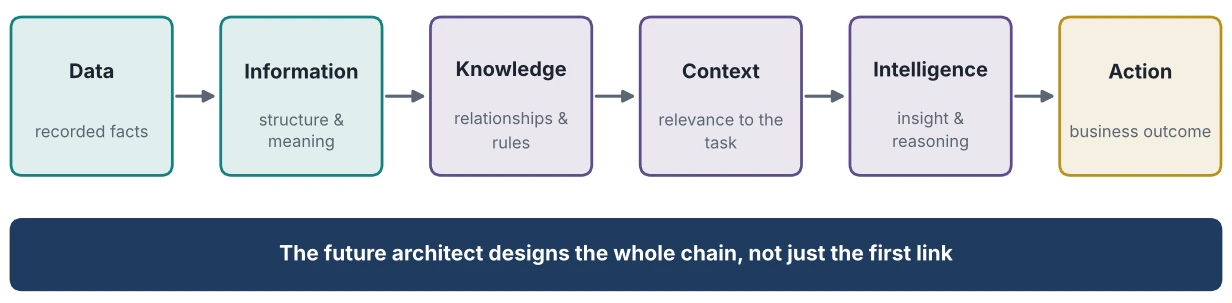
Data represents recorded observations or facts. Information adds structure and meaning. Knowledge connects information through relationships, rules, and accumulated understanding. Context determines what information and knowledge are relevant to a particular situation. Intelligence applies analytical or reasoning capabilities to generate insight, recommendations, predictions, or actions. Action connects intelligence to business processes and outcomes. The future architect must understand the architecture across this entire chain. This is why the role may increasingly overlap with what can be called an Enterprise Intelligence Architect.
The term should not be interpreted as a replacement title or formal industry standard. It is a useful way of describing an expanded architectural responsibility. The architect’s question becomes:
How does the enterprise transform trusted information into responsible, reusable intelligence?
That question encompasses much of the architecture described throughout this book.
24.2 The Declining Importance of Technology-Specific Architecture
Technology expertise will remain important, but technology-specific knowledge will have a shorter half-life. Cloud services evolve. Data platforms change. AI model capabilities change rapidly. New interfaces and protocols emerge. Vendors consolidate, expand, or change strategy. Open-source ecosystems evolve. The architect who defines their identity around one technology will therefore face increasing career risk. This does not mean technology expertise becomes less valuable. It means that technology expertise must be combined with architectural abstraction.
The future architect should be able to understand a technology deeply enough to evaluate its implications while maintaining enough abstraction to recognize when the technology should or should not influence the architecture. This creates a useful distinction:
- Technology knowledge answers: How does this technology work?
- Architecture knowledge answers: Where does this capability belong, what should it depend on, and what consequences does the choice create?
- Strategic architecture answers: Why does the enterprise need this capability, and how should it contribute to business outcomes?
The future architect needs all three.
24.3 Architecture in an AI-Native Enterprise
An AI-native enterprise is not simply an enterprise that uses many AI applications. It is an organization in which AI becomes integrated into the way work is performed, decisions are supported, knowledge is accessed, and business processes are designed. This changes architecture. Traditional enterprise applications were often designed around explicit workflows. A user performed a sequence of actions. AI introduces systems that can interpret intent, retrieve context, generate plans, recommend actions, and in some cases execute actions through tools. The architecture therefore becomes more dynamic. Instead of:
User → Application → Database
an intelligent workflow may look more like:
User or Event → AI Orchestrator → Context and Knowledge → Model → Tool Selection → Enterprise Service → Result → Evaluation → Human or Automated Action
Each stage creates architectural responsibilities. The architect must consider identity, authorization, context, tool access, state, memory, observability, evaluation, failure recovery, and human oversight. The data architecture becomes part of the intelligence architecture.
24.4 Data as Context
One of the most important future developments is the changing role of data. Historically, data was often treated as something to be stored, processed, and analyzed. In AI systems, data increasingly serves as context. A model’s usefulness depends not only on its underlying capabilities but also on the information available to it at the time of interaction. Context may come from:
- Structured enterprise data
- Documents
- Policies
- Customer information
- Transaction history
- Business rules
- Application state
- Knowledge graphs
- APIs
- Real-time events
- Previous interactions
- User permissions
This creates a new architectural discipline around context. The architect must determine:
- What information is relevant
- Where it comes from
- Whether it is authoritative
- How current it must be
- Who is allowed to access it
- How it is transformed
- How it is retrieved
- How it is presented to the model
- How it is protected
The future data architect therefore becomes increasingly a context architect as well. This is one reason semantic architecture, metadata, lineage, data products, and governance become more important rather than less important in an AI-driven enterprise.
24.5 The Rise of Machine-Consumable Enterprise Architecture
Traditional enterprise architecture documentation is designed primarily for humans. Architects create diagrams, documents, standards, models, and decision records that people read and interpret. The future enterprise will increasingly require architecture information to be machine-consumable. Consider an AI development platform that needs to determine:
- Which data products exist
- Who owns them
- What they mean
- What classifications apply
- What access policies govern them
- How fresh they are
- What quality measures they have
- Which APIs can be called
- Which models are approved
- Which tools an agent may access
If this information exists only in documents, AI systems and automated engineering tools cannot reliably use it. The architecture must therefore become increasingly represented as structured metadata. Enterprise architecture may increasingly include machine-readable representations of:
- Capabilities
- Domains
- Entities
- Data products
- APIs
- Policies
- Classifications
- Lineage
- Quality metrics
- Models
- Tools
- Controls
- Ownership
- Dependencies
This creates an important opportunity. The enterprise architecture repository could become an operational knowledge source rather than simply a documentation repository. Architecture metadata may itself become a data product.
24.6 The Semantic Enterprise
As AI systems become more capable, semantic consistency becomes increasingly important. An enterprise may contain thousands of systems and millions of data attributes. Different applications may use different terminology for similar concepts. One system may refer to a “client.” Another may use “customer.” A third may use “party.” A fourth may use “account holder.” Humans can often understand the relationship from context. AI systems require more explicit representation. The future enterprise will therefore increasingly need semantic architecture that connects:
Business Concepts ↔︎ Data ↔︎ Applications ↔︎ Knowledge ↔︎ AI
This may involve business glossaries, semantic models, ontologies, knowledge graphs, entity resolution, metadata systems, and machine-readable definitions. The architect’s role will be to ensure that semantic assets are not created independently by every AI application. Instead, common enterprise meaning should become reusable infrastructure. This does not imply that every enterprise needs a single universal ontology. Different domains may require specialized semantics. The architectural challenge is to establish enough common meaning to enable interoperability while preserving domain-specific precision.
24.7 The Emergence of Autonomous Data Operations
Data operations have historically required significant human intervention. Engineers monitor pipelines, investigate failures, manage schemas, tune workloads, review data quality issues, and respond to operational incidents. AI-assisted engineering will increasingly automate some of these activities. Future data platforms may detect anomalies, identify likely causes, recommend remediation, generate transformation logic, suggest schema changes, and optimize workloads. Some operational actions may eventually be performed automatically within defined guardrails. This creates a new architectural responsibility. Automation must have boundaries. An autonomous system that can modify production pipelines, alter data structures, or change access policies requires carefully controlled authority.
The architect must define:
- What the system can observe
- What it can recommend
- What it can change
- What requires approval
- How changes are logged
- How actions can be reversed
- How failures are detected
The future of data operations is therefore unlikely to be simply “more automation.” It will be governed automation.
24.8 Agents as Architectural Participants
Traditional architecture assumes that applications are passive systems that execute predefined logic. Agents challenge this assumption. An agent can interpret a goal, decide which tools to use, retrieve information, execute actions, observe results, and potentially revise its plan. The agent therefore becomes an active participant in the enterprise architecture. This introduces questions that traditional application architecture did not always need to answer:
- What authority does an agent have?
- Which systems can it access?
- Which actions can it perform?
- What information can it retrieve?
- How long does its authorization remain valid?
- How are actions audited?
- What happens when an agent makes an incorrect decision?
- How does the enterprise distinguish between an authorized action and an unintended action?
These are architecture questions, not merely AI engineering questions. The future Enterprise Data Architect will therefore need to understand agent authority architecture. Data access policies will increasingly need to account for non-human actors. Identity will expand from users and applications to include models, agents, automated workflows, and services. This makes identity, metadata, authorization, lineage, and observability increasingly central to enterprise architecture.
24.9 The Evolution of Data Products
Data products are likely to evolve beyond datasets. A future data product may combine:
- Data
- Metadata
- Semantic definitions
- APIs
- Quality guarantees
- Policies
- Analytical models
- Knowledge
- Events
- AI interfaces
Instead of exposing only a table, a domain might expose an intelligent information capability. For example, a customer domain could provide:
- Customer profile data
- Customer relationships
- Identity resolution
- Customer events
- Approved analytical attributes
- Semantic definitions
- Customer knowledge retrieval
- Authorized APIs
Consumers could use different interfaces depending on their needs. An analytical application might consume structured data. An AI assistant might use retrieval. An operational application might call an API. An event-driven system might subscribe to customer events. The underlying domain remains the accountable owner. This could make data products more powerful and more reusable. It also increases the importance of product thinking. A data product needs users, owners, service expectations, lifecycle management, documentation, observability, and investment. The architect will increasingly need to think about information capabilities as products rather than simply assets.
24.10 Architecture and Continuous Intelligence
Traditional analytics often operates through periodic cycles. Data is collected. Pipelines run. Reports are generated. Users interpret results. AI and event-driven architectures enable more continuous intelligence. Events can trigger analysis. Models can continuously evaluate signals. Knowledge can be updated dynamically. Agents can monitor business processes. Decisions can be supported at the moment they are required. This changes the temporal dimension of architecture. The architect must consider not only what data do we have? but also:
- When does the information become available?
- How long does it remain valid?
- How quickly must the enterprise respond?
- What happens when information changes?
- How does the system distinguish current state from historical state?
Real-time and continuous architectures therefore require strong event modeling, temporal data management, observability, and governance. The enterprise becomes increasingly capable of responding to events as they happen rather than analyzing them after the fact.
24.11 The Economics of Intelligence
The economics of enterprise intelligence will become an important architectural discipline. AI workloads introduce new cost dimensions. Costs may include:
- Model inference
- Token consumption
- Retrieval
- Vector storage
- Data movement
- GPU or accelerator infrastructure
- Model training
- Evaluation
- Observability
- Human review
- Platform operations
The architect must therefore think beyond traditional infrastructure costs. A technically effective AI solution may be economically unsustainable if every interaction requires expensive model calls and large context windows. Architecture can influence economics through:
- Model routing
- Caching
- Retrieval optimization
- Smaller specialized models
- Workload placement
- Batching
- Context management
- Data lifecycle management
- Platform reuse
This makes FinOps increasingly relevant to AI architecture. The future architect will need to understand not only whether an intelligent system works but also whether it can operate economically at enterprise scale.
24.12 The Architect and Human-Machine Collaboration
The future enterprise will not simply become automated. It will become increasingly collaborative between humans and machines. Some activities will remain human-led. Some will become AI-assisted. Some will become highly automated. Some may become autonomous within defined boundaries. The architect needs to understand the appropriate division of responsibility. For each process, the organization should determine:
- What humans decide
- What AI recommends
- What automation executes
- What requires approval
- What requires escalation
- What must always remain human-controlled
This is especially important for consequential decisions. The architecture should support human intervention rather than making intervention technically difficult. Human oversight should therefore be treated as an architectural capability. Interfaces, workflows, audit trails, escalation mechanisms, approval services, and decision records may all become part of the architecture.
24.13 The Future Architecture Practice
The architecture practice itself will evolve. Architecture work that consists primarily of manually maintaining diagrams and documents may increasingly be automated. AI tools can assist with:
- Architecture documentation
- Dependency analysis
- Impact assessment
- Pattern identification
- Technology comparison
- Standards analysis
- Code and configuration review
- Architecture decision records
- Modernization analysis
This does not eliminate architects. It changes where architects spend their time. Architects may spend less time gathering information manually and more time interpreting trade-offs, shaping strategy, facilitating decisions, and governing complex systems. The architecture repository may become dynamic. Instead of a static diagram updated quarterly, architecture information may be continuously connected to:
- Cloud environments
- Application inventories
- Data catalogs
- API registries
- Code repositories
- Security systems
- Observability platforms
- AI model registries
This could allow architecture teams to see the relationship between intended architecture and actual implementation more continuously. The result is a shift from documented architecture toward operational architecture intelligence.
24.14 Skills for the Future Enterprise Data Architect
The future architect will require a broad and continuously evolving skill portfolio.
Technical Architecture
The architect must understand distributed systems, cloud platforms, data platforms, integration, APIs, event architectures, security, and modern engineering.
Information Architecture
The architect must understand information domains, data modeling, semantics, metadata, lineage, data products, and knowledge structures.
AI Architecture
The architect must understand machine learning, generative AI, retrieval, vector search, model gateways, agents, evaluation, and AI governance.
Business Architecture
The architect must understand business capabilities, value streams, operating models, strategic priorities, and economics.
Organizational Leadership
The architect must understand organizational design, incentives, decision rights, change management, and stakeholder alignment.
Risk and Governance
The architect must understand security, privacy, regulatory expectations, responsible AI, resilience, and operational risk.
Communication
The architect must communicate effectively with executives, engineers, product leaders, data scientists, security teams, legal and compliance teams, and business stakeholders.
Learning Agility
Perhaps most importantly, the architect must remain capable of learning. No static curriculum will fully prepare an architect for a rapidly changing technological environment. The durable skill is the ability to understand new capabilities, evaluate their implications, and integrate them into a coherent enterprise model.
24.15 Career Evolution for the Enterprise Data Architect
The future does not imply a single career path. Enterprise Data Architects may evolve into roles such as:
- Chief Data Architect
- Chief Data Officer
- Chief AI Architect
- Enterprise Architect
- Data and AI Platform Leader
- Information Architecture Leader
- Data Product Executive
- AI Strategy Leader
- Digital Transformation Leader
Others may remain deeply technical and become distinguished architects without moving into executive management. The common thread is not the title. It is increasing responsibility for enterprise-level decisions. The architect who develops business understanding, leadership ability, technical breadth, and strategic judgment can move across organizational boundaries as the enterprise changes. The career becomes more resilient when it is built around enduring architectural capabilities rather than one technology stack.
24.16 Ethical Responsibility of the Future Architect
The increasing power of data and AI creates a corresponding increase in architectural responsibility. Architects influence what information organizations collect, how it is connected, who can access it, how models use it, what actions systems can perform, and how those actions are monitored. These decisions can affect customers, employees, communities, and society. The architect therefore needs ethical awareness. This does not mean that the architect independently resolves every ethical question. It means recognizing when an architecture creates consequences that require broader organizational consideration. Questions may include:
- Is the data being used for an appropriate purpose?
- Are access boundaries clear?
- Could automation create unintended harm?
- Is human oversight appropriate?
- Are decisions sufficiently auditable?
- Can the organization explain how information is being used?
- Are vulnerable populations affected differently?
- Can incorrect automated actions be detected and reversed?
Architecture should create mechanisms for responsible behavior rather than assuming that responsible outcomes will emerge automatically.
Case study: Meridian Financial Group
24.17 The Future Enterprise Data Architect at Meridian Financial Group
Meridian provides a useful view of how the role could evolve. By the later stages of its transformation, Meridian no longer treats the Enterprise Data Architect as primarily responsible for reviewing data designs. Architects participate in strategic planning. They help identify emerging information capabilities. They work with business leaders to understand where intelligent automation can create value. They help establish enterprise semantic models. They shape AI platform strategy. They define agent authority patterns. They evaluate architectural risk. They participate in investment planning. They guide modernization portfolios. They also work with engineering teams to ensure that the architecture is reflected in actual platforms and products. One important change occurs when Meridian begins building AI agents that can interact with operational systems. The architecture team recognizes that traditional application authorization models are insufficient. The agents require explicit identities, scoped permissions, auditable actions, tool boundaries, and escalation mechanisms. The architects therefore introduce an enterprise agent access model. Agents receive controlled identities. Tools expose explicit capabilities. Sensitive actions require additional authorization. Actions are logged. Policies are evaluated before execution. Human approval is required for designated high-impact operations. The architectural team does not own the agents themselves. Instead, it creates reusable enterprise capabilities that allow business teams to build agents safely. This becomes representative of the future role. The architect does not build every intelligent application. The architect creates the conditions in which the enterprise can build many intelligent applications coherently and responsibly.
24.18 Practical Artifact: Future Enterprise Data Architect Capability Map
The practical artifact for this chapter is a Future Enterprise Data Architect Capability Map. The map can be used for individual development, architecture-team capability planning, and organizational workforce strategy. Assess capabilities across six dimensions:
| Capability Dimension | Core Capabilities |
|---|---|
| Enterprise Architecture | Strategy alignment, capability mapping, reference architecture, roadmaps |
| Data Architecture | Information modeling, data products, platforms, integration, metadata |
| Intelligence Architecture | AI, RAG, semantics, knowledge graphs, agents, decision intelligence |
| Governance and Risk | Security, privacy, responsible AI, quality, observability |
| Leadership | Influence, communication, negotiation, executive engagement |
| Transformation | Modernization, operating models, investment, change management |
Each capability can be assessed using four stages:
- Foundational: understands the concepts and terminology.
- Practitioner: can design and implement within the capability.
- Strategic: can shape enterprise-level decisions.
- Leader: can establish organizational capability and influence strategy.
The purpose is not to create a rigid certification framework. The purpose is to identify capability gaps. For example, an architect with deep technical expertise may discover that executive communication, financial reasoning, or organizational change leadership requires additional development. An architecture organization may discover that it has strong traditional data skills but insufficient AI, semantic, or agent architecture capabilities. The capability map can then inform learning, hiring, mentoring, and succession planning.
24.19 A Durable Definition of the Enterprise Data Architect
The future role can be expressed in a simple definition:
The Enterprise Data Architect designs the structures, capabilities, relationships, and controls that enable an organization to turn trusted information into sustainable business value and responsible intelligence.
This definition deliberately goes beyond databases. It includes information. It includes platforms. It includes data products. It includes knowledge. It includes AI. It includes governance. It includes operating models. It includes business outcomes. It also preserves the core identity of architecture. The architect creates structure and coherence. The architect manages boundaries and relationships. The architect makes trade-offs visible. The architect creates reusable patterns. The architect anticipates consequences. The architect guides evolution. These responsibilities remain durable even as technologies change.
Remember these
24.20 Key Takeaways
The future Enterprise Data Architect will operate across an increasingly interconnected landscape of data, information, knowledge, AI, automation, and enterprise strategy. The most important lessons are:
- The role is evolving from data architecture toward broader intelligence architecture.
- Technology-specific knowledge remains important, but durable architectural thinking is becoming more valuable.
- Data increasingly functions as context for intelligent systems, not simply as stored information.
- Enterprise architecture will increasingly need machine-readable representations of data, meaning, policies, ownership, and dependencies.
- Semantic architecture will become increasingly important as enterprises rely on AI to interpret and reason over information.
- Autonomous data operations and AI agents will require carefully designed authority, identity, observability, and recovery mechanisms.
- Data products will increasingly combine information, semantics, APIs, events, knowledge, and AI capabilities.
- Continuous intelligence will increase the importance of event-driven, temporal, and real-time architecture.
- The economics of AI will become an increasingly important architectural concern.
- Human-machine collaboration will require explicit architectural boundaries for automation, approval, escalation, and accountability.
- The architecture practice itself will become more automated and increasingly connected to live enterprise environments.
- The future architect needs a combination of technical depth, business literacy, leadership, governance, and learning agility.
- Ethical responsibility becomes increasingly important as architecture determines how data and AI can influence real-world decisions and actions.
- The most durable career strategy is to develop architectural capabilities rather than becoming dependent on one technology.
- The future Enterprise Data Architect creates the conditions for the enterprise to turn trusted information into responsible intelligence at scale.
Think about your own organization
Architect’s Reflection
The future is often described through technologies. New models will appear. New cloud platforms will emerge. New data architectures will become popular. New agent frameworks will be introduced. New forms of automation will change how systems are built. But technology is only one part of the future. The deeper transformation is the changing relationship between organizations and information. Enterprises are moving from systems that store information toward systems that can interpret information, reason over it, act on it, and continuously learn from operational experience. That transformation makes architecture more important, not less.
When systems become more autonomous, boundaries matter more. When data becomes more interconnected, semantics matter more. When AI becomes more capable, governance matters more. When decisions become more automated, observability matters more. When technology changes faster, architectural principles matter more. The future Enterprise Data Architect therefore should not attempt to predict every technology that will matter. Instead, the architect should build the ability to understand change. Learn new technologies. Question assumptions. Understand business strategy. Protect architectural integrity. Create reusable capabilities. Make uncertainty visible. Design for reversibility. Build trust. And most importantly, remain focused on the purpose of architecture: enabling the enterprise to change without losing coherence. The Enterprise Data Architect of the future may work with technologies that do not yet exist. The specific platforms will change. The models will change. The interfaces will change. The organizational structures will change. But the fundamental architectural responsibility will remain.
Create a coherent foundation through which the enterprise can transform information into intelligence, and intelligence into responsible action.
That is the enduring role of the Enterprise Data Architect.