The journey of enterprise data architecture has always been about more than technology. It began with the need to organize information. It evolved through databases, data warehouses, enterprise integration, business intelligence, data lakes, cloud platforms, lakehouses, streaming, data products, and modern data engineering. It is now entering another stage. Artificial intelligence, generative AI, semantic technologies, knowledge graphs, retrieval systems, intelligent automation, and agentic architectures are changing the role information plays within the enterprise. Data is no longer simply something the enterprise stores and analyzes. It is becoming the foundation through which the enterprise understands its customers, operations, markets, products, risks, and opportunities.
The enterprise is moving from a world of data architecture toward a world of enterprise intelligence. This does not mean that data architecture disappears. Quite the opposite. Enterprise intelligence depends on trusted data, clear information models, interoperable platforms, governed data products, strong semantics, secure integration, observability, and accountable ownership. The foundation remains data architecture. What changes is what the enterprise builds on top of that foundation. The objective is no longer simply to make data available. The objective is to make enterprise information trusted, meaningful, contextual, accessible, intelligent, and actionable.
This final chapter brings together the ideas developed throughout the book and considers what it means to move from enterprise data architecture toward enterprise intelligence.
25.1 The Evolution of Enterprise Data Architecture
The history of enterprise data architecture can be viewed as a sequence of expanding responsibilities. Early enterprise systems focused primarily on storing operational data. The data warehouse introduced integrated analytical information. Enterprise integration connected systems. Data lakes expanded the range and scale of information that could be captured. Cloud platforms changed the economics and scalability of data infrastructure. Lakehouses brought together broader data types and analytical workloads. Data products introduced stronger domain ownership and reusable information capabilities. Semantic architecture increased the emphasis on meaning and context. Generative AI introduced new ways of interacting with enterprise information. Agents introduced systems capable of using information to perform actions. Each stage did not eliminate the previous stage. Instead, each expanded the architectural landscape. This suggests an important principle:
Enterprise architecture evolves by accumulation and integration more often than by simple replacement.
The future enterprise will still have databases. It will still have warehouses. It will still have APIs. It will still have batch pipelines. It will still have applications. It will still have reports. But these capabilities will increasingly participate in a larger intelligence ecosystem.
25.2 From Data as an Asset to Data as a Capability
Organizations have often described data as an asset. The metaphor is useful because it emphasizes value, stewardship, protection, and investment. But an asset-oriented view can also make data appear passive. The future enterprise needs to think about data as a capability. A customer information capability allows the organization to understand customers. A product information capability allows it to understand products and relationships. A transaction intelligence capability allows it to detect patterns and risks. A knowledge capability allows employees and AI systems to retrieve relevant information. A decision intelligence capability allows the organization to combine evidence, predictions, business rules, and judgment.
This changes the architectural question. Instead of asking:
Where should this data be stored?
the organization increasingly asks:
What enterprise capability does this information enable?
Storage remains important. But it becomes one part of a broader capability.
25.3 The Enterprise Intelligence Value Chain
Enterprise intelligence can be represented as a value chain.
Data → Information → Context → Knowledge → Intelligence → Decision → Action → Learning
Data represents observations and recorded events. Information organizes those observations into meaningful structures. Context determines relevance. Knowledge connects facts, concepts, relationships, rules, and experience. Intelligence applies analytical and AI capabilities to generate insight, prediction, recommendation, or reasoning. Decision connects intelligence to a choice. Action connects the decision to an operational outcome. Learning closes the loop by allowing the enterprise to evaluate what happened and improve future decisions. This final step is particularly important. An intelligent enterprise should not simply automate decisions. It should learn from outcomes. If a recommendation produces poor results, the organization should be able to determine why. If a process improves, the organization should understand what changed. If an AI system repeatedly retrieves poor information, the architecture should expose the problem. Enterprise intelligence therefore requires feedback loops.

25.4 The Trusted Information Foundation
The first requirement for enterprise intelligence is trust. Without trusted information, intelligence becomes unreliable. The trust foundation includes:
- Data quality
- Metadata
- Lineage
- Ownership
- Security
- Privacy
- Governance
- Observability
- Semantic consistency
- Appropriate access
These capabilities are sometimes treated as supporting functions. They should instead be considered foundational architecture. A generative AI system cannot reliably answer questions about enterprise policy if the policy sources are outdated or contradictory. A fraud detection model cannot reliably operate if critical transaction data is incomplete. An autonomous agent cannot safely execute actions if its authorization boundaries are unclear. A decision intelligence system cannot support executives if business definitions vary between reports. The quality of enterprise intelligence is constrained by the quality of the information foundation. This leads to a simple relationship:
Intelligence quality ≤ information trustworthiness
Advanced AI cannot compensate indefinitely for weak enterprise information architecture.
25.5 The Enterprise Knowledge Fabric
The modern enterprise needs more than data integration. It needs a way to connect information, meaning, context, and relationships across domains. This can be understood as an enterprise knowledge fabric. The knowledge fabric is not necessarily one physical platform. It is a logical architecture connecting:
- Data products
- Metadata
- Business glossary
- Semantic models
- Ontologies
- Knowledge graphs
- Documents
- APIs
- Events
- Analytical models
- AI retrieval systems
The purpose is to allow information to remain connected to its meaning and context as it moves through the enterprise. This is especially important for AI. A model should not receive an isolated piece of information without knowing its source, authority, relevance, security classification, and relationship to other information. The knowledge fabric provides the context necessary for trustworthy intelligence.
25.6 Enterprise Intelligence as a Layered Architecture
The concepts developed throughout the book can be brought together into a layered enterprise intelligence architecture.
Layer 1: Business Strategy and Capabilities
This layer defines strategic objectives, business capabilities, value streams, operating models, and measurable outcomes.
Layer 2: Enterprise Information Architecture
This layer defines information domains, business entities, conceptual models, master data, reference data, and shared enterprise concepts.
Layer 3: Data and Integration Foundation
This layer includes operational systems, APIs, events, CDC, batch pipelines, streaming, ingestion, and integration capabilities.
Layer 4: Data Platform
This layer includes storage, processing, orchestration, lakehouses, warehouses, analytical platforms, and specialized data stores.
Layer 5: Data Products
This layer exposes governed, reusable, domain-owned information capabilities.
Layer 6: Semantic and Knowledge Architecture
This layer provides business meaning, metadata, ontology, knowledge graphs, context, and retrieval capabilities.
Layer 7: Intelligence Architecture
This layer includes machine learning, generative AI, RAG, decision intelligence, agents, and intelligent automation.
Layer 8: Business Applications and Decisions
This layer delivers intelligence through applications, workflows, employee experiences, customer interactions, and business decisions.
Across every layer run the cross-cutting concerns of security, privacy, governance, quality, observability, risk, and architecture.
This layered model is not intended to prescribe a specific physical implementation. It is a way to understand the relationships among capabilities.
25.7 The Intelligent Enterprise Is Not an AI Enterprise
There is an important distinction between an AI-enabled enterprise and an intelligent enterprise. An AI-enabled enterprise uses AI technologies. An intelligent enterprise uses information, technology, people, processes, and AI together to continuously improve how it operates and makes decisions. AI is therefore an important component of enterprise intelligence, but it is not the entire concept. An organization may have hundreds of AI applications and still struggle to make consistent decisions because its information is fragmented. Another organization may use fewer AI systems but have strong information foundations, clear business processes, reusable data products, effective governance, and strong feedback loops. The second organization may have greater architectural maturity even though it uses less AI. This distinction matters because technology adoption alone does not create intelligence. Enterprise intelligence is an organizational capability.
25.8 From Systems of Record to Systems of Intelligence
Traditional enterprise architecture often distinguishes between systems of record, systems of engagement, and systems of insight. The modern enterprise increasingly adds systems of intelligence. A system of record maintains authoritative information. A system of engagement supports interactions. A system of insight supports analysis. A system of intelligence combines information, context, models, reasoning, and actions to help the enterprise make or execute decisions. These systems will increasingly interact. For example:
- System of record: customer account information.
- System of engagement: customer service application.
- System of insight: customer analytics.
- System of intelligence: an AI assistant that retrieves customer context, interprets the request, recommends a response, and invokes approved enterprise services.
The boundaries between these categories will increasingly blur. The Enterprise Data Architect must therefore design the interfaces among them.
25.9 From Pipelines to Intelligence Flows
Traditional data architecture is often visualized as pipelines. Data moves from source to destination. The pipeline is transformed, scheduled, monitored, and governed. The intelligent enterprise requires a broader concept: intelligence flows. An intelligence flow may involve:
- An event occurs.
- Relevant information is identified.
- Context is assembled.
- A model or analytical service evaluates the situation.
- A recommendation is generated.
- A policy is evaluated.
- A human or agent makes a decision.
- An action occurs.
- The outcome is observed.
- The result becomes feedback.
The flow is no longer simply movement of data. It is movement of information, context, reasoning, decisions, and actions. This is a major conceptual shift for enterprise architecture.
25.10 The Role of Data Products in Enterprise Intelligence
Data products become increasingly important in the intelligence architecture because they provide trusted interfaces to domain information. Without data products, AI applications may connect directly to databases, files, APIs, and documents. This creates duplication. Each application must independently understand the data. Each application may apply different transformations. Each application may implement different access rules. Each application may develop its own definition of business concepts. Data products provide a reusable alternative. A well-designed data product can provide:
- Trusted information
- Business meaning
- Quality expectations
- Metadata
- Lineage
- Access controls
- APIs or analytical interfaces
- Events
- Knowledge interfaces
The AI ecosystem can then consume the same governed information used by analytics and operational applications. This creates an important architectural principle:
AI should consume enterprise information through governed capabilities rather than bypassing enterprise architecture.
25.11 The Role of Semantics in Enterprise Intelligence
Semantics may ultimately become one of the most important architectural disciplines in the intelligent enterprise. AI systems can process enormous quantities of information. But processing more information does not necessarily produce better understanding. Meaning matters. An enterprise needs to know:
- What a customer is
- What constitutes an account
- How an account relates to a customer
- What qualifies as a transaction
- How products are classified
- What a risk exposure means
- Which policy is authoritative
- Which definitions apply in which contexts
These are semantic questions. The enterprise that establishes strong semantic foundations can make information more reusable across applications, analytics, AI, and decision systems. The semantic architecture therefore becomes a bridge between human business understanding and machine processing.
25.12 Enterprise Intelligence and Decision-Making
The ultimate purpose of enterprise intelligence is not to produce more information. It is to improve decisions and actions. This requires recognizing that not every decision should be automated. Some decisions can be fully automated. Some should be AI-assisted. Some should remain human-led but better informed. Some require collective organizational judgment. The architecture should therefore classify decision types. A useful model is:
| Decision Type | Typical Architecture |
|---|---|
| Routine and low risk | Automated |
| High volume and predictable | AI-assisted or automated |
| Complex analytical | Decision intelligence |
| High impact | Human-led with AI support |
| Strategic | Human-led with analytical and AI support |
| Regulated or highly sensitive | Controlled workflow with explicit oversight |
The exact boundaries depend on organizational context. The architectural principle is that the degree of automation should reflect the nature and consequences of the decision.
25.13 The Closed-Loop Intelligent Enterprise
The mature intelligent enterprise operates through feedback loops. Consider a customer service process. A customer interacts with the organization. The interaction generates data. AI interprets the request. Enterprise knowledge provides context. The system recommends an action. A human or agent executes the action. The customer responds. The outcome is measured. The information is incorporated into future analytics, models, knowledge, and process improvements. This creates a loop. The organization is no longer simply processing transactions. It is continuously learning from interactions. Similar loops can exist in:
- Fraud management
- Supply chain optimization
- Product development
- Employee operations
- Marketing
- Financial management
- Risk management
- Regulatory processes
The architecture therefore becomes increasingly dynamic. The enterprise must be able to observe outcomes and feed those outcomes back into the information and intelligence ecosystem.
25.14 Architecture as an Enterprise Learning System
This leads to a broader concept. The enterprise itself can be viewed as a learning system. Business activities generate data. Data becomes information. Information becomes knowledge. Knowledge supports decisions. Decisions create outcomes. Outcomes generate new information. The cycle repeats. Architecture determines how effectively the cycle operates. If data is fragmented, learning is fragmented. If definitions are inconsistent, learning is inconsistent. If outcomes are not measured, learning stops. If governance prevents useful information from being reused, organizational learning slows. If architecture creates reusable data products and semantic services, learning accelerates.
The Enterprise Data Architect therefore becomes an architect of organizational learning. This is perhaps the deepest evolution of the role.
25.15 Enterprise Intelligence and Organizational Design
Technology alone cannot create an intelligent enterprise. Organizational structures must support intelligence. Domains need ownership. Platforms need product teams. Governance needs clear decision rights. AI needs risk management. Data products need consumers. Architecture needs executive sponsorship. Employees need appropriate skills. Incentives need to reward reuse and collaboration rather than isolated optimization. The operating model described earlier in this book therefore becomes part of the intelligence architecture. An organization cannot operate a federated data-product model with a funding structure designed exclusively around temporary projects. It cannot build reusable enterprise capabilities if every team is measured only on local delivery. It cannot responsibly deploy autonomous AI if no function owns agent risk. The intelligent enterprise requires organizational alignment around information and intelligence.
25.16 The Economics of Enterprise Intelligence
Enterprise intelligence must also be economically sustainable. The enterprise should evaluate intelligence capabilities based on value and cost. Value may include:
- Revenue growth
- Cost reduction
- Risk reduction
- Faster decision-making
- Improved customer experience
- Improved employee productivity
- Regulatory efficiency
- New products and services
Costs may include:
- Platform infrastructure
- Data storage
- Compute
- Model inference
- Integration
- Engineering
- Governance
- Security
- Human oversight
- Operational support
The architect should help leadership understand the economics of the entire capability rather than evaluating AI or data costs in isolation. For example, an AI assistant may have an acceptable model cost but require expensive retrieval infrastructure and substantial human review. A data platform may have a high infrastructure cost but eliminate multiple duplicated platforms. A semantic program may appear difficult to justify through infrastructure savings but enable multiple AI and analytical use cases. Architecture must therefore connect cost to capability and value.
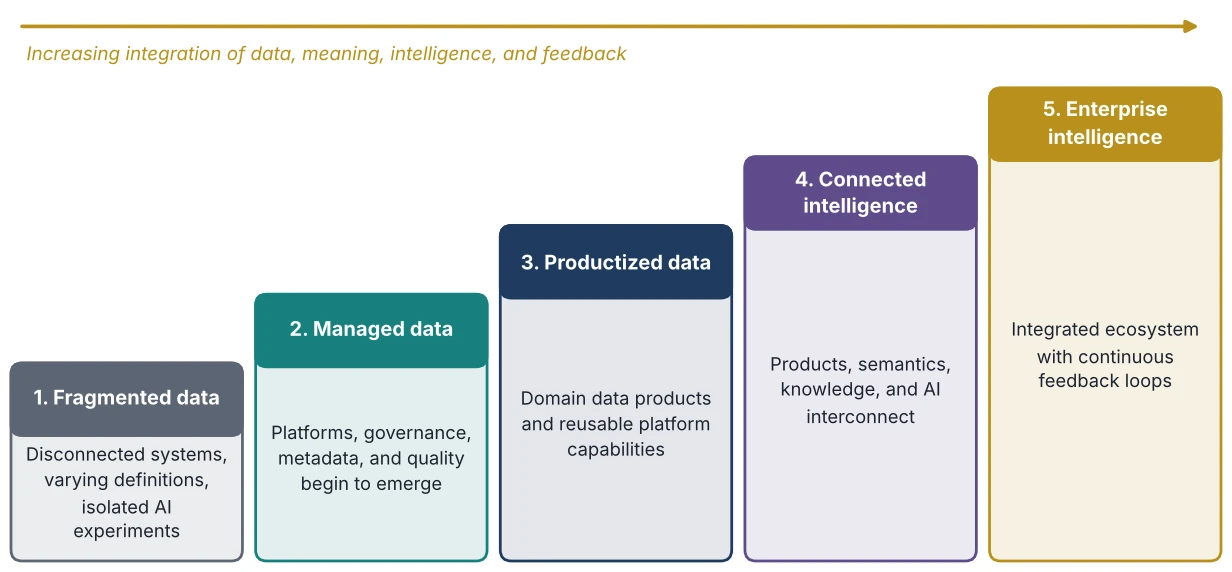
25.17 The Enterprise Intelligence Maturity Model
Organizations can assess their evolution toward enterprise intelligence through a maturity model.
Level 1 — Fragmented Data
Data exists across disconnected systems. Definitions vary. Integration is primarily project-specific. Governance is largely manual. AI experimentation is isolated.
Level 2 — Managed Data
Enterprise data platforms and governance capabilities begin to emerge. Data quality and metadata improve. Cloud and modern analytical platforms are introduced. AI use cases begin to move beyond experimentation.
Level 3 — Productized Data
Domains take greater ownership of data products. Reusable platform capabilities emerge. Semantic services become more important. AI applications increasingly consume governed enterprise data.
Level 4 — Connected Intelligence
Data products, semantics, knowledge, analytics, and AI become interconnected. Enterprise AI platforms provide reusable capabilities. Decision intelligence becomes more integrated with business processes.
Level 5 — Enterprise Intelligence
The organization operates through connected information and intelligence flows. AI, analytics, data products, knowledge, applications, and human decisions operate as an integrated ecosystem. Feedback loops continuously improve information, models, processes, and decisions.
This maturity model is not a scorecard for judging organizations. It is a way to understand architectural evolution. Organizations may be at different maturity levels in different domains. One business area may operate highly automated intelligence capabilities while another remains dependent on fragmented legacy data. The objective is not uniform maturity. The objective is intentional evolution toward strategic outcomes.
Case study: Meridian Financial Group
25.18 Enterprise Intelligence at Meridian Financial Group
Meridian’s transformation provides the final case study for the book.
At the beginning of the journey, Meridian has fragmented data, inconsistent definitions, legacy warehouses, multiple cloud environments, duplicated analytical platforms, and disconnected AI experiments. The organization initially views modernization as a technology program. Over time, its perspective changes. Business capabilities become connected to information domains. Information domains become connected to data products. Data products become connected to semantic services. Semantic services become connected to knowledge retrieval. Knowledge retrieval becomes connected to AI applications. AI applications become connected to enterprise services and decision processes. Governance, security, privacy, quality, and observability span the ecosystem. The architecture begins to function as a connected system.
Consider a hypothetical fraud-management process. A transaction event enters the enterprise through a streaming platform. Relevant customer, account, device, and transaction data is retrieved from governed data products. Semantic services provide the relationships among the entities. A fraud model evaluates the transaction. A generative AI service provides investigators with contextual information from approved policies, historical cases, and relevant transaction information. An agent can retrieve additional information through authorized enterprise tools. A high-risk action requires human approval. The investigator’s decision is recorded. The outcome becomes feedback for future analysis and model improvement.
This is no longer simply a data pipeline. It is an intelligence flow. Meridian’s architecture has evolved from moving data to enabling decisions. That is the transition this book has described.
25.19 Practical Artifact: Enterprise Intelligence Blueprint
The final practical artifact is an Enterprise Intelligence Blueprint. It brings together the major artifacts developed throughout the book. The blueprint should contain:
Business Strategy
What strategic outcomes is the enterprise pursuing?
Business Capabilities
Which capabilities create those outcomes?
Information Domains
What information is required?
Data Products
Which reusable information products support the domains?
Data and Platform Foundation
What platforms provide storage, processing, integration, and engineering capabilities?
Semantic and Knowledge Foundation
How are meaning, relationships, context, and enterprise knowledge represented?
Intelligence Capabilities
Which analytical, AI, retrieval, decision, and agentic capabilities are required?
Business Applications
Where does intelligence become part of operational work and customer experience?
Governance and Trust
How are security, privacy, quality, observability, lineage, and responsible AI enforced?
Operating Model
Who owns each capability and how are decisions made?
Economics
What investment and operating costs are required, and what value is expected?
Evolution Roadmap
What capabilities should be developed first, and what dependencies determine the sequence?
A simplified blueprint can be represented as:
| Architecture Area | Core Question |
|---|---|
| Strategy | What outcomes matter? |
| Capabilities | What must the enterprise be able to do? |
| Information | What must the enterprise know? |
| Data Products | What reusable information capabilities are required? |
| Platform | What technology foundation enables them? |
| Semantics | What does the information mean? |
| Knowledge | What context and relationships are required? |
| Intelligence | What should the enterprise predict, recommend, reason, or automate? |
| Decisions | Where should intelligence influence action? |
| Trust | What controls make the system reliable and responsible? |
| Operating Model | Who owns and operates it? |
| Economics | What is the sustainable cost and value? |
| Evolution | How will the enterprise move from current to future state? |
The blueprint should be treated as a living enterprise asset. It should evolve with strategy, technology, organization, and regulatory expectations.
25.20 The Enterprise Data Architect’s Enduring Principles
The final chapter of this book is also an opportunity to restate the principles that should remain durable regardless of technological change.
Principle 1: Start with Business Outcomes
Architecture exists to create organizational capability.
Principle 2: Treat Information as an Enterprise Responsibility
Data may be distributed, but accountability must be explicit.
Principle 3: Design for Trust
Quality, security, privacy, lineage, governance, and observability belong in the architecture from the beginning.
Principle 4: Make Meaning Explicit
Data without context is increasingly insufficient for intelligent systems.
Principle 5: Build Reusable Capabilities
The enterprise should not repeatedly solve the same architectural problem in different projects.
Principle 6: Enable Domain Ownership
Those closest to the business meaning of information should have meaningful accountability for it.
Principle 7: Separate Logical Architecture from Technology Choices
Technology changes. Architectural responsibilities endure longer.
Principle 8: Design for Change
Assume that platforms, models, vendors, business requirements, and organizational structures will evolve.
Principle 9: Automate Controls Where Possible
Architecture should make the safe path the easy path.
Principle 10: Preserve Human Accountability
Automation should not eliminate responsibility for consequential outcomes.
Principle 11: Measure Value
Architecture should connect investment to business outcomes, risk reduction, reuse, and sustainable operations.
Principle 12: Keep Learning
The most durable capability of the Enterprise Data Architect is the ability to understand change and guide the enterprise through it.
25.21 From Architecture to Enterprise Intelligence
The title of this final chapter represents the central idea of the book. The future is not about abandoning enterprise data architecture. It is about extending it. The enterprise needs a trusted data foundation. It needs modern platforms. It needs strong integration. It needs data products. It needs semantic and knowledge architecture. It needs AI architecture. It needs governance, security, privacy, quality, and observability. It needs an operating model that creates accountability. And it needs leadership capable of connecting all of these capabilities to business strategy.
Together, these capabilities create something larger than a data platform. They create an enterprise intelligence architecture. Enterprise intelligence is not a product that can simply be purchased. It is not a single AI model. It is not a cloud service. It is not a data lake. It is not a knowledge graph. It is not an agent. It is the organizational capability created when trusted information, technology, people, processes, and intelligent systems work together coherently.
That distinction is important. An enterprise may implement every modern technology and still fail to become intelligent if its information remains fragmented, its definitions remain inconsistent, its governance remains disconnected from engineering, and its operating model prevents reuse. Conversely, an organization with disciplined architecture, strong information foundations, accountable ownership, and thoughtful use of AI can create significant intelligence without pursuing every new technology trend.
The Enterprise Data Architect is therefore not responsible for predicting the future. The architect is responsible for preparing the enterprise to adapt to it.
Think about your own organization
25.22 Final Architect’s Reflection
Every generation of technology creates a temptation to believe that the newest technology will solve the oldest organizational problems. Data warehouses did not eliminate data silos. Data lakes did not automatically create trusted information. Cloud did not remove architectural complexity. Data mesh did not eliminate ownership challenges. Generative AI does not eliminate the need for information architecture. Agents do not eliminate the need for governance. Technology expands what an enterprise can do. Architecture determines how those capabilities fit together. That is why the role of the Enterprise Data Architect remains important. The technologies will continue to change. The architecture will continue to evolve. The organizational models will continue to adapt. But the fundamental questions remain:
- What does the enterprise need to know?
- Where does that knowledge come from?
- Can it be trusted?
- Who owns it?
- How is it protected?
- How is it connected?
- How is it interpreted?
- How can it be reused?
- How can intelligence be applied responsibly?
- How does the enterprise learn from the results?
And ultimately:
How can architecture help the organization become more capable without becoming less trustworthy?
These are not merely technology questions. They are leadership questions. They are business questions. They are organizational questions. They are increasingly questions about the future relationship between humans and intelligent systems.
The Enterprise Data Architect stands at that intersection. The role is no longer simply to design where data lives. It is to help design how the enterprise understands itself. That is the deeper transition from data architecture to enterprise intelligence. And it is the opportunity for the next generation of Enterprise Data Architects.