Enterprise Data Architecture has traditionally been associated with models, platforms, integration patterns, governance frameworks, and technology standards. These remain important responsibilities. However, the transformation described throughout this book requires something more. The modern Enterprise Data Architect must become a strategic leader.
This does not necessarily mean becoming a people manager or moving into an executive title. Strategic leadership is primarily about the ability to connect architecture with business strategy, influence decisions beyond the technology organization, create alignment across competing interests, and guide the enterprise through uncertainty and change.
The importance of this role has increased because data and AI have become deeply connected to enterprise strategy. Organizations now use data to manage customers, products, operations, risk, finance, supply chains, employees, and regulatory obligations. AI increasingly influences how organizations analyze information, automate work, support decisions, interact with customers, and create new products and services. As a result, architectural decisions about data and AI can have consequences far beyond technology.
A decision about customer identity can affect regulatory compliance, marketing, fraud management, and customer experience. A decision about data ownership can determine whether an AI initiative can scale. A decision about model access can influence security and financial exposure. A decision about data platform architecture can shape years of investment.
The Enterprise Data Architect therefore operates at the intersection of strategy, technology, information, risk, and organizational change. The strategic architect does not simply answer the question, “How should we build this?” The architect increasingly asks:
- Why are we building it?
- What business capability does it enable?
- What information does it depend on?
- What risks does it introduce?
- What capabilities should be reusable?
- What should the enterprise standardize, and what should it allow to vary?
- How will the architecture evolve as the business changes?
These questions define the transition from technical architect to strategic architecture leader.
23.1 From Technical Architect to Strategic Leader
The evolution of the Enterprise Data Architect can be understood as a progression. The traditional architect often focused on technical correctness. The objective was to create models, standards, integration patterns, and platforms that met defined requirements. The modern architect must still understand technical architecture deeply, but technical expertise is no longer sufficient. The strategic architect connects technical decisions to enterprise outcomes. This requires understanding business models, operating models, financial constraints, regulatory expectations, organizational behavior, and executive priorities. The distinction can be illustrated simply:
| Traditional Orientation | Strategic Orientation |
|---|---|
| Design the data platform | Enable strategic business capabilities |
| Define data models | Establish enterprise information meaning |
| Govern databases | Govern information as an enterprise asset |
| Build integrations | Enable business interoperability |
| Support reporting | Enable decisions and intelligence |
| Implement AI data pipelines | Establish trusted foundations for AI |
| Define standards | Create reusable architectural capabilities |
| Review solutions | Shape investment and architectural direction |
| Manage technology complexity | Reduce enterprise complexity |
| Deliver architecture | Create sustainable business capability |
The strategic architect does not abandon technical architecture. Instead, technical architecture becomes one instrument for achieving larger organizational outcomes.
23.2 Understanding Business Strategy
Strategic architecture begins with understanding the business. An Enterprise Data Architect should be able to explain how the organization creates value, how it competes, how it serves customers, how it generates revenue, where its major costs occur, and which risks could materially affect its objectives. This does not mean becoming a business executive. It means developing sufficient business literacy to understand the consequences of architectural decisions. Consider an organization pursuing a strategy centered on improving customer experience. A technically focused architect might begin by proposing a customer data platform. A strategic architect begins differently, by asking what customer experience means in the organization’s strategy. Is the objective faster service? More personalized interactions? Reduced customer effort? Improved retention? Better digital engagement? More accurate recommendations?
The answers determine the architecture. If the strategic objective is consistent customer recognition across channels, identity resolution becomes important. If the objective is personalized interaction, customer and product data products may become important. If the objective is real-time service, event-driven architecture may be required. If the objective is AI-assisted customer support, governed knowledge retrieval and conversational AI become important. The technology follows the strategy. This is one of the most important disciplines of strategic architecture:
Do not begin with the technology capability. Begin with the business outcome.
23.3 Translating Strategy into Architectural Capabilities
The Enterprise Data Architect provides a translation function between business language and technology language. Executives may describe objectives such as:
- Improve customer experience
- Reduce operational cost
- Increase revenue
- Manage risk
- Accelerate product development
- Improve regulatory reporting
- Enable intelligent automation
Architecture translates these objectives into capabilities. For example:
- Business objective: reduce fraud losses.
- Business capabilities: fraud detection, transaction monitoring, investigation, customer verification.
- Information capabilities: transaction data, customer identity, behavioral data, device information, external intelligence.
- Data architecture capabilities: streaming ingestion, real-time processing, trusted customer and transaction data products, event-driven integration.
- AI capabilities: anomaly detection, predictive models, investigator assistance, knowledge retrieval.
- Control capabilities: security, privacy, model governance, auditability, and explainability where required.
The architecture therefore creates a chain from strategy to implementation.
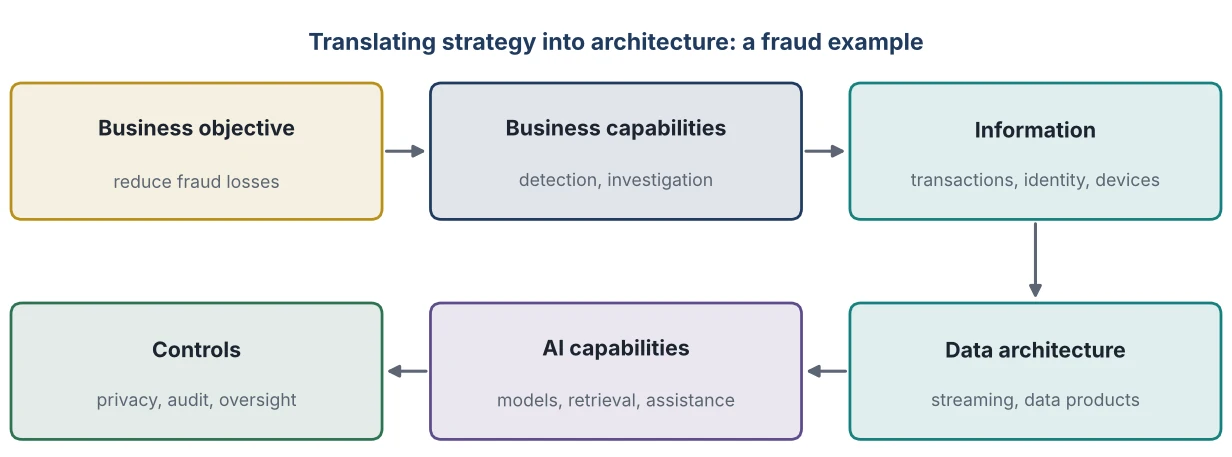
This chain allows investment discussions to become more meaningful.
Instead of saying, “We need a new data platform,” the architect can explain which business capabilities require which architectural capabilities and why the investment matters.
23.4 Architecture as an Investment Discipline
One of the most significant changes in the role of the Enterprise Data Architect is increased involvement in investment decisions. Data architecture is no longer simply an engineering concern. Cloud platforms, data platforms, AI infrastructure, integration technologies, observability tools, security capabilities, and data products represent substantial and recurring investments. The architect should therefore understand the economics of architecture. This includes:
- Platform costs
- Storage costs
- Compute consumption
- Data movement
- Licensing
- Engineering capacity
- Operational support
- Migration costs
- Technical debt
- Opportunity cost
- Resilience requirements
A technically elegant architecture may not be economically appropriate. Conversely, the cheapest short-term solution may create substantial long-term technical debt. Strategic architecture seeks sustainable value rather than simply minimizing initial cost. The architect should be able to frame investment decisions using questions such as:
- What capability does this investment create?
- What duplication does it eliminate?
- What risk does it reduce?
- What future options does it create?
- What operational cost does it introduce?
- What business outcomes depend on it?
This changes architecture from a review function into an investment discipline.
23.5 The Architect as Enterprise Connector
Modern enterprise data problems rarely stay within one organizational boundary. Customer data may cross marketing, sales, service, finance, risk, and digital channels. Product information may cross operations, technology, analytics, regulatory reporting, and customer-facing applications. AI initiatives may involve business teams, data engineering, security, legal, privacy, risk, architecture, and procurement. No single team controls the entire architecture. The Enterprise Data Architect therefore becomes a connector. The architect creates relationships among teams that otherwise may operate independently. This requires the ability to understand different perspectives. A business leader may care about outcomes and speed. An engineer may care about reliability and maintainability. A security leader may care about attack surfaces and access controls. A privacy leader may care about appropriate data use. A data scientist may care about feature availability and experimentation. An AI product team may care about model quality and user experience. A platform team may care about standardization and operational efficiency. The strategic architect does not simply choose one perspective. The architect creates an architectural model that allows the perspectives to coexist within a coherent decision framework.
23.6 Influencing Without Direct Authority
Many Enterprise Data Architects operate without direct authority over the teams whose decisions they influence. This makes influence a core architectural skill. Architecture standards can define expectations, but standards alone rarely create alignment. Influence comes from several sources:
- Credibility. Teams need confidence that the architect understands both technology and business realities.
- Clarity. Architectural decisions should be understandable and connected to concrete outcomes.
- Consistency. Teams need predictable principles rather than constantly changing architectural preferences.
- Evidence. Recommendations should be supported by data, experiments, cost analysis, risk analysis, or demonstrated outcomes.
- Collaboration. Architecture should be developed with stakeholders rather than imposed on them unnecessarily.
- Pragmatism. The architect must recognize constraints and provide realistic paths forward.
A strategic architect therefore spends significant time communicating. Architecture reviews, executive briefings, design workshops, roadmaps, decision records, standards, reference architectures, and architecture communities are all communication mechanisms.
The quality of the architecture is partly determined by the quality of the conversations it creates.
23.7 Architecture Decision-Making Under Uncertainty
Modern data and AI architecture involves significant uncertainty. Technology changes rapidly. Business priorities change. AI capabilities evolve. Regulatory expectations develop. Vendor strategies change. Organizations reorganize. Architects therefore cannot wait for complete information before making decisions. Instead, they need a disciplined approach to uncertainty. One useful method is to distinguish between decisions that are difficult to reverse and decisions that are relatively easy to change. A major enterprise data model may have long-term consequences. A model provider may be replaceable if the architecture isolates model access appropriately. A physical storage technology may be replaceable if the logical architecture remains stable. A domain ownership decision may be difficult to reverse organizationally even if it appears simple technically. The architect should therefore pay particular attention to architectural reversibility. Where uncertainty is high, designs should preserve options where economically practical. This may involve abstraction layers, well-defined interfaces, data contracts, modular services, portable formats, or technology-neutral architecture boundaries. The goal is not to eliminate uncertainty. It is to prevent uncertainty from becoming unnecessary architectural fragility.
23.8 Strategic Use of Standards
Standards are one of the architect’s most powerful tools, but they can also become a source of unnecessary bureaucracy. A standard should exist because consistency creates meaningful enterprise value. Useful standards may address:
- Security
- Identity
- Data classification
- Metadata
- Data contracts
- Interoperability
- Naming
- Integration
- Observability
- Quality
- AI model access
- Responsible AI
- Platform engineering
- Architectural documentation
Not everything needs to be standardized. An organization can become so focused on standardization that innovation becomes difficult. The strategic architect should therefore distinguish between:
- Things that must be consistent
- Things that should be reusable
- Things that can vary by context
- Things that should remain experimental
This creates architectural freedom within appropriate boundaries. The objective is not maximum standardization. The objective is intentional standardization.
23.9 Creating Architectural Guardrails
Guardrails provide another mechanism for strategic leadership. A guardrail defines a boundary within which teams can make local decisions. For example:
Enterprise AI applications must access production data through governed interfaces rather than direct database connections.
This rule does not prescribe every technology choice. Another guardrail might state:
Sensitive enterprise data must carry machine-readable classification metadata throughout its lifecycle.
Again, teams can choose different implementations as long as the architectural outcome is achieved. Good guardrails therefore express architectural intent without unnecessarily prescribing implementation details. They are particularly valuable in large organizations where centralized review cannot scale to every technical decision. The Enterprise Data Architect should aim to make the safe and compliant path the easiest path. This means embedding guardrails into platforms, templates, APIs, CI/CD pipelines, policy engines, metadata systems, and reusable services wherever possible.
23.10 Architecture and Organizational Change
Architecture transformation is also organizational transformation. Introducing data products changes ownership. Moving toward a federated data model changes decision rights. Introducing an enterprise AI platform changes how AI applications are developed. Implementing a semantic layer changes how teams define business concepts. Modernizing legacy platforms changes skills and responsibilities. The architect must therefore understand organizational change. A technically sound target architecture may fail if the operating model remains aligned to the old architecture.
For example, an organization may create domain-owned data products but continue evaluating teams only on application delivery. Domain teams may then have little incentive to invest in reusable data products. Similarly, an organization may establish a platform-as-product model but continue funding the platform as a temporary project. The platform team may struggle to operate sustainably. Strategic architecture therefore considers:
- Ownership
- Incentives
- Funding
- Skills
- Organizational boundaries
- Performance measures
- Leadership sponsorship
- Communication
- Adoption
The architecture is successful only when the organization can operate it.
23.11 Leading Through Modernization
Enterprise modernization creates another important leadership responsibility. Large organizations cannot replace everything at once. The architect must create a path from current state to target state. This requires balancing competing priorities. Some legacy systems may be strategically important and therefore need careful coexistence. Some platforms may be expensive but difficult to replace. Some capabilities may need modernization because they block high-value business initiatives. Others may be acceptable to leave unchanged. The strategic architect therefore needs to distinguish between technical age and strategic importance. An old system is not automatically a modernization priority. Likewise, a modern technology is not automatically strategically valuable. The modernization roadmap should consider:
- Business value
- Architectural dependency
- Risk
- Cost
- Complexity
- Regulatory requirements
- Operational resilience
- AI readiness
- Organizational capacity
This makes modernization a portfolio decision rather than a technology replacement exercise.
23.12 Leading Enterprise AI Architecture
AI creates a particularly important leadership opportunity for the Enterprise Data Architect. AI initiatives often begin in business units, innovation teams, or application teams. They may initially focus on proving a use case. The strategic architect must help the organization determine what happens after the prototype succeeds. Questions include:
- Where does enterprise data come from?
- How is information authorized?
- How is knowledge retrieved?
- Which models are approved?
- How are models evaluated?
- How are prompts and context managed?
- How are AI interactions observed?
- How are costs managed?
- How are users authenticated?
- What tools can agents access?
- What actions require human approval?
- How are incidents handled?
- How is AI capability reused across applications?
These questions turn an AI experiment into an enterprise capability. The architect should therefore help the organization move through three stages:
Experimentation → Productization → Industrialization
Experimentation focuses on learning. Productization focuses on delivering a reliable business capability. Industrialization focuses on reuse, governance, scale, economics, and operational sustainability. The Enterprise Data Architect has an important role at each stage.
23.13 Communicating Architecture to Executives
Strategic architects must communicate differently with different audiences. Executives usually do not need a detailed pipeline diagram. They need to understand:
- The business problem
- The strategic capability
- The investment
- The major risks
- The expected outcomes
- The dependencies
- The decision required
For example, rather than explaining a complex lakehouse architecture, an architect might explain:
The proposed architecture creates a reusable enterprise information foundation that allows customer, transaction, and product information to be governed once and reused across analytics, regulatory reporting, and AI applications.
The technical architecture still matters. But it is communicated in the context of enterprise value. For technical audiences, the same architecture can then be explained through interfaces, data contracts, platform capabilities, security controls, reliability, deployment patterns, and technology choices. The ability to move between these levels is a defining capability of strategic architecture.
23.14 Measuring Architectural Leadership
Architecture should have measurable outcomes. Some measures are technical:
- Reduction in duplicate platforms
- Data-product adoption
- Data quality improvement
- Platform reliability
- Integration reuse
- Reduction in technical debt
- Architecture standard adoption
Others are business-oriented:
- Faster delivery of strategic capabilities
- Reduced operational cost
- Improved customer outcomes
- Reduced regulatory risk
- Faster access to trusted information
- Improved decision quality
AI introduces additional measures:
- Reuse of governed AI capabilities
- Retrieval quality
- Model evaluation results
- AI incident rates
- Cost per AI interaction
- Percentage of AI workloads using approved controls
- Time required to move AI solutions from prototype to production
The architect should avoid creating metrics simply because they are easy to measure. The best architectural measures demonstrate whether the architecture is enabling the organization to achieve its objectives.
23.15 Building the Strategic Architecture Practice
Strategic architecture should not depend entirely on one exceptional architect. Organizations need an architecture practice. Such a practice may include Enterprise Data Architects, solution architects, domain architects, security architects, AI architects, platform architects, and business architecture partners. The practice should establish common methods for:
- Architecture principles
- Reference architectures
- Decision records
- Architecture reviews
- Technology standards
- Capability mapping
- Roadmaps
- Risk assessment
- Architecture metrics
Communities of practice are especially valuable. They allow architects to share patterns, lessons learned, emerging technologies, and difficult decisions. A strong architecture practice also creates institutional memory. Architecture decisions should not disappear when individuals change roles. Decision records, standards, reference architectures, models, roadmaps, and principles preserve organizational knowledge. This is particularly important in an environment where technology and organizational structures evolve rapidly.
23.16 The Strategic Architect’s Skill Set
The modern Enterprise Data Architect needs a broader skill profile than the traditional role required. Technical depth remains essential. The architect should understand data modeling, distributed systems, cloud architecture, data platforms, integration, security, metadata, AI architectures, and modern engineering practices. But technical skills must be complemented by:
- Business literacy. Understanding strategy, business models, capabilities, value streams, and economics.
- Communication. Explaining complex architectural concepts to technical and nontechnical audiences.
- Influence. Building alignment without relying solely on organizational authority.
- Systems thinking. Understanding interactions across technology, people, processes, information, and economics.
- Decision-making. Making sound choices under uncertainty.
- Negotiation. Balancing competing priorities and stakeholder interests.
- Leadership. Creating direction and enabling others to execute.
- Learning agility. Continuously adapting to new technologies and business models.
- Ethical judgment. Recognizing the consequences of architectural decisions involving data, automation, and AI.
The strategic architect is therefore both technologist and organizational thinker.
Case study: Meridian Financial Group
23.17 The Enterprise Data Architect at Meridian Financial Group
At Meridian Financial Group, the evolution of the architecture role becomes visible through the modernization program. Initially, the enterprise expected data architects to review designs and define standards. As the transformation progressed, that model became insufficient. The architects began participating in strategic planning discussions. They helped executives connect customer strategy to information capabilities. They worked with risk leaders to define trusted data requirements. They partnered with platform teams to establish reusable capabilities. They worked with domain leaders to define data ownership. They collaborated with AI teams to establish enterprise retrieval, model access, and agent security patterns.
Architecture reviews changed as well. Instead of asking only whether a proposed system followed technical standards, architects began asking:
- What business capability does this solution enable?
- Does the required data already exist as an enterprise product?
- Is a new platform actually necessary?
- Can an existing enterprise capability be reused?
- Who owns the information?
- What happens if the model or vendor changes?
- How will the capability be governed?
- What is the long-term operating cost?
- How does this solution contribute to the target architecture?
These questions changed the relationship between architecture and delivery teams. Architecture became less about approving designs and more about helping teams make better decisions.
The architects also introduced a strategic architecture portfolio view. Major data and AI investments were mapped against business capabilities, information domains, platform dependencies, risk, and modernization priorities. This allowed leadership to see where multiple initiatives were attempting to solve the same problem independently. In one example, three business units were developing separate customer knowledge retrieval capabilities. Rather than selecting one project as the winner, the architecture team identified the common capabilities across the initiatives and proposed an enterprise knowledge retrieval service. The business units retained responsibility for their use cases while sharing common capabilities for identity, retrieval, security, evaluation, and observability. The architectural outcome was not simply platform consolidation. It was the creation of a reusable enterprise capability. This became an important example of strategic architecture in practice.
23.18 Practical Artifact: Enterprise Architecture Leadership Canvas
The practical artifact for this chapter is an Enterprise Architecture Leadership Canvas. The canvas helps an Enterprise Data Architect move from technical architecture concerns toward strategic leadership. It should contain eight areas.
1. Strategic Outcomes
What are the organization’s most important strategic objectives?
2. Business Capabilities
Which capabilities must improve or emerge to achieve those objectives?
3. Information Dependencies
What information is required to support those capabilities?
4. Architectural Capabilities
Which data, platform, integration, semantic, AI, governance, security, and observability capabilities are required?
5. Major Decisions
Which architectural decisions will materially influence the outcome?
6. Stakeholders and Decision Rights
Who owns the business outcome, information, platform, risk, and investment decisions?
7. Investment and Economics
What investment is required, what duplication can be avoided, and what measurable value or risk reduction is expected?
8. Evolution Roadmap
What must happen now, next, and later?
A practical leadership canvas can be summarized as:
| Dimension | Strategic Question |
|---|---|
| Business | What outcome are we trying to achieve? |
| Capability | What must the enterprise become able to do? |
| Information | What information enables the capability? |
| Architecture | What capabilities and patterns are required? |
| Governance | What controls and decision rights are required? |
| Economics | What will the capability cost and what value does it create? |
| Organization | Who owns and operates it? |
| Evolution | How do we move from current state to target state? |
The canvas should be used in strategic planning, major architecture initiatives, modernization programs, and significant AI investments. Its purpose is not to create another documentation requirement. Its purpose is to change the questions architects ask.
Remember these
23.19 Key Takeaways
The modern Enterprise Data Architect is increasingly a strategic leader rather than solely a technical designer. The most important lessons are:
- Technical expertise remains essential, but it must be connected to business strategy.
- Strategic architecture begins with business outcomes rather than technology choices.
- The architect translates strategy into business, information, data, platform, AI, and governance capabilities.
- Data architecture increasingly influences enterprise investment decisions and therefore requires economic awareness.
- The architect acts as a connector across business, technology, security, privacy, governance, risk, and AI teams.
- Influence without direct authority is a core architecture skill.
- Architecture should preserve options when uncertainty is high and decisions are difficult to reverse.
- Standards should create meaningful consistency without unnecessarily restricting innovation.
- Guardrails allow decentralized teams to move quickly within safe architectural boundaries.
- Modernization is an organizational transformation as well as a technology transformation.
- AI architecture requires leadership that connects experimentation with productization and industrialization.
- Architecture communication must adapt to executives, engineers, product teams, governance functions, and other stakeholders.
- Architectural leadership should be measured through business, technical, risk, and organizational outcomes.
- A mature architecture practice creates institutional knowledge rather than depending on individual architects.
- The strategic Enterprise Data Architect creates coherence across technologies, teams, information, and business objectives.
Think about your own organization
Architect’s Reflection
The most important transition in the career of an Enterprise Data Architect may not be from one technology to another. It may be from designing systems to shaping decisions. A technical architect can produce an excellent architecture. A strategic architect helps the organization decide which problems are worth solving, which capabilities should be shared, where investment should be made, which risks should be accepted, and how the enterprise should evolve. That requires a different mindset. The architect must become comfortable in conversations where there is no perfect technical answer. There may be competing business priorities. There may be incomplete information. There may be organizational resistance. There may be financial constraints. There may be uncertainty about emerging technologies. There may be disagreement among stakeholders. Strategic architecture does not eliminate these conditions. It provides a structured way to navigate them. The modern Enterprise Data Architect should therefore spend less time asking, “What is the most advanced architecture we can build?” and more time asking, “What architecture allows this enterprise to achieve its objectives sustainably?” That distinction is profound.
The future belongs neither to the organization with the most technology nor to the organization with the most architecture documents. It belongs to organizations that can continuously translate strategy into capabilities, capabilities into architecture, architecture into execution, and execution into measurable outcomes. The Enterprise Data Architect has an increasingly important role in making that translation possible.
The next chapter will look beyond the current role and examine how the Enterprise Data Architect itself may evolve as cloud platforms, AI systems, data products, semantic technologies, and autonomous agents become increasingly integrated into the enterprise.