The preceding chapters have examined the major capabilities required to build a modern enterprise data architecture: information architecture, cloud platforms, lakehouses, integration, data engineering, data products, semantics, generative AI, agentic systems, governance, security, privacy, observability, trust, operating models, and modernization. Each capability is important in its own right. However, enterprise architecture becomes valuable only when these capabilities are connected into a coherent system.
This is the purpose of an enterprise data and AI reference architecture.
A reference architecture is not a single implementation diagram and it is not a prescription for a particular technology vendor. It is a reusable architectural model that describes the major capabilities, relationships, interfaces, responsibilities, controls, and design principles required to support a class of enterprise outcomes. It provides a common language for architecture decisions while allowing individual organizations, domains, and platforms to make implementation-specific choices.
In the age of AI, the reference architecture must evolve beyond the traditional data platform. The architecture must support not only reporting and analytics but also machine learning, generative AI, enterprise knowledge retrieval, intelligent automation, decision intelligence, and increasingly autonomous agents. At the same time, it must preserve the foundations that enterprises have always required: security, privacy, quality, resilience, governance, accountability, and regulatory control.
The Enterprise Data Architect therefore needs to think in terms of an interconnected architecture rather than a collection of platforms.
The objective is not to create the largest possible architecture. The objective is to create an architecture that enables the enterprise to turn trusted data into reusable information, information into knowledge and context, and knowledge into intelligence while maintaining appropriate control over risk.
22.1 Purpose of an Enterprise Data and AI Reference Architecture
An enterprise reference architecture provides a conceptual blueprint for how data and AI capabilities fit together across an organization. It establishes the architectural boundaries and relationships that individual solutions should follow while leaving room for implementation-specific decisions.
Without such a reference architecture, organizations often develop capabilities independently. A data platform team may design its storage architecture without understanding downstream AI requirements. An AI team may build a retrieval system without integrating enterprise metadata or security classifications. A business domain may publish a data product without understanding enterprise identity requirements. A governance function may define policies that are difficult to implement within actual engineering workflows.
Each decision may appear reasonable in isolation, yet the resulting environment becomes fragmented. The reference architecture addresses this problem by creating a shared architectural model. It answers questions such as:
- Where does enterprise data originate?
- How does data move through the organization?
- Where is authoritative information maintained?
- How are domains represented?
- How are data products created and consumed?
- Where do semantic definitions live?
- How does enterprise knowledge become available to AI systems?
- How are models connected to enterprise data and tools?
- Where are security, privacy, governance, and quality controls applied?
- Who owns each capability?
- How are architectural decisions governed?
- How does the architecture evolve over time?
A reference architecture should therefore describe capabilities and relationships, not merely technologies. The distinction is important. A diagram that contains a collection of cloud services may describe one implementation. A reference architecture describes the architectural responsibilities that those services collectively fulfill.
For example, a reference architecture may identify a capability called enterprise data catalog and metadata management. A specific implementation may use one commercial catalog, an open-source platform, a combination of services, or capabilities embedded into a broader data platform. The architecture remains valid even when the technology changes.
This technology-neutral quality gives the reference architecture longevity. It also provides a foundation for architecture governance. Projects can be evaluated against a common target model rather than being assessed independently. Exceptions can be documented deliberately rather than emerging accidentally.
22.2 Principles for Building the Reference Architecture
A useful reference architecture begins with principles:
- Business alignment. Data and AI architecture exists to support business capabilities, customer outcomes, operational processes, risk management, regulatory obligations, and strategic objectives. Technology should not become the organizing principle of the architecture.
- Data as an enterprise asset with accountable ownership. Data may be distributed across domains, but responsibility for its meaning, quality, protection, and appropriate use must remain explicit.
- Platform capabilities as reusable enterprise services. Organizations should avoid rebuilding foundational capabilities repeatedly within individual projects. Identity, metadata, observability, integration, security controls, AI gateways, model evaluation, and common engineering capabilities should be reusable wherever practical.
- Domain-oriented accountability with enterprise interoperability. Domains should own the information closest to their business responsibilities while adhering to enterprise standards that allow information to be discovered, understood, trusted, and reused across organizational boundaries.
- Trust by design. Quality, lineage, security, privacy, governance, and observability should be integrated into architecture rather than added after implementation.
- Separation of concerns. Storage, processing, integration, semantic services, AI models, applications, and governance should have clear architectural responsibilities. This does not require physical separation in every implementation, but it requires logical clarity.
- Design for change. The architecture must accommodate new technologies, models, data sources, business requirements, regulatory expectations, and organizational structures without requiring wholesale redesign.
- Automation of control. Wherever possible, architectural policies should become executable controls through metadata, infrastructure-as-code, policy-as-code, automated testing, observability, and deployment pipelines.
- Human accountability for consequential decisions. Increasing automation does not eliminate organizational responsibility. High-impact AI and data-driven decisions require appropriate human oversight and clearly defined decision rights.
- Economic sustainability. Architecture must account for cost, performance, utilization, resilience, and operational complexity. An architecture that technically works but cannot be economically sustained is not an effective enterprise architecture.
22.3 Business and Strategy Alignment
The reference architecture begins above the technology layer.
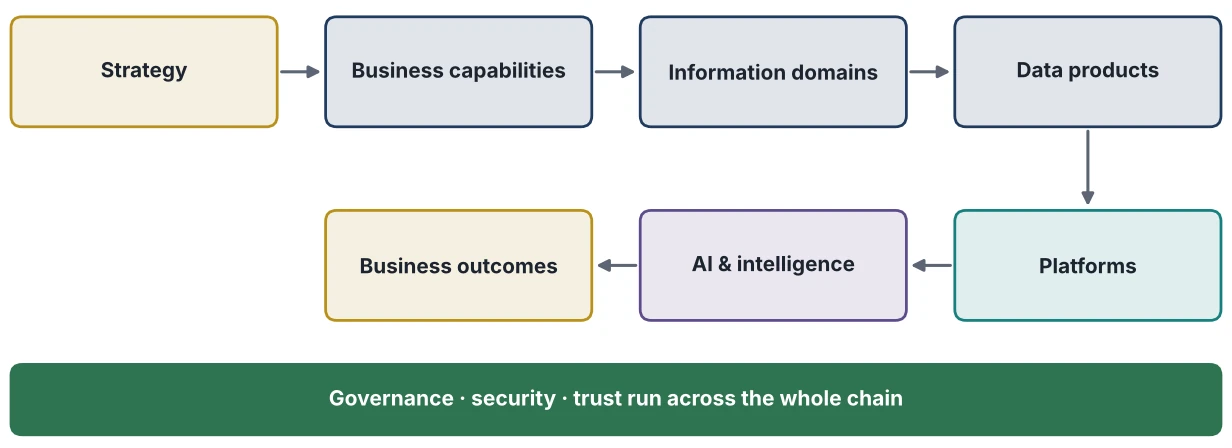
Business strategy defines the outcomes the enterprise seeks to achieve. Business capabilities describe what the organization must be able to do. Value streams describe how those capabilities contribute to customer and stakeholder outcomes. Information domains identify the major bodies of information required to operate and manage those capabilities.
The architecture should connect these elements.
For example, a financial services organization may identify strategic objectives around customer experience, operational efficiency, risk management, regulatory compliance, and intelligent decision-making. These objectives may depend on capabilities such as customer management, product management, payments, lending, fraud management, regulatory reporting, and relationship management.
Each capability generates and consumes information. The reference architecture therefore establishes a traceable relationship:
Strategy → Business Capabilities → Information Domains → Data Products → Platforms → AI and Intelligence Capabilities
This relationship is one of the most important architectural chains in the book. It prevents the data architecture from becoming detached from business priorities.
It also helps prioritize modernization. A legacy data store that supports a strategically critical capability may warrant modernization before a technically older platform supporting a less important capability. Likewise, a high-value AI use case may justify investment in a particular data product or semantic capability.
Architecture decisions should therefore be traceable to business value, risk reduction, regulatory obligation, or strategic capability.
22.4 Enterprise Information and Domain Architecture
The information architecture provides the conceptual structure of the reference architecture. An enterprise should identify its major information domains and the relationships among them. Typical domains might include customer, product, account, transaction, organization, employee, supplier, location, risk, financial instrument, contract, and regulatory information. These domains should not be interpreted simply as database schemas. A domain represents a meaningful area of business responsibility. The architecture should distinguish between the business concept, the authoritative representation, and the physical implementation of that concept.
For example, “Customer” is a business concept. A customer master record is an authoritative representation. Multiple databases, applications, data products, analytical models, and AI knowledge sources may physically store or derive information about customers. The reference architecture must preserve the distinction.
This is particularly important for AI. Generative AI systems require context, but context is only useful when its meaning and authority are understood. A model may retrieve several documents describing a customer, product, or policy. Without semantic and governance controls, the model may treat conflicting information as equally authoritative.
Information architecture therefore becomes part of AI architecture. The enterprise reference architecture should define how information domains relate to:
- Master and reference data
- Transactional data
- Analytical datasets
- Data products
- Metadata
- Semantic models
- Knowledge graphs
- Documents and unstructured content
- AI retrieval systems
- Operational applications
The result is a common information foundation across analytical and intelligent workloads.
22.5 Data Platform and Lakehouse Architecture
The data platform provides the computational and storage foundation for enterprise data capabilities.
Modern enterprise architectures often use a combination of object storage, lakehouse technologies, analytical warehouses, streaming platforms, operational databases, specialized data stores, and cloud services. The reference architecture should not assume that one technology will replace every other form of data storage.
Instead, it should define the responsibilities of each architectural capability. The platform should support ingestion, storage, processing, transformation, serving, analytical workloads, metadata management, quality controls, observability, and lifecycle management. A lakehouse-centered architecture may provide a common foundation for many analytical and AI workloads, but the reference architecture should remain flexible enough to accommodate workloads that require specialized stores or processing engines. The architect should distinguish between the logical data platform and the physical data platform. The logical platform describes capabilities such as:
- Ingestion
- Storage
- Processing
- Orchestration
- Serving
- Metadata
- Observability
- Security
- Governance
The physical platform identifies the technologies implementing those capabilities. This distinction allows the enterprise architecture to survive technology evolution.
The platform should also support multiple processing modes. Batch processing remains important for large-scale transformation and periodic workloads. Streaming and event processing support operational intelligence and low-latency use cases. Interactive analytical workloads support exploration and decision-making. AI workloads introduce additional requirements such as feature computation, document processing, embedding generation, vector retrieval, model evaluation, and inference support.
A modern data platform is therefore better understood as a portfolio of interoperable capabilities than as a single database.
22.6 Enterprise Data Integration Architecture
Data integration connects the enterprise’s operational and analytical ecosystem. The reference architecture should support multiple integration patterns because no single pattern is appropriate for every requirement.
Batch integration is useful where latency requirements are measured in hours or days. APIs support application-to-application interactions and transactional use cases. Change data capture provides efficient propagation of operational changes. Event-driven integration supports loosely coupled systems and near-real-time processing. Streaming platforms provide scalable transport and processing for high-volume event flows.
The reference architecture should therefore define integration as a capability rather than selecting one integration mechanism as the universal solution. Integration should also preserve important enterprise controls. Every significant integration path should have appropriate ownership, schema management, security, monitoring, error handling, lineage, and quality controls. Data contracts provide an important bridge between integration architecture and data products. A contract can define the expected structure, semantics, quality expectations, ownership, compatibility rules, and service characteristics of a data interface. This becomes increasingly important as organizations move toward domain-oriented architectures.
Instead of treating integration as movement between systems, the architecture can increasingly treat integration as the controlled exchange of enterprise information between accountable producers and consumers.
22.7 Data Products and Domain-Oriented Architecture
Data products provide the bridge between enterprise information architecture and reusable data consumption. A data product should provide data that is discoverable, understandable, accessible, governed, and fit for an identified purpose. It should have an owner, defined consumers, quality expectations, metadata, lineage, security controls, and a lifecycle. The reference architecture should define the capabilities required to create and operate such products. A typical data product architecture includes:
- Source data and domain systems
- Transformation and engineering pipelines
- Quality controls
- Metadata
- Semantic definitions
- Access controls
- Product interfaces
- Documentation
- Observability
- Consumption interfaces
The data product should not be reduced to a table or dataset. Its value comes from the combination of data, context, quality, documentation, access, and accountability. This becomes particularly significant for AI. A customer data product may support analytics, customer segmentation, fraud detection, recommendation models, retrieval systems, and agentic applications. If each consumer independently assembles customer information, the enterprise creates duplication and inconsistent interpretations. Reusable data products reduce this fragmentation. The reference architecture should therefore encourage domain ownership while providing shared enterprise platform capabilities.
This is one of the central architectural balances of the modern enterprise:
Domain ownership without platform fragmentation.
22.8 Semantic and Knowledge Architecture
Traditional data architectures often focus on structure: tables, schemas, columns, relationships, and pipelines. AI introduces a stronger requirement for meaning. An AI system needs to understand not merely that two fields contain strings or numbers, but what those values represent, how concepts relate, which source is authoritative, when information is valid, and under what conditions it may be used. Semantic architecture addresses this requirement. The reference architecture should include capabilities such as:
- Enterprise business glossary
- Semantic models
- Ontology management
- Metadata management
- Knowledge graphs
- Entity resolution
- Terminology mapping
- Relationship modeling
- Context management
These capabilities connect information architecture with AI architecture. A semantic layer can also improve analytics. Business users may ask questions using business terminology rather than physical database terminology. A governed semantic model can translate business concepts into appropriate analytical representations. Knowledge graphs can complement both structured data and retrieval systems by representing relationships among entities and concepts. The goal is not to force every workload into a knowledge graph. The goal is to provide architectural capabilities for representing meaning where meaning materially improves interoperability, retrieval, reasoning, analytics, or decision-making.
22.9 AI and Intelligence Architecture
The intelligence layer consumes capabilities from the layers below it. This layer may include machine learning models, generative AI applications, retrieval-augmented generation, model gateways, agentic systems, decision intelligence, predictive analytics, recommendation systems, and intelligent automation. The reference architecture should not treat AI as a separate island. AI depends on data. AI depends on information architecture. AI depends on metadata and semantics. AI depends on security and identity. AI depends on governance and observability. AI depends on operational integration. AI therefore sits within the enterprise architecture rather than outside it.
A reusable AI architecture should provide common capabilities for model access, prompt and context management, retrieval, model evaluation, safety controls, tool integration, observability, cost management, and lifecycle management. An enterprise AI gateway can provide a controlled interface to multiple models. This can reduce direct coupling between applications and individual model providers while allowing the enterprise to apply common security, logging, routing, and policy controls. RAG architectures can connect AI systems to enterprise knowledge sources. Agent architectures can connect models to tools and business services. Decision intelligence can combine predictive, descriptive, and prescriptive capabilities.
The reference architecture should allow these patterns to coexist. The architectural question is not simply, “Where do we put AI?” It is:
How does intelligence consume and contribute to the enterprise’s trusted information ecosystem?
That question changes AI architecture from an application-specific concern into an enterprise architecture capability.
22.10 Governance, Security, Privacy, and Responsible AI
Governance, security, privacy, and responsible AI should be represented as cross-cutting architectural capabilities. They should not appear as a final box at the bottom of a diagram. Security begins with identity and access management and extends through networks, applications, data stores, pipelines, APIs, models, prompts, tools, and agents. Privacy requires classification, purpose limitation, access controls, retention management, masking, tokenization or other appropriate protection mechanisms, and appropriate handling of sensitive information throughout its lifecycle. Governance establishes policies, standards, decision rights, ownership, stewardship, metadata requirements, and controls.
Responsible AI extends these principles into AI-specific concerns such as model evaluation, transparency, human oversight, risk management, monitoring, and appropriate use.
The architecture should therefore support policy propagation.
For example, a data classification assigned to a customer attribute should be usable by downstream systems to determine appropriate handling. A restricted dataset should not become unrestricted simply because it has been copied into another platform. An AI application should inherit or enforce the relevant controls on the information it retrieves.
This is where metadata becomes an important control plane. Metadata can connect business meaning, classification, ownership, lineage, quality, access policy, and usage constraints. The reference architecture should make this control flow explicit.
22.11 Data Quality, Observability, and Trust
A reference architecture is incomplete if it describes where data is stored but not how trust is established. Data quality should be connected to business requirements. Different data products have different quality expectations. A regulatory reporting dataset may require strict completeness and accuracy. A recommendation dataset may tolerate certain forms of approximation. A streaming fraud signal may prioritize latency and availability. The reference architecture should therefore support quality expectations as part of the product and service definition. Observability provides the operational mechanisms to detect deviations. The architecture should support visibility into:
- Pipeline health
- Data freshness
- Volume
- Schema changes
- Quality metrics
- Lineage
- Infrastructure performance
- Model behavior
- Retrieval quality
- Application behavior
- Cost
AI systems introduce additional observability requirements.
For a RAG system, for example, the enterprise may need to observe retrieval relevance, source authority, citation behavior, latency, prompt and response characteristics, and failure patterns. For agents, it may need to observe tool invocation, authorization, action outcomes, and escalation events.
Trust therefore extends beyond the dataset. It becomes an end-to-end architectural property. A useful reference architecture makes trust observable from source to consumption.
22.12 Enterprise Operating Model and Decision Rights
Architecture cannot be implemented through diagrams alone. The reference architecture must identify who owns capabilities, who makes decisions, who operates platforms, who defines policies, and who is accountable for outcomes. The operating model described in Chapter 20 provides the organizational foundation. A modern enterprise will often use a hybrid model. Central teams provide common platforms, security capabilities, architecture standards, governance frameworks, and reusable services. Business domains own the meaning, quality, and lifecycle of their information products. The reference architecture should therefore map capabilities to organizational responsibilities. For example:
| Capability | Typical Accountability |
|---|---|
| Enterprise architecture | Enterprise architecture leadership |
| Information domains | Business/data domain owners |
| Data products | Domain product teams |
| Data platform | Data platform engineering |
| Integration platform | Integration/platform engineering |
| Enterprise metadata | Data governance/platform teams |
| Security | Enterprise security |
| Privacy | Privacy/legal/compliance functions |
| AI platform | AI/data platform engineering |
| AI risk controls | AI governance/risk |
| Data quality | Domain owners with platform support |
| Observability | Platform and product engineering |
| Business outcomes | Business executives and product owners |
These responsibilities should be adapted to organizational context. The important architectural principle is that responsibility should be explicit. If a capability has no owner, the architecture contains an organizational gap regardless of how technically sophisticated the platform may be.
22.13 Reference Architecture Deployment Patterns
The logical reference architecture can be implemented through different deployment patterns:
- A centralized platform pattern places most data and AI capabilities under a central technology organization. This can simplify governance and platform management but may create bottlenecks or weaken domain accountability if taken too far.
- A federated domain pattern distributes engineering and data-product ownership across business domains while providing shared platform services. This can improve business alignment but requires stronger standards and platform engineering.
- A hybrid enterprise pattern combines centralized foundational capabilities with decentralized domain ownership. For many large enterprises, this provides a practical balance.
- A lakehouse-centric pattern uses a shared analytical foundation for many data and AI workloads.
- An event-driven pattern emphasizes streaming and event-based integration for operational intelligence.
- A knowledge-centric AI pattern places semantic services, knowledge repositories, and retrieval capabilities near the center of enterprise AI architecture.
- A multi-cloud pattern distributes workloads across multiple cloud environments, usually because of regulatory, geographic, business, resilience, or existing-investment requirements.
These patterns are not mutually exclusive. An enterprise may use a hybrid operating model, lakehouse architecture, event streaming, and knowledge-centric AI simultaneously.
The reference architecture should therefore describe composable patterns rather than prescribe one universal topology.
22.14 Technology-Neutral Architecture and Technology Choices
One of the most important disciplines in reference architecture is separating architecture from product selection. Technology choices matter. Performance, scalability, ecosystem maturity, skills, integration, cost, support, security, and vendor strategy all influence implementation. However, selecting technologies before defining architectural capabilities can lead to technology-driven architecture. The reference architecture should first describe what must be accomplished. For example:
- Capability: Enterprise model access.
- Architectural responsibility: Provide controlled access to approved foundation and specialized models.
- Requirements: Authentication, authorization, routing, logging, evaluation, cost management, and policy enforcement.
Only after these responsibilities are defined should the enterprise evaluate implementation options. The same principle applies to data storage. The architecture may require scalable object storage, analytical processing, transactional databases, streaming systems, vector retrieval, and semantic services. Specific technologies can then be evaluated against those requirements. This separation provides flexibility while still allowing concrete technology standards to be established. The enterprise may maintain a separate technology reference model that maps approved products and platforms to the logical reference architecture. This creates two useful layers:
- Logical reference architecture: what capabilities are required and how they relate.
- Technology reference architecture: which technologies are approved to implement those capabilities.
Keeping these layers distinct makes architectural governance more durable.
Case study: Meridian Financial Group
22.15 Reference Architecture at Meridian Financial Group
Meridian Financial Group provides a useful example of how the reference architecture can be applied. Meridian operates across multiple regions and business lines. Its environment includes legacy operational systems, enterprise warehouses, departmental analytical stores, cloud platforms, fragmented customer information, event streams, document repositories, and emerging AI applications. The organization historically treated data platforms as separate technology initiatives. The transformation described throughout this book changes that approach. At the strategy layer, Meridian identifies customer intelligence, risk management, operational efficiency, regulatory reporting, and intelligent automation as strategic priorities.
These priorities are mapped to business capabilities and information domains. Customer, account, transaction, product, risk, and regulatory information become explicit enterprise information domains. Domain teams become accountable for the information they produce and consume. The data platform provides shared storage, processing, integration, orchestration, metadata, quality, and observability capabilities. Data products are created around high-value domains rather than around individual databases.
For example, a Customer 360 data product can combine authoritative customer information, relationship information, relevant account relationships, and approved analytical attributes. A risk data product can provide governed risk indicators and related information to approved analytical and AI consumers. The semantic layer connects business concepts such as customer, account, exposure, transaction, relationship, and risk event to physical data sources and data products. Meridian then introduces an enterprise AI architecture. An AI gateway provides controlled access to approved models. RAG services connect AI applications to governed internal knowledge sources. A semantic and metadata layer provides context. Agentic applications access enterprise tools through controlled authorization boundaries. Governance and security span the entire architecture. Data classification determines how information may be stored, shared, retrieved, and used. Identity and access policies are applied across platforms and applications. Observability provides visibility into pipelines, data products, retrieval systems, models, and AI applications. The resulting architecture is not a replacement for every existing platform. Instead, Meridian creates a target architecture that allows existing systems to participate in the transformation while progressively reducing unnecessary duplication and architectural fragmentation. The most important change is therefore conceptual. Meridian stops treating data, analytics, and AI as separate technology programs and begins treating them as parts of one enterprise intelligence architecture.
22.16 Practical Artifact: Enterprise Data and AI Reference Architecture Blueprint
The practical artifact for this chapter is an Enterprise Data and AI Reference Architecture Blueprint. The blueprint should be maintained as a living architectural asset rather than a one-time diagram. A useful blueprint contains at least seven components.
1. Business Alignment View
Document the strategic objectives, business capabilities, value streams, and information domains that the architecture supports. The purpose is to establish why the architecture exists.
2. Capability Map
Identify the required enterprise capabilities across:
- Information architecture
- Data platforms
- Integration
- Data products
- Semantics
- Knowledge management
- AI
- Governance
- Security
- Privacy
- Quality
- Observability
- Operating model
3. Logical Reference Architecture
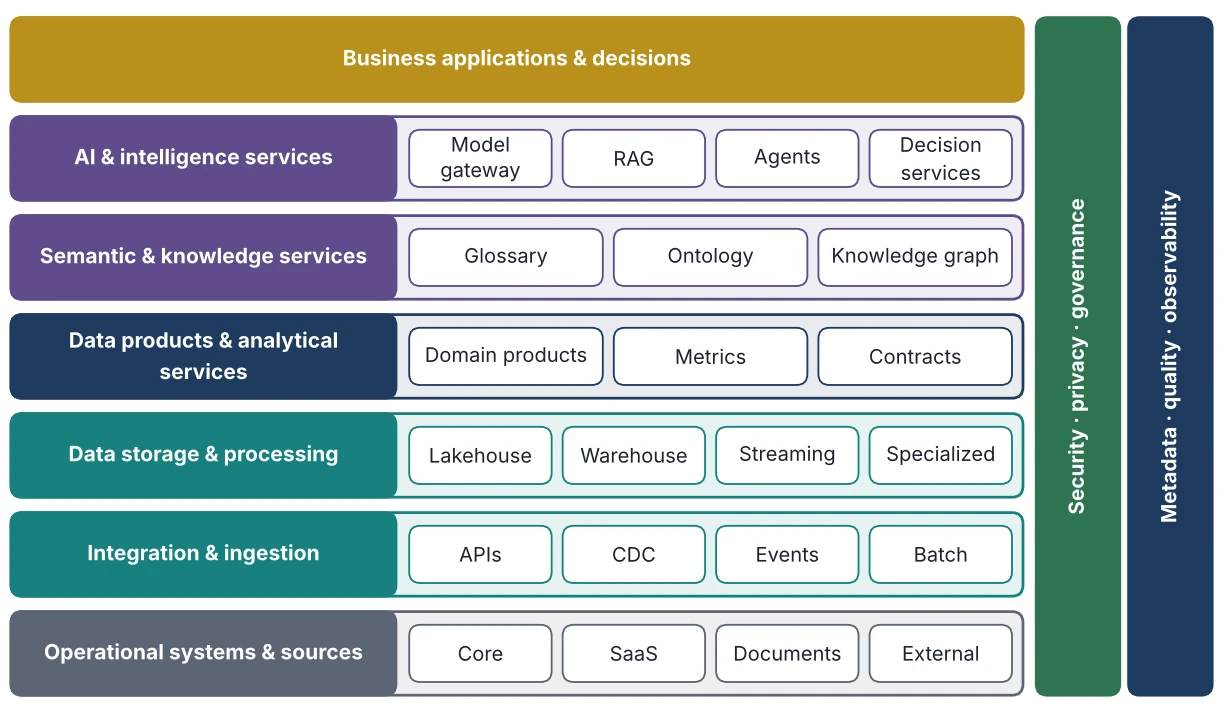
Create a technology-neutral architecture showing the major layers and relationships. A useful logical model, from top to bottom, is:
- Business and strategy
- Business capabilities and information domains
- Operational systems and data sources
- Integration and ingestion
- Data storage and processing
- Data products and analytical services
- Semantic and knowledge services
- AI and intelligence services
- Business applications and decisions
Across all layers run the cross-cutting concerns: security, privacy, governance, metadata, quality, observability, and risk.
4. Ownership and Decision Rights
For each capability, identify the accountable organization, decision authority, operational owner, and major consumers.
5. Technology Reference Model
Map logical capabilities to approved technologies, platforms, standards, and reusable services.
6. Architecture Standards and Controls
Define the principles, standards, patterns, security controls, data contracts, quality requirements, and AI controls that implementations are expected to follow.
7. Evolution Roadmap
Identify the transition from the current state to the target architecture. The roadmap should distinguish between:
- Capabilities to build
- Capabilities to modernize
- Capabilities to consolidate
- Capabilities to retire
- Dependencies
- Business outcomes
- Risk reduction
- Investment requirements
A simple assessment can use the following structure:
| Architecture Dimension | Current State | Target State | Gap | Priority | Owner |
|---|---|---|---|---|---|
| Information architecture | Fragmented | Enterprise domain model | High | High | Data Architecture |
| Data platform | Multiple platforms | Rationalized platform ecosystem | High | High | Platform Engineering |
| Integration | Batch and point-to-point | API, CDC, event, and contract-based | High | High | Integration |
| Data products | Limited | Domain-owned products | High | High | Domain Teams |
| Semantics | Inconsistent | Governed semantic layer | High | Medium | Data Governance |
| AI architecture | Experimental | Governed enterprise AI platform | High | High | AI Platform |
| Governance | Policy-centric | Embedded and automated | Medium | High | Governance |
| Observability | Pipeline-focused | End-to-end data and AI trust | Medium | Medium | Platform Engineering |
| Operating model | Centralized | Hybrid/federated | Medium | High | Leadership |
The blueprint should be reviewed periodically. A reference architecture that never changes becomes disconnected from the enterprise it was intended to guide.
Remember these
22.17 Key Takeaways
An enterprise data and AI reference architecture provides the connective tissue between the individual capabilities discussed throughout this book. The most important lessons are:
- A reference architecture describes capabilities and relationships, not merely technologies.
- Business strategy should provide the starting point for the architecture.
- Information architecture provides the conceptual foundation for data and AI.
- Modern data platforms should be treated as portfolios of interoperable capabilities rather than single technologies.
- Integration architecture should support multiple patterns, including APIs, batch, CDC, events, and streaming.
- Data products connect domain accountability with enterprise data reuse.
- Semantic and knowledge architecture provide the context increasingly required by AI systems.
- AI should be integrated into enterprise architecture rather than treated as a disconnected application technology.
- Security, privacy, governance, quality, and observability are architectural control planes, not afterthoughts.
- The logical reference architecture should remain technology-neutral while a separate technology reference model identifies approved implementation choices.
- The operating model is part of the architecture because every important capability requires ownership and decision rights.
- Reference architecture should support multiple deployment patterns rather than impose a universal physical topology.
- The architecture must evolve continuously as business priorities, technologies, risks, and organizational structures change.
- The ultimate purpose of the architecture is not technological sophistication. It is the ability to turn trusted enterprise information into measurable business value and responsible intelligence.
Think about your own organization
Architect’s Reflection
A reference architecture can become one of the most powerful tools in an enterprise architect’s toolkit—or one of the least useful. The difference is rarely the quality of the diagram. The difference is whether the architecture becomes a living decision framework. A beautiful architecture diagram that nobody uses has little enterprise value. A simpler architecture that shapes investment decisions, clarifies ownership, guides solution design, exposes dependencies, and creates common language can become enormously valuable. The Enterprise Data Architect should therefore resist the temptation to make the reference architecture unnecessarily complex.
The goal is not to represent every database, interface, application, model, and technology. The goal is to make the important architectural relationships visible.
The reference architecture should help an executive understand where investment is required. It should help an engineer understand the boundaries within which a solution should be designed. It should help a data product owner understand their responsibilities. It should help a security leader understand where controls are applied. It should help an AI team understand how models connect to trusted enterprise information.
Most importantly, it should help the organization make better architectural decisions repeatedly.
The modern enterprise is unlikely to converge on one platform, one database, one cloud, one model, or one architecture pattern. Instead, the enterprise architect’s role is to create coherence across diversity. That is the real purpose of enterprise architecture. The future enterprise will contain many technologies, many data products, many models, many agents, many platforms, and many teams. The architecture must make them behave like an enterprise rather than a collection of independent technologies.