This chapter shifts from operating the modern data enterprise to transforming the existing one. It addresses legacy modernization, modernization strategies, migration patterns, sequencing, coexistence, technical debt, organizational change, cloud and lakehouse adoption, data product transformation, AI readiness, and the architectural roadmap for moving from today’s environment toward the intelligent enterprise.
Why this chapter matters
Introduction
Enterprise data modernization is often described as a technology migration: move databases to the cloud, replace legacy warehouses, adopt a lakehouse, implement streaming, or introduce new data platforms. These technologies can be important, but modernization is fundamentally broader than technology replacement.
The objective of modernization is to change the way an enterprise creates, manages, shares, governs, and uses information. Technology provides the enabling infrastructure, but architecture provides the structure and transformation provides the path from the current state to the target state.
Most large enterprises cannot replace their existing data environment in a single initiative. They have decades of accumulated applications, warehouses, interfaces, reports, data models, operational processes, regulatory obligations, and undocumented dependencies. Some legacy platforms may be inefficient, but they may also contain critical business logic that has never been formally documented elsewhere.
Modernization must therefore balance two competing responsibilities. The enterprise must create a modern foundation for cloud, data products, analytics, and AI while continuing to operate the existing business safely. This creates a central architectural challenge:
How can an enterprise evolve its data architecture without destabilizing the business that depends on the existing architecture?
The answer is not a universal migration pattern. It is an intentional transformation strategy based on business priorities, architectural dependencies, risk, cost, data criticality, organizational readiness, and the target operating model. This chapter examines how Enterprise Data Architects can design and lead such transformations. It focuses on modernization as a continuous architectural journey rather than a single migration project.
21.1 Why Enterprise Data Modernization Is Difficult
Legacy data environments rarely evolve according to a single architectural plan. They are usually the result of decades of business growth, acquisitions, technology changes, regulatory requirements, organizational restructuring, and project-specific decisions. An organization may simultaneously operate mainframe applications, relational databases, enterprise warehouses, departmental marts, integration platforms, file transfers, cloud storage, SaaS applications, streaming systems, and emerging AI platforms. The resulting landscape contains multiple generations of architecture.
Some systems are technically old but highly stable. Others are newer but poorly integrated. Some contain authoritative information. Others contain duplicated or transformed versions of the same information. Some have well-documented interfaces. Others depend on undocumented batch jobs and manual processes.
Modernization becomes difficult because the architecture is not simply a technology landscape. It is an accumulated representation of business processes. Replacing a database may therefore change more than storage. It may affect transaction behavior, reporting logic, regulatory controls, reconciliation processes, operational procedures, and downstream consumers. This is why modernization programs that begin with technology inventory alone often underestimate the problem. The Enterprise Data Architect must understand both the technical dependency graph and the business dependency graph.
21.2 Modernization as an Architectural Transformation
Modernization should be treated as transformation rather than replacement. Replacement asks:
What technology should replace this legacy system?
Transformation asks:
What capability does the organization need, what architectural constraints exist today, and what target capability should replace or evolve the current one?
This distinction changes the design process. Suppose an enterprise has a twenty-year-old reporting warehouse. A replacement-oriented project may migrate its tables into a cloud warehouse and declare success. A transformation-oriented approach asks additional questions.
Which business capabilities depend on the warehouse? Which data products should exist independently of individual reports? Which business definitions are embedded in transformation logic? Which consumers need historical data? Which regulatory reports require controlled reproducibility? Which data should be mastered elsewhere? Which workloads belong in operational systems, analytical platforms, or specialized AI environments?
The modernization objective may ultimately be to eliminate the warehouse, partially migrate it, reorganize its information architecture, or retain portions of it for a defined period. Architecture determines the destination. Transformation determines the path.
21.3 Establishing the Current-State Baseline
Modernization begins with a reliable understanding of the current state. The baseline should capture more than technologies and versions. It should describe business capabilities, applications, information domains, data flows, platforms, data products, integrations, quality issues, ownership, regulatory constraints, costs, and dependencies. A useful baseline has several views:
- The business view identifies capabilities and processes that depend on data.
- The application view identifies operational systems, analytical applications, reporting environments, SaaS platforms, and AI applications.
- The information view identifies important business entities, information domains, authoritative sources, duplicated concepts, and major data flows.
- The technology view identifies databases, warehouses, lakes, cloud services, integration technologies, orchestration platforms, and infrastructure.
- The operational view identifies service dependencies, quality incidents, support arrangements, batch windows, recovery requirements, and production constraints.
- The financial view identifies licensing, infrastructure, cloud consumption, operational support, and modernization costs.
- The risk view identifies security, privacy, regulatory, resilience, concentration, and technical-debt concerns.
These views should be connected. A list of systems is far less useful than a map showing which business capabilities depend on those systems and which data products flow through them.
21.4 Understanding Technical Debt in Data Architecture
Technical debt is often discussed in terms of obsolete software or infrastructure. In enterprise data architecture, it is broader. Data technical debt includes duplicated data models, undocumented transformations, fragile integrations, obsolete platforms, manual reconciliation, inconsistent business definitions, missing lineage, unsupported interfaces, poor quality controls, and architectures that require specialized knowledge to operate. Technical debt also exists when the organization has created temporary solutions that became permanent.
A manually maintained spreadsheet may begin as a tactical workaround and eventually become a critical input to a regulatory process. A reporting mart may be created for one project and later become a dependency for dozens of applications. A local customer table may persist long after an enterprise customer capability exists.
The danger is not simply that these assets are old. The danger is that their continued existence constrains future change. Modernization should therefore distinguish between age and architectural risk. A decades-old platform may be stable and inexpensive to operate, while a relatively new platform may create substantial risk because of poor design or fragmented ownership. A useful modernization assessment considers business criticality, change difficulty, operational risk, cost, security exposure, technical supportability, data quality, and strategic alignment.
21.5 Defining the Target Architecture
Modernization cannot succeed without a credible target architecture. The target should describe the desired business, information, platform, integration, governance, and AI capabilities. It should not simply be a collection of technology products.
The target architecture should establish where authoritative data will reside, how domains will publish data products, how analytical workloads will operate, how streaming and batch processing will coexist, how metadata and lineage will be managed, how AI applications will access governed information, and how security and governance will be embedded.
The target architecture should also define what will not be modernized. Not every legacy component must disappear. Some systems may remain because they provide stable operational capabilities, have acceptable economics, or require substantial investment to replace without corresponding business value. This creates an important principle:
The target architecture should optimize the enterprise ecosystem, not maximize the number of systems replaced.
A hybrid target state may therefore be entirely appropriate. Legacy systems can remain as systems of record while modern platforms progressively become systems of insight, integration, data products, and intelligence.
21.6 Modernization Strategies
Different architectural circumstances require different modernization strategies:
- Retain keeps a system largely unchanged when the system remains fit for purpose and modernization would create disproportionate risk or cost.
- Rehost moves a workload to new infrastructure with minimal architectural change. This can provide infrastructure benefits but does not necessarily address deeper data architecture problems.
- Replatform moves a workload to a newer platform while making selected changes to take advantage of modern capabilities.
- Refactor substantially redesigns the workload to use modern architectural patterns.
- Repurchase replaces a custom capability with a commercially provided service or SaaS product.
- Rebuild creates a new capability around modern business and architectural requirements.
- Retire removes a capability when its business function or data is no longer required.
- Replace and transform combines system replacement with redesign of the associated information and business processes.
These strategies should not be selected uniformly across an estate. A critical operational system may require careful coexistence and incremental modernization, while a redundant reporting mart may simply be retired. The architect should evaluate each candidate according to business value, risk, complexity, cost, dependencies, and target-state alignment.
21.7 Incremental Modernization versus Big-Bang Migration
Large-scale data migrations often tempt organizations toward a big-bang approach. The reasoning is understandable: build the new platform, migrate everything, shut down the old platform. In practice, enterprise dependencies make this difficult.
The old and new environments often need to coexist for an extended period. Consumers may migrate at different speeds. Data may have different structures and semantics across platforms. Historical information may require special handling. Reconciliation is necessary to establish confidence.
Incremental modernization reduces some of these risks. The organization can establish the modern platform, migrate selected workloads or domains, validate the results, and progressively move consumers. This approach allows lessons from early migrations to improve later ones. The disadvantage is complexity during the transition. The enterprise may temporarily operate duplicate pipelines, storage, interfaces, and controls. Costs can increase before they decline. The architect should therefore treat coexistence as a designed architectural state rather than an accidental period between old and new systems.
21.8 The Strangler Pattern for Data Modernization
The strangler pattern provides one useful approach for incremental modernization.
Instead of replacing a legacy environment immediately, new capabilities are built around it. Over time, individual functions or data flows are moved to the modern architecture. Consumers are redirected as new capabilities become available, and legacy functionality is progressively reduced.
For data architecture, the pattern can be applied at several levels.
A legacy reporting environment may continue to serve existing reports while new data products are published from a modern platform. New consumers adopt the data products rather than connecting to the legacy warehouse. As consumer dependencies decline, portions of the warehouse can be retired.
Similarly, a legacy integration layer can remain in place while new domain APIs and event streams are introduced. New consumers adopt the modern interfaces, reducing the dependency on point-to-point legacy integration. The pattern is particularly useful when the organization cannot safely migrate everything simultaneously. However, it requires discipline. Without explicit retirement milestones, the enterprise may simply create another permanent layer beside the legacy system.
21.9 Domain-by-Domain Modernization
Modernization can also be organized around business domains. Rather than migrating technology platforms wholesale, the enterprise selects a domain such as customer, payments, finance, or risk and modernizes the associated information products, pipelines, governance, and analytical capabilities. This approach has several advantages. The domain provides a coherent business context. Ownership is easier to establish. Consumers can be identified. Quality requirements can be defined. Business outcomes can be measured. The resulting data product can also become a building block for later modernization.
For example, once a trusted customer data product exists, multiple analytics and AI applications can adopt it without independently extracting customer information from legacy systems. Domain modernization therefore creates architectural leverage.
The challenge is cross-domain dependency. A customer domain may depend on identity, finance, risk, and product information. The modernization roadmap must therefore account for shared entities and interoperability.
21.10 Modernizing Data Integration
Integration is often one of the largest sources of modernization complexity. Legacy environments may contain thousands of interfaces implemented through file transfers, proprietary middleware, stored procedures, scripts, and point-to-point connections. Modernization should not simply reproduce these interfaces on a new platform.
The architect should classify integration requirements according to business purpose and interaction pattern. Some require APIs because applications need synchronous interaction. Others are better represented as events because multiple consumers need to react independently. Analytical workloads may use batch ingestion or change data capture. Data products may expose governed interfaces designed for reusable consumption.
This creates an opportunity to reduce integration complexity rather than merely relocate it. A modernization program should therefore establish integration principles alongside platform migration principles.
21.11 Modernizing the Enterprise Data Warehouse
The enterprise warehouse deserves particular attention because it often contains decades of accumulated business logic. A common modernization mistake is to assume that moving warehouse tables to a cloud platform automatically modernizes the architecture. The migration may improve infrastructure economics or scalability, but the resulting architecture may still contain tightly coupled schemas, report-specific transformations, duplicated business rules, and centralized ownership. Modernization should examine what the warehouse actually does.
Some structures may represent authoritative business information. Others may exist solely to support individual reports. Some transformations may encode important business rules that should become governed domain logic. Others may be obsolete. The target architecture may distribute these responsibilities across operational systems, data products, lakehouse or warehouse layers, semantic models, and analytical applications.
The objective is not to eliminate the warehouse concept. Modern cloud analytical platforms may continue to provide important warehouse capabilities. The objective is to ensure that the warehouse is part of an intentional architecture rather than the accidental center of the enterprise information ecosystem.
21.12 Modernizing Data Lakes and Lakehouses
Modernization programs frequently introduce lakehouse architecture as a target platform. The lakehouse can provide a unified environment for analytical and AI workloads, but it should not become another uncontrolled data repository. The architect must establish domain ownership, data lifecycle policies, access controls, quality requirements, metadata, lineage, and product boundaries. A lakehouse should be treated as an architectural platform, not a substitute for information architecture. The presence of large-scale object storage does not eliminate the need to understand business entities, authoritative sources, semantic definitions, or consumer requirements.
Modernization should also distinguish between data that belongs in shared analytical storage and data that should remain in operational systems or specialized services. The target platform should support multiple processing patterns without forcing every workload into a single technology pattern.
21.13 Modernizing Master Data and Enterprise Information
Many modernization programs discover that technical migration cannot solve fundamental information problems. An organization may have multiple customer identifiers, inconsistent product definitions, conflicting organizational hierarchies, and different interpretations of the same business status. Moving these datasets to a modern platform does not resolve the underlying semantic problem. Information architecture must therefore accompany platform modernization. The enterprise should identify important shared business concepts, define authoritative sources and stewardship responsibilities, establish reference data and master data practices where appropriate, and expose governed information through reusable capabilities.
This is especially important for AI. An AI application may retrieve multiple representations of a customer or product and produce an apparently coherent answer based on conflicting information. Modernization should therefore improve not only where data is stored but also what the enterprise means by its data.
21.14 Modernization for AI Readiness
AI changes the modernization equation because modern data environments are increasingly expected to support intelligent applications. AI readiness requires more than moving data to a cloud platform. The architecture needs reliable data products, accessible metadata, lineage, semantic context, document processing capabilities, vector and retrieval services where appropriate, secure access controls, evaluation datasets, and observability. Modernization should identify which legacy limitations prevent these capabilities. For example, a legacy reporting environment may contain useful information but expose it only through tightly coupled reports. A modernization program can progressively convert the underlying information into reusable data products.
Similarly, a collection of policy documents stored across file systems may require classification, metadata enrichment, ownership, version management, and governed retrieval before it can reliably support an enterprise AI assistant. AI therefore provides a new lens through which modernization priorities can be evaluated.
21.15 Migration, Reconciliation, and Data Validation
Data migration is not complete when records have been copied. The organization must demonstrate that the migrated information is complete, correctly transformed, accessible to authorized consumers, and suitable for its intended use. Reconciliation should occur at multiple levels.
Record counts can identify missing or duplicated populations. Aggregate measures can validate financial or operational totals. Referential checks can verify relationships. Field-level comparisons can validate important attributes. Business-rule validation can establish whether the migrated data behaves correctly in downstream processes.
Historical data presents additional challenges. Legacy systems may have different interpretations of dates, statuses, identifiers, currencies, or organizational structures. Transformation may require preserving historical meaning rather than simply converting formats. The migration architecture should therefore make validation a first-class capability.
For critical migrations, parallel operation can provide additional confidence. The legacy and modern environments process comparable workloads for a defined period, with results reconciled before consumers are fully transitioned.
21.16 Managing Coexistence
During modernization, the enterprise often operates two architectural worlds simultaneously. Legacy systems continue to serve operational and reporting needs while modern platforms begin serving new use cases. This coexistence creates risks of data divergence. If the same information is independently transformed in both environments, definitions can drift. If updates occur in multiple places, synchronization becomes difficult. If consumers do not know which platform is authoritative, confidence declines. The architecture should therefore establish explicit rules for coexistence.
The enterprise should identify systems of record, systems of reference, and derived products. Data movement between old and new environments should be controlled and observable. Duplicate transformations should be minimized. New consumers should generally be directed toward the target architecture rather than creating additional dependencies on the legacy environment.
Coexistence should have an intended exit strategy. Every significant legacy dependency should eventually have one of three states: retained intentionally, migrated, or retired.
21.17 Organizational Change and Modernization
Technology modernization changes responsibilities.
A central warehouse team may evolve into a platform organization. Application teams may become accountable for producing events or governed operational data. Business domains may take ownership of data products. Analysts may transition from directly querying legacy structures to consuming governed products and semantic models.
These changes can create legitimate organizational tension. Modernization programs therefore need change management alongside technical planning. People need to understand not only what technology is changing but why responsibilities are changing, what new capabilities they are expected to develop, and how success will be measured. The enterprise architect should engage stakeholders early, particularly teams whose responsibilities or platforms are affected by the target architecture. Modernization should not be framed as eliminating the value of existing teams. It should explain how their expertise can be redirected toward capabilities that are more sustainable and strategically important.
21.18 Sequencing the Modernization Roadmap
A modernization roadmap should not be a simple list of systems ordered by age. Prioritization should consider business value, architectural dependency, risk, complexity, cost, readiness, and strategic leverage. A capability with high business importance and many downstream dependencies may require early architectural attention even if its migration is technically difficult. Conversely, a technically obsolete but isolated system may be a relatively simple modernization candidate. The architect should identify enabling capabilities that make later modernization easier.
Examples include enterprise identity, metadata and lineage, data quality services, cloud landing zones, integration patterns, data product standards, observability, and shared AI services. These capabilities may not produce immediate visible business outcomes, but they reduce the cost and risk of subsequent modernization. The roadmap should therefore contain both business-facing modernization initiatives and architectural enabling initiatives.
21.19 Measuring Modernization Success
Modernization programs often measure progress through technical milestones: systems migrated, databases decommissioned, workloads moved, or cloud adoption percentages. These measures are useful but incomplete. A modernized environment should improve business and architectural outcomes.
Possible measures include reduced time to deliver new data products, improved data quality, reduced manual reconciliation, faster analytical processing, lower operational risk, improved lineage coverage, reduced duplicated platforms, increased reuse of shared data products, improved AI readiness, and measurable changes in operating cost.
Legacy retirement should also be measured carefully. Decommissioning a platform is valuable only when its capabilities have been safely replaced or eliminated. Cloud consumption should not be treated as a modernization success by itself. A poorly designed cloud architecture can cost more than the legacy platform it replaced. Modernization should therefore be measured against the target architecture and business outcomes rather than technology adoption alone.
21.20 The Economics of Modernization
Modernization requires investment before savings appear. During transition, the enterprise may operate both old and new platforms. Teams may require additional skills. Data may need to be migrated and validated. New governance and observability capabilities must be established. The business case should therefore distinguish between transition costs and steady-state economics. It should also consider avoided costs and risk reduction. A modernization initiative may not immediately reduce infrastructure spending but may substantially reduce the cost of future change, improve resilience, simplify regulatory reporting, or enable new digital and AI capabilities.
FinOps and enterprise architecture should work together to evaluate these trade-offs. A useful business case connects technology decisions to business capabilities rather than relying only on infrastructure savings.
21.21 Modernization Governance
Large transformation programs need governance that is strong enough to coordinate change but lightweight enough to preserve delivery momentum. A modernization governance structure should establish target architecture, standards, migration principles, decision rights, exception processes, and measurable outcomes. Architecture review should focus on decisions that affect the target state or create significant future constraints. Transformation governance should also track dependencies among initiatives. A domain modernization may depend on identity services, a new integration platform, a master-data capability, or a shared data product.
Without dependency management, individual projects can make locally rational decisions that collectively undermine the transformation. Architecture roadmaps and portfolio planning should therefore be connected.
Case study: Meridian Financial Group
21.22 Enterprise Data Modernization at Meridian Financial Group
Meridian Financial Group begins its modernization journey with a complex estate. Its core banking and transaction platforms remain on long-established technologies. Several regional business units operate different customer and product systems. The enterprise warehouse contains decades of reporting logic. A growing cloud lakehouse supports newer analytics, but its ownership model is inconsistent.
Meridian initially considers migrating the enterprise warehouse directly to a cloud platform. The architecture team recognizes that this would reproduce many existing problems. Instead, Meridian establishes a target architecture based on business domains, governed data products, shared cloud platforms, modern integration, enterprise metadata, and AI-ready information services.
The first modernization wave focuses on the customer domain. Meridian identifies authoritative customer sources, defines key customer concepts, establishes data quality expectations, and creates a governed customer data product. The product is initially populated from legacy systems, so the old platforms remain operational.
New analytics consumers begin using the customer product rather than creating new extracts from the warehouse.
The second wave focuses on payments. Change data capture and event-driven integration are introduced to make transaction information available to modern analytical and operational consumers. A new payments data product is established alongside existing reporting processes. The enterprise warehouse remains operational throughout these waves. As consumer dependencies decline, Meridian begins retiring selected warehouse structures. Some transformations are moved into domain data products. Others are eliminated because their original business purpose no longer exists.
Meridian also modernizes its document environment. Policies, procedures, and regulatory materials are cataloged, classified, and connected to governed retrieval services. This becomes a foundation for internal AI assistants.
The transformation is not executed as one large migration. It proceeds through architectural waves, each producing a useful capability while reducing dependency on legacy platforms. After several waves, Meridian’s architecture contains both legacy and modern components, but the direction of travel is clear. Legacy systems remain where they provide necessary operational value. Modern platforms increasingly provide reusable information, analytics, and AI capabilities.
The most important result is not that Meridian has moved a particular percentage of data to the cloud. It is that the enterprise has changed the way data capabilities are created and consumed.
21.23 Practical Artifact: Enterprise Data Modernization Assessment and Roadmap
The Enterprise Data Modernization Assessment can be used to evaluate a candidate system, domain, or platform and determine the appropriate modernization strategy.
| Assessment area | Questions to evaluate | Evidence |
|---|---|---|
| Business criticality | How important is the capability to current business operations? | Business capability map |
| Strategic alignment | Does the current capability support the target architecture? | Target architecture |
| Technical condition | Is the technology supported, stable, scalable, and maintainable? | Platform assessment |
| Data quality | Are there significant quality or reconciliation issues? | Quality metrics |
| Integration complexity | How many upstream and downstream dependencies exist? | Lineage and interface inventory |
| Information value | Does the capability contain authoritative or strategically important information? | Information model |
| Regulatory exposure | What retention, privacy, security, or regulatory obligations apply? | Compliance assessment |
| Cost | What are current operating and licensing costs? | FinOps and financial data |
| Change difficulty | How difficult would migration or redesign be? | Dependency analysis |
| AI readiness | Can the capability support modern analytics and AI use cases? | AI readiness assessment |
| Ownership | Is accountability clear today and in the target state? | Operating model |
| Modernization strategy | Should the capability be retained, rehosted, replatformed, refactored, rebuilt, replaced, or retired? | Architecture decision |
| Migration sequence | What capabilities must exist before modernization can proceed? | Dependency roadmap |
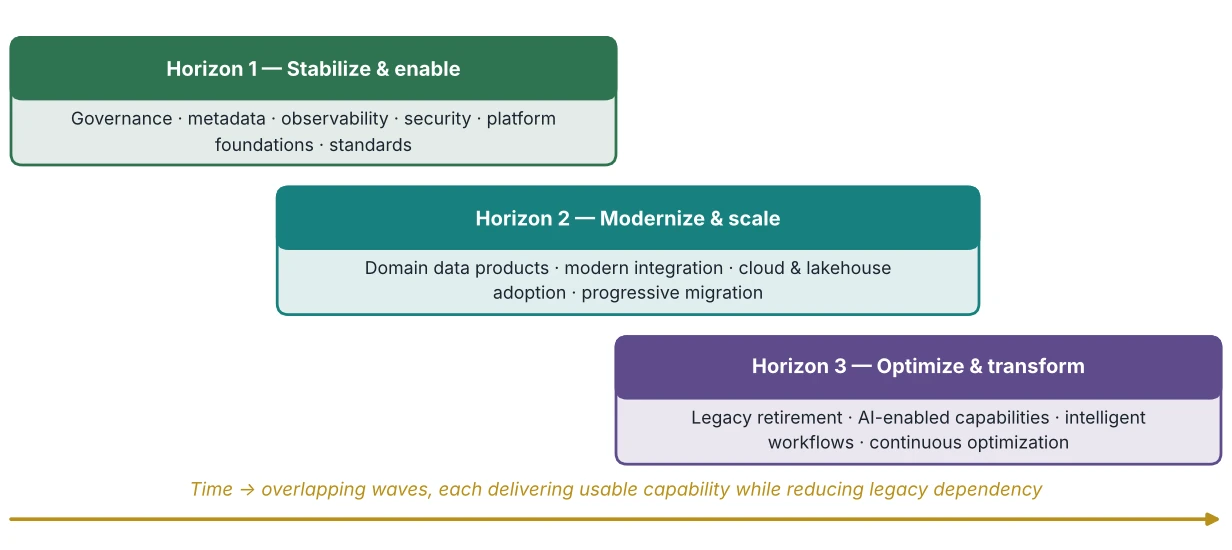
The assessment should produce more than a classification. Each modernization candidate should have a target state, a transition state, key dependencies, risks, estimated effort, expected outcomes, and a proposed sequencing position. A useful roadmap distinguishes three horizons:
- Horizon 1 — Stabilize and Enable focuses on establishing governance, metadata, observability, security, platform foundations, and architectural standards.
- Horizon 2 — Modernize and Scale focuses on domain data products, modern integration, cloud and lakehouse adoption, analytical modernization, and progressive legacy migration.
- Horizon 3 — Optimize and Transform focuses on legacy retirement, advanced automation, AI-enabled capabilities, intelligent workflows, and continuous architectural optimization.
These horizons should overlap rather than operate as rigid sequential phases.
Remember these
21.24 Key Takeaways
- Enterprise data modernization is not primarily a technology replacement exercise. It is a transformation of how the enterprise creates, manages, shares, governs, and uses information.
- The current state must be understood from multiple perspectives: business, application, information, technology, operational, financial, and risk.
- The target architecture should define desired capabilities rather than simply specify replacement technologies. It should also make deliberate decisions about which legacy systems should remain.
- Incremental modernization is often more practical than big-bang migration. Coexistence should be designed explicitly, with clear rules for authority, synchronization, consumer migration, and eventual retirement.
- Domain-oriented modernization can create architectural leverage because it connects technology change to business ownership and produces reusable data products.
- Modernization should improve information architecture as well as technology. Moving inconsistent definitions and duplicated data into a new platform does not solve the underlying problem.
- AI readiness should be incorporated into modernization planning. Governed data products, metadata, lineage, semantic context, quality, retrieval capabilities, and secure access are increasingly foundational enterprise capabilities.
- Migration requires rigorous reconciliation and validation. Copying data successfully is not the same as proving that the migrated information is correct and fit for use.
- Technical debt should be assessed by architectural risk and business impact rather than age alone.
- Modernization roadmaps should combine business-facing initiatives with enabling capabilities such as metadata, observability, integration, security, platform engineering, and governance.
- The ultimate measure of modernization is not how much legacy technology has been removed. It is whether the enterprise has become more capable of delivering reliable information, analytics, AI, and business change.
Think about your own organization
Architect’s Reflection
Enterprise modernization creates a temptation to focus on the destination. Architects draw the future-state platform. Transformation leaders establish migration programs. Technology teams select new services. Business leaders expect visible progress. But the difficult part of modernization is usually the path between today’s architecture and tomorrow’s. Ask yourself:
- What must remain stable while the enterprise changes?
- Which legacy capabilities contain business knowledge that has never been formally captured?
- Which systems are genuinely strategic, and which survive simply because no one has owned their retirement?
- Where are business definitions embedded in technical transformations?
- Which architectural capabilities must be established before larger migrations can succeed?
- Most importantly, are you modernizing technology or modernizing the enterprise’s ability to use information?
The distinction matters. A cloud migration can move technical debt. A lakehouse can centralize fragmented data without resolving ownership. A new AI platform can amplify poor-quality information. A modern integration platform can reproduce the same point-to-point complexity at greater scale. Modernization succeeds when architecture, information, technology, operating model, governance, and business strategy move together. The Enterprise Data Architect’s responsibility is therefore not simply to design the future state. It is to make the journey to that future state understandable, governable, economically sustainable, and safe for the business.