Enterprise data architecture defines how information is organized, governed, integrated, and made available across the enterprise. But architecture becomes real only when the organization can operate it. This is where data engineering and platform architecture become essential.
The modern enterprise may have thousands of data sources, millions or billions of records, hundreds of pipelines, multiple cloud environments, analytical platforms, streaming systems, and an expanding collection of AI workloads. Designing the logical architecture is only the beginning. The enterprise must also build reliable mechanisms for acquiring data, transforming it, processing it, monitoring it, securing it, and delivering it to consumers.
Data engineering provides many of the implementation capabilities required to make this possible. Platform architecture provides the environment in which those capabilities can operate consistently at enterprise scale. The distinction between the two is useful. Data engineering focuses on building and operating data flows and transformations. Data platform architecture focuses on creating the reusable technical capabilities, standards, services, and operating environment that allow data engineering teams to work effectively. The Enterprise Data Architect must understand both.
A data pipeline that works for one dataset may not be an appropriate enterprise pattern. Similarly, a sophisticated platform can fail to create business value if it does not support the actual information needs of the organization. The central architectural question is therefore:
How should an enterprise build a data engineering and platform environment that is reliable, scalable, secure, observable, reusable, and capable of supporting analytics and AI?
This chapter examines that question.
9.1 From Data Pipelines to Data Engineering
Early enterprise data environments often relied on relatively simple extraction and transformation processes. A scheduled job would extract information from an operational database, transform it, and load it into a warehouse. As data volumes and business requirements increased, these processes became more sophisticated. Organizations began building:
- Complex transformation pipelines
- Distributed processing systems
- Streaming pipelines
- Orchestration frameworks
- Metadata systems
- Data quality services
- Automated deployment processes
The discipline of data engineering emerged around these capabilities. Modern data engineering is not simply writing scripts that move data. It involves designing systems that reliably convert source information into usable enterprise information. A data engineer may need to consider:
- Source-system behavior
- Schemas
- Transformations
- Dependencies
- Data quality
- Processing patterns
- Performance
- Security
- Testing
- Deployment
- Monitoring
- Recovery
At enterprise scale, these concerns become architectural concerns. A pipeline is therefore not an isolated technical artifact. It is part of the enterprise data architecture.
9.2 The Data Engineering Lifecycle
A useful way to understand data engineering is through the lifecycle of a data asset. Information begins in a source system. It is then acquired, transported, stored, transformed, validated, published, consumed, monitored, and eventually archived or deleted. Conceptually:
Source → Ingest → Store → Transform → Validate → Publish → Consume → Observe → Retain/Dispose
Each stage creates architectural responsibilities.
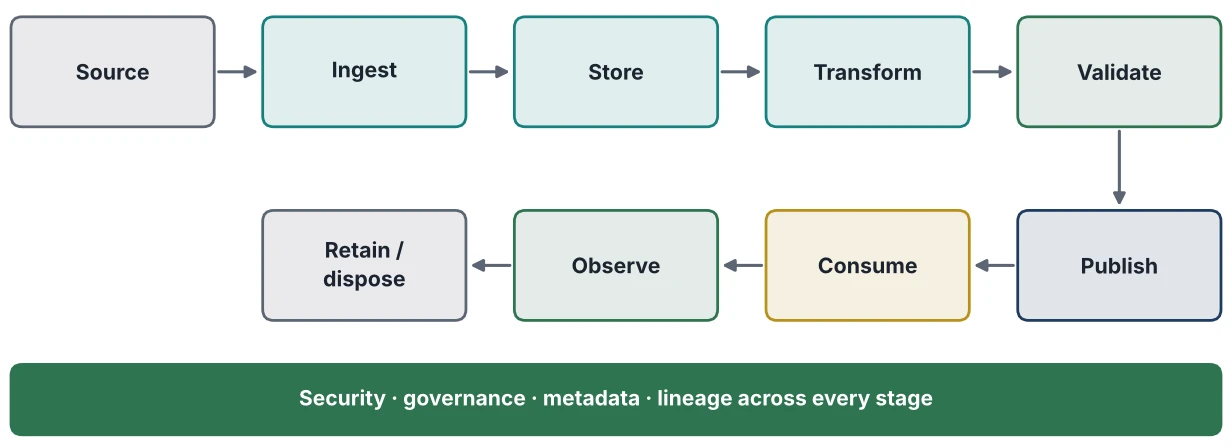
The lifecycle is not necessarily linear. Modern systems may continuously process information. Streaming data can move through the lifecycle repeatedly. Data products can be updated continuously. AI applications can consume information dynamically. The lifecycle should therefore be understood as a set of capabilities rather than a rigid sequence.
9.3 Data Ingestion Architecture
Ingestion is the process of bringing information from source systems into a data platform. Chapter 8 examined integration patterns such as APIs, batch processing, CDC, and events. Data engineering builds on those patterns by implementing reliable ingestion mechanisms. The architect must first understand the characteristics of the source. A source may be:
- A relational database
- A SaaS application
- A file repository
- An API
- An event stream
- An IoT platform
- An application log
- A document repository
Each source creates different engineering requirements. A database may support CDC. A SaaS application may expose APIs. A legacy system may only produce files. An event platform may provide continuous streams. The platform therefore needs multiple ingestion capabilities.
Ingestion Should Preserve Context
A common mistake is to think of ingestion simply as copying data. A mature ingestion process should preserve information about:
- Source
- Timestamp
- Ingestion time
- Schema
- Version
- Processing status
- Lineage
- Quality
This metadata becomes important later when users need to determine where a dataset originated and whether it is trustworthy.
9.4 Data Transformation Architecture
Raw information is rarely ready for direct enterprise consumption. Transformation converts source information into representations suitable for specific uses. Transformations may include:
- Standardization
- Cleansing
- Joining
- Enrichment
- Aggregation
- Deduplication
- Validation
- Derivation
For example, one source system may represent a country as US, another as USA, and another as United States. A transformation may standardize these values. However, not every transformation should be performed centrally. This is where the information architecture established in Chapter 5 becomes important. Some transformations are technical. For example:
- Converting timestamps
- Parsing files
- Changing data types
Others are business transformations. For example:
- Calculating customer profitability
- Defining revenue
- Determining risk categories
Business transformations require business ownership. If a central engineering team changes a business definition without domain involvement, the resulting data may be technically correct but semantically wrong.
9.5 ELT, ETL, and Modern Transformation
Traditional enterprise warehouses often used ETL, or Extract, Transform, Load. Data was transformed before being loaded into the target environment. Modern cloud data platforms frequently support ELT, or Extract, Load, Transform. In this model, data is loaded into scalable storage or analytical infrastructure before substantial transformation occurs. The distinction reflects changes in computing architecture. Cloud platforms can provide scalable compute that allows transformations to occur closer to the data. Neither approach is universally correct. The architect should consider:
- Source characteristics
- Target platform
- Transformation complexity
- Data volume
- Latency
- Security
- Governance
- Compute economics
The broader principle is more important than the terminology:
Transformation should occur where it creates the best combination of performance, governance, reuse, and cost.
9.6 Data Processing Architectures
Data processing can occur in several ways.
Batch Processing
Batch processing operates on accumulated data. It remains highly effective for:
- Historical transformations
- Reporting
- Large-scale data preparation
- Periodic regulatory processing
Stream Processing
Stream processing operates continuously or incrementally. It is useful for:
- Real-time monitoring
- Fraud detection
- Operational intelligence
- Event-driven applications
- Rapidly changing information
Interactive Processing
Interactive processing allows users or applications to query information dynamically. This is common in:
- Analytical environments
- Business intelligence
- Exploratory analysis
- Data science
AI-Oriented Processing
AI workloads introduce additional processing requirements. These may include:
- Document parsing
- Text processing
- Embedding generation
- Feature computation
- Model preparation
- Retrieval indexing
The modern data platform must increasingly support all of these processing patterns.
9.7 Data Orchestration and Workflow Architecture
As the number of pipelines grows, managing them individually becomes impractical. A modern data platform therefore requires orchestration. Orchestration coordinates:
- Dependencies
- Scheduling
- Execution
- Retries
- Error handling
- Notifications
- Data-quality checks
- Downstream publication
For example, Customer Ingestion must complete before Customer Standardization, which must complete before the Customer Data Product is refreshed, which must in turn complete before Customer Analytics runs. A workflow orchestrator can manage these dependencies. However, orchestration should not become an uncontrolled collection of technical dependencies. The architect should distinguish between technical dependency and business dependency.
For example, a pipeline may technically depend on another pipeline because one produces a file. But the deeper business relationship may be that one data product depends on another domain’s information. The latter should be visible in the architecture.
9.8 Data Pipelines as Production Systems
One of the major changes in modern data engineering is the recognition that data pipelines should be treated as production systems. A pipeline is not complete simply because it produces the expected output. It must also be:
- Testable
- Observable
- Recoverable
- Secure
- Maintainable
- Version-controlled
- Documented
Consider a pipeline that normally processes one million records per hour. If it suddenly processes only 100,000 records, the pipeline may technically succeed. But the business process may have failed. This illustrates an important distinction:
Technical pipeline success does not necessarily mean business data success.
Data engineering therefore needs business-aware quality and observability.
9.9 Data Quality Engineering
Data quality should be incorporated into engineering rather than performed only after data has arrived in an analytical environment. A mature data engineering process can validate information throughout the lifecycle. For example, ingestion may check:
- File structure
- Schema
- Required fields
Transformation may check:
- Referential integrity
- Valid values
- Duplicate records
Publication may check:
- Completeness
- Business rules
- Freshness
The specific controls depend on the data product and business requirement.
Quality Gates
A quality gate can prevent unreliable information from being published as trusted data. For example:
Ingestion → Validation → Transformation → Quality Gate → Publication
If the quality threshold is not met, the system can:
- Reject the data
- Quarantine it
- Alert the owner
- Publish with an appropriate quality status
This creates a more disciplined relationship between engineering and trust.
9.10 Metadata and Data Lineage in Engineering
Metadata is often treated as documentation. In modern data engineering, it is much more than documentation. Metadata can drive:
- Discovery
- Governance
- Security
- Orchestration
- Quality
- Lineage
- Lifecycle management
For example, a platform may know that a dataset is classified as restricted. That metadata can potentially influence:
- Who can access it
- Where it can be copied
- Whether it can be used for certain workloads
Similarly, lineage metadata can identify downstream consumers before an upstream schema changes. This makes metadata an operational capability.
9.11 Data Platform Architecture
As data engineering capabilities grow, organizations need a reusable platform. A data platform can provide common services to multiple engineering and business teams. A conceptual platform may include a flow of capabilities:
Data Sources → Ingestion → Storage → Processing → Data Quality → Data Products → Analytics and AI
with cross-cutting services for:
- Security
- Metadata
- Governance
- Observability
- Orchestration
- Cost management
The purpose of the platform is reuse. Without a platform, every team may need to build its own:
- Ingestion mechanism
- Monitoring
- Security integration
- Deployment process
- Metadata handling
This creates duplication. The platform provides common capabilities so teams can focus on business-specific data products and transformations.
9.12 Platform Engineering and the Internal Data Platform
Modern data platforms increasingly adopt principles from platform engineering. Instead of providing only infrastructure, platform teams create reusable internal capabilities for engineering teams. A platform may provide standardized mechanisms for:
- Creating pipelines
- Provisioning storage
- Deploying workloads
- Managing secrets
- Registering data products
- Monitoring pipelines
- Implementing quality checks
The platform becomes an internal product. This is an important organizational shift. The platform team is not simply operating infrastructure. It is providing capabilities to internal customers.
Platform as a Product
A successful internal data platform should therefore be evaluated according to questions such as:
- Is it easy to use?
- Does it reduce engineering effort?
- Does it provide reliable defaults?
- Does it enforce enterprise policies?
- Does it allow appropriate flexibility?
- Does it provide good developer experience?
This helps avoid a common problem in enterprise architecture: building technically sophisticated platforms that teams avoid using.
9.13 Infrastructure as Code and Automation
Cloud-native data platforms depend heavily on automation. Infrastructure as code allows infrastructure and configuration to be defined programmatically. This can support:
- Repeatable environments
- Version control
- Automated deployment
- Testing
- Rollback
- Standardized configuration
Automation can also be applied to data engineering. A pipeline can be automatically:
- Tested
- Deployed
- Monitored
- Validated
- Promoted across environments
This creates greater consistency than manually configured infrastructure. For the Enterprise Data Architect, the important architectural principle is:
If an enterprise capability must be repeated consistently at scale, it should be a candidate for automation.
9.14 Data Observability
As data environments become more distributed, traditional infrastructure monitoring is not enough. The platform may be operationally healthy while the data itself is incorrect. Data observability focuses on understanding the health of data and data pipelines. Important dimensions can include:
- Freshness
- Volume
- Distribution
- Schema
- Completeness
- Pipeline execution
- Downstream impact
For example, a customer data pipeline may successfully complete but produce 40 percent fewer records than expected. Infrastructure monitoring might report success. Data observability should identify the anomaly. This makes observability an essential part of trust engineering.
9.15 Scalability and Performance
Modern enterprise data platforms must handle growth. Growth can occur in:
- Data volume
- Number of users
- Number of pipelines
- Number of data products
- Number of AI workloads
- Processing frequency
Scaling is therefore more than increasing compute capacity. The architect should consider:
- Partitioning
- Parallel processing
- Workload isolation
- Caching
- Storage optimization
- Data locality
- Query optimization
- Concurrency
The architecture should also distinguish between predictable and unpredictable growth. A platform designed for today’s workload may fail when a new AI application suddenly generates large volumes of embedding, retrieval, or inference activity. Scalability should therefore consider future workload classes.
9.16 Reliability and Resilience
A data platform should be designed around the assumption that components will fail. Failures may occur because of:
- Source-system outages
- Network interruptions
- Malformed data
- Software defects
- Cloud-service failures
- Configuration changes
- Capacity limits
A resilient architecture should support:
- Retries
- Idempotent processing
- Checkpoints
- Replay
- Backup
- Recovery
- Failure isolation
Idempotency
Idempotency is particularly important in data engineering. If a pipeline processes the same input twice, the resulting data should not unintentionally create duplicate business records. This becomes especially important in distributed and event-driven environments.
Recovery
Recovery should also be designed at the data level. The architect should determine:
- How far processing can be rolled back
- Whether data can be replayed
- Where checkpoints exist
- How downstream consumers recover
9.17 Security in Data Engineering Platforms
Security should be integrated into the engineering platform rather than implemented separately by every team. A platform can provide common capabilities for:
- Identity
- Role management
- Secrets
- Encryption
- Network controls
- Data classification
- Access logging
This creates more consistent security. However, domain-specific security requirements still need to be considered. A platform should provide secure defaults while allowing appropriate domain controls.
Security by Default
A useful principle is:
The easiest path through the platform should also be a secure path.
If engineers must perform many manual security steps before deploying a pipeline, security becomes inconsistent. If secure configurations are built into reusable platform capabilities, the likelihood of consistent implementation increases.
9.18 Data Engineering Economics
Data engineering has an economic dimension that is sometimes overlooked. Every pipeline consumes resources. Every copy of data consumes storage. Every transformation consumes compute. Every cross-region movement can create network costs. Every additional platform creates operational overhead. Therefore, platform architecture should consider:
- Reuse
- Consolidation
- Workload optimization
- Data lifecycle
- Storage tiers
- Processing efficiency
The architect should also understand that engineering productivity has an economic dimension. A platform that reduces the time required to create and operate reliable pipelines can create significant enterprise value even if its infrastructure cost is not the lowest possible. The right objective is not simply minimizing technical expenditure. It is optimizing total value.
9.19 Data Engineering for AI
AI introduces additional responsibilities for data engineering. Traditional data pipelines often focus on producing tables. AI pipelines may need to produce several different representations of the same enterprise information. For example, a document may become:
- A raw document
- Extracted text
- Structured metadata
- Chunks
- Embeddings
- Searchable representations
- Access-control metadata
Similarly, structured business data may be transformed into:
- Analytical tables
- Features
- Semantic representations
- Retrieval-friendly views
This creates a broader concept of data engineering. The engineer is no longer preparing information for only one analytical representation. The engineer may be preparing information for multiple forms of machine consumption.
This reinforces the importance of the information architecture established earlier. The same business concept may require multiple physical representations while maintaining a common enterprise meaning.
9.20 Data Engineering and Data Products
Data products require engineering discipline. A data product is not simply a table placed in a catalog. It needs:
- An owner
- Defined consumers
- Documented semantics
- Quality expectations
- Reliable pipelines
- Interfaces
- Monitoring
- Lifecycle management
Data engineering provides much of the technical foundation. The domain provides business meaning. The platform provides reusable technical capabilities. Governance provides enterprise controls. This creates a useful division of responsibility.
| Capability | Primary Responsibility |
|---|---|
| Business meaning | Domain |
| Data ownership | Domain |
| Pipeline implementation | Data Engineering |
| Platform capabilities | Platform Engineering |
| Enterprise standards | Architecture |
| Policy | Governance |
| Consumption | Business and technical consumers |
The boundaries may vary by organization, but the principle is important. No single team should be expected to own every dimension of a data product.
Case study: Meridian Financial Group
9.21 Data Engineering and Platform Architecture at Meridian Financial Group
Meridian Financial Group had accumulated hundreds of data pipelines across business units. Some were centrally managed. Others were created by individual teams. Several different technologies were used for similar workloads. The engineering organization identified several recurring problems. Some pipelines had limited monitoring. Some transformations existed in multiple places. Some data products depended on undocumented processes. Some teams manually configured infrastructure. And when a pipeline failed, determining its downstream impact could be difficult. Meridian therefore established an enterprise data platform. The platform provided standardized capabilities for:
- Ingestion
- Transformation
- Orchestration
- Quality
- Metadata
- Monitoring
- Security
- Deployment
The objective was not to force every engineering team into exactly the same implementation. Instead, the platform established guardrails and reusable capabilities. For example, teams could select different processing technologies where justified, but all production workloads were required to provide:
- Ownership
- Metadata
- Lineage
- Monitoring
- Security classification
- Quality checks
- Deployment controls
The Platform Product Model
Meridian also changed how the platform team operated. The platform was treated as an internal product. Engineering teams were considered users. The platform team therefore measured:
- Developer adoption
- Time to create a new pipeline
- Deployment reliability
- Incident frequency
- Platform utilization
- Engineering satisfaction
This shifted the platform conversation from infrastructure provision to engineering enablement.
AI Extension
As Meridian expanded its AI initiatives, the platform was extended to support:
- Document processing
- Embedding generation
- Retrieval indexes
- AI data pipelines
- Model-data integration
The architecture maintained common governance and security controls across these new workloads.
The result was not a single centralized engineering organization. Instead, Meridian established a common platform with distributed engineering responsibilities. This allowed domains to retain ownership of their information while reducing the amount of infrastructure every team had to build independently.
Practical Artifact: Enterprise Data Engineering and Platform Assessment
A useful assessment should examine both engineering practices and platform capabilities.
Step 1: Inventory Data Pipelines
For major pipelines, document:
- Source
- Destination
- Owner
- Frequency
- Latency
- Technology
- Business criticality
- Dependencies
This establishes the engineering landscape.
Step 2: Assess Engineering Standards
Determine whether production pipelines consistently provide:
- Version control
- Testing
- Deployment automation
- Monitoring
- Logging
- Error handling
- Quality checks
- Documentation
Step 3: Assess Platform Capabilities
Evaluate whether the enterprise provides reusable capabilities for:
- Ingestion
- Storage
- Processing
- Orchestration
- Metadata
- Security
- Observability
- Quality
Identify capabilities being independently recreated by multiple teams.
Step 4: Assess Reliability
For critical pipelines, examine:
- Failure frequency
- Recovery time
- Retry mechanisms
- Replay
- Checkpointing
- Dependency management
The assessment should focus on business impact rather than simply technical availability.
Step 5: Assess Data Quality
Determine whether quality checks exist at appropriate stages. Look for:
- Schema validation
- Completeness
- Accuracy
- Freshness
- Duplicate detection
- Business-rule validation
Step 6: Assess Platform Developer Experience
Ask engineering teams:
- How long does it take to create a production pipeline?
- How difficult is deployment?
- How easy is monitoring?
- How easy is debugging?
- How much infrastructure must each team build themselves?
These questions reveal whether the platform is genuinely enabling engineering teams.
Step 7: Assess AI Readiness
Determine whether the platform can support:
- Document processing
- Embeddings
- Vector indexing
- Retrieval
- Feature pipelines
- AI-specific data products
- Governed model access
Data Engineering and Platform Assessment Matrix
| Dimension | Key Question |
|---|---|
| Engineering | Are pipelines engineered as production systems? |
| Automation | Can infrastructure and deployments be automated? |
| Quality | Are quality controls built into pipelines? |
| Orchestration | Are dependencies managed reliably? |
| Metadata | Is data context captured and maintained? |
| Observability | Can pipeline and data health be understood? |
| Security | Are secure controls built into the platform? |
| Resilience | Can failures be detected and recovered? |
| Scalability | Can workloads grow without architectural redesign? |
| Reuse | Are common capabilities provided as platform services? |
| Developer experience | Does the platform reduce engineering effort? |
| AI readiness | Can the platform support AI-specific data processing? |
Remember these
Key Takeaways
- Data engineering turns enterprise data architecture into operational reality.
- Data pipelines should be treated as production systems rather than simple scripts.
- Modern data engineering requires ingestion, transformation, orchestration, quality, metadata, observability, security, and resilience.
- Data platforms provide reusable capabilities that prevent every team from rebuilding the same technical foundation.
- Platform engineering should treat the internal data platform as a product for its engineering consumers.
- Automation and infrastructure as code improve consistency, repeatability, and operational control.
- Data observability extends traditional infrastructure monitoring by examining the health of data itself.
- Data quality should be engineered into pipelines rather than treated only as a downstream governance activity.
- Reliability requires explicit mechanisms for retries, replay, checkpointing, idempotency, and recovery.
- Platform architecture must balance standardization with appropriate engineering and domain autonomy.
- AI introduces new data engineering requirements, including document processing, embeddings, retrieval representations, and multiple forms of machine-consumable data.
- The modern data platform is increasingly becoming a shared foundation for analytics, data products, machine learning, and AI.
Think about your own organization
Architect’s Reflection
There is a tendency to think of architecture as something that exists above engineering. A diagram is created. Standards are documented. Technology decisions are approved. Then engineering teams are expected to make the architecture real. In modern enterprise data environments, that separation is increasingly artificial. Architecture must understand how systems will actually be built and operated. A beautifully designed platform that is difficult to use will not create adoption. A perfectly standardized pipeline framework that prevents teams from solving legitimate business problems will create workarounds. A highly scalable data platform without observability may simply produce failures at greater scale. A sophisticated AI data architecture without reliable engineering will not produce trustworthy AI. This is why the Enterprise Data Architect must work closely with data engineers and platform engineers. The architect should understand not only what the target architecture looks like but also what it takes to operate it every day. The most effective architecture therefore provides both direction and enablement. Direction establishes principles, standards, boundaries, and target capabilities. Enablement provides reusable platforms, automation, patterns, and guardrails that allow engineering teams to move quickly without repeatedly solving the same problems. This balance becomes especially important as enterprises adopt data products and AI. The organization cannot afford to centralize every engineering decision. Nor can it afford to let every team build an independent platform. The architectural objective is to create a shared foundation that makes the right behavior easier.
When the platform provides secure ingestion, automated deployment, quality controls, metadata, observability, and reusable infrastructure as standard capabilities, engineering teams can concentrate on the business problems that make their data valuable. This is the deeper role of platform architecture. It does not replace data engineering. It amplifies it. And when data engineering, platform engineering, information architecture, and enterprise governance operate together, the organization gains something more valuable than a collection of pipelines. It gains an enterprise capability for continuously turning raw information into trusted, reusable, and intelligent data assets.