Enterprise data architecture is not only about where information is stored. It is equally about how information moves. An enterprise may have well-designed databases, a modern cloud platform, a lakehouse, sophisticated analytical models, and strong governance, but those capabilities provide limited value if information cannot move reliably between the systems, domains, applications, and people that need it. Data integration provides that connective tissue.
Every modern enterprise contains multiple representations of information. A customer may exist in a CRM system, a billing system, a digital application, a data warehouse, a data lake, a customer master, and an AI knowledge environment. An account may exist in a core banking platform, a reporting system, a risk platform, and several downstream analytical applications.
The Enterprise Data Architect must therefore address a fundamental architectural problem:
How can enterprise information move between systems while preserving meaning, quality, security, timeliness, and business context?
Historically, organizations addressed this problem through batch files, database replication, enterprise service buses, and point-to-point interfaces. Modern enterprises now have a much broader set of integration capabilities, including APIs, event streaming, change data capture, managed cloud integration services, data pipelines, messaging platforms, and event-driven architectures.
The challenge is not a lack of integration technologies. The challenge is choosing the appropriate integration pattern for each business requirement and establishing enough architectural consistency that the enterprise does not become an interconnected collection of fragile interfaces. This chapter examines enterprise data integration as an architectural discipline and connects it to the broader principles established throughout this book.
8.1 The Evolution of Enterprise Data Integration
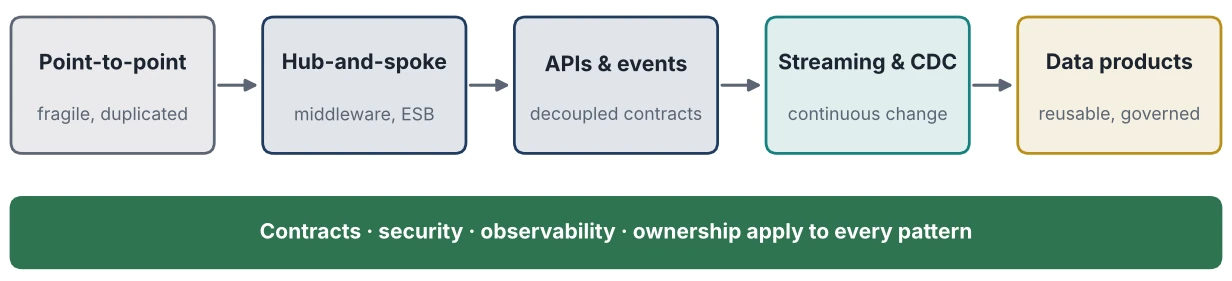
Early enterprise integration was often relatively simple. One application produced a file, and another application consumed it. A nightly batch process might extract information from an operational system and transfer it to a reporting environment. As enterprises grew, the number of applications increased. Each application introduced its own database, data model, interfaces, and integration requirements. The organization then began creating connections between systems. A customer system might send information to a billing system. The billing system might send information to a reporting system. The reporting system might send information to a regulatory platform. Another system might consume information from all three.
As the number of systems increased, integration complexity increased rapidly. This led to a common architectural pattern in which applications became connected through large numbers of point-to-point interfaces. At first, this approach appeared practical. If System A needed information from System B, the teams built an interface between them. But over time, the architecture became increasingly difficult to understand. A change in one system could affect many downstream systems. An interface might depend on a particular database structure. A file format might be interpreted differently by different consumers. A failure in one pipeline could remain undetected until a business report was produced.
The enterprise therefore began looking for more systematic approaches to integration. Enterprise application integration platforms, middleware, service-oriented architecture, APIs, message brokers, and enterprise service buses emerged as different responses to this problem. Cloud computing and modern data platforms introduced another generation of integration patterns. Organizations now combine:
- APIs
- Batch pipelines
- Streaming
- Event-driven integration
- Change data capture
- File transfer
- Database replication
- Managed integration services
- Application integration
- Data-sharing mechanisms
The modern Enterprise Data Architect must understand all of these patterns and, more importantly, understand when each one is appropriate.
8.2 Integration as an Architectural Capability
Data integration is sometimes treated as an implementation activity. A development team receives a requirement to move data from one system to another and builds a pipeline. That approach is sufficient for small environments. At enterprise scale, integration becomes an architectural capability. The architecture must define:
- How information moves
- Who owns interfaces
- How schemas are managed
- How failures are handled
- How data is secured
- How interfaces evolve
- How lineage is maintained
- How consumers discover available information
- How performance is managed
This means that integration architecture should be connected to the enterprise information architecture described in Chapter 5. If the enterprise has defined a common concept such as Customer, integration architecture must help preserve the meaning of Customer as information moves between systems. The integration layer should not silently transform the concept into different meanings in every interface. This leads to a critical principle:
Integration should move information without destroying its business meaning.
8.3 Point-to-Point Integration and Its Limitations
Point-to-point integration connects one system directly to another. Conceptually:
System A → System B
The pattern is simple, and for a small number of systems, it can be effective. However, the number of potential connections increases rapidly as systems are added. If ten systems each need to exchange information with several other systems, the number of interfaces can become difficult to manage. The problem is not simply the number of interfaces. Each interface may contain:
- Transformation logic
- Authentication
- Business rules
- Error handling
- Retry logic
- Monitoring
- Schema assumptions
- Operational dependencies
As these responsibilities become duplicated across interfaces, the architecture becomes increasingly difficult to govern.
The Integration Mesh Problem
A highly interconnected environment can eventually resemble a mesh of dependencies. A change in one application may require changes in many interfaces. A new consumer may require another interface. Different teams may implement similar transformations differently. The result can be an architecture that works operationally but is difficult to evolve. The solution is not necessarily to eliminate all direct integration. Instead, the architect should establish reusable integration patterns and determine where shared capabilities are appropriate.
8.4 Batch Data Integration
Batch integration remains one of the most important enterprise integration patterns. A batch process collects information over a period of time and processes it as a group. For example, a financial organization may transfer transaction information to an analytical platform every hour. Another process may load customer information every night. A regulatory reporting process may execute once per day or month. Batch integration has several important advantages. It can be efficient for large volumes of information because data can be processed together. It can also be operationally predictable: the organization knows when the process begins, what data it is expected to process, and when it should complete.
Batch processing is therefore appropriate for many workloads where real-time information is unnecessary. The architectural mistake is assuming that everything should become real-time simply because modern technologies make it possible. Real-time processing introduces additional complexity. If a business process can operate with information that is updated every hour, building a sub-second integration architecture may add complexity without meaningful business benefit. The architect should therefore begin with the business latency requirement.
8.5 APIs and Application Integration
Application programming interfaces, or APIs, provide standardized mechanisms through which applications expose and consume capabilities or information. APIs are particularly useful when one application needs to request information or invoke a business capability from another application. For example:
Customer Application → Customer API → Customer Service
An API can provide a controlled boundary between systems. Instead of allowing consumers to access another application’s database directly, the application exposes an interface that defines how information and capabilities are accessed. This creates an important architectural boundary. The consumer does not need to know how the provider stores its information internally.
APIs and Data Architecture
APIs should not be treated as simply another mechanism for moving data. A well-designed API represents a business capability or information contract. For example, an API might provide a Get Customer Profile operation rather than exposing every database table used to construct the customer profile. This distinction protects the internal implementation of the provider and allows the interface to evolve.
API Governance
Enterprise API architecture should address:
- Ownership
- Authentication
- Authorization
- Versioning
- Schema design
- Error handling
- Rate limits
- Monitoring
- Lifecycle management
Without governance, APIs can become another form of integration fragmentation.
8.6 Change Data Capture
Change Data Capture, commonly known as CDC, is an important pattern for modern data integration. Instead of repeatedly extracting an entire dataset, CDC identifies changes occurring in a source system. These changes may include:
- Inserts
- Updates
- Deletes
The changes can then be propagated to downstream platforms. For example:
Operational Database → CDC → Data Platform
This approach can significantly reduce unnecessary data movement. If a customer database contains 100 million records but only 50,000 records change during an hour, processing only the changes can be substantially more efficient than repeatedly extracting all 100 million records. CDC is particularly valuable in modern analytical architectures because it can help connect operational systems to cloud data platforms with lower latency. However, CDC introduces architectural considerations. The architect must understand:
- Transaction ordering
- Deletes
- Updates
- Schema changes
- Duplicate events
- Replay
- Source-system behavior
- Downstream consistency
CDC should therefore be treated as an architectural pattern rather than simply a replication mechanism.
8.7 Event-Driven Data Integration
Event-driven architecture changes the way systems communicate. Instead of one system directly requesting information from another, a system can publish an event describing something that happened. Examples include Customer Created, Payment Completed, and Account Closed. Other systems can subscribe to these events. The producing system does not necessarily need to know every consumer. This creates a degree of decoupling. For example, a Customer Created event published by the customer system may be consumed by:
- Analytics Platform
- Marketing Platform
- Risk Platform
- Notification Service
- Customer Data Product
This is fundamentally different from building separate integrations from the customer system to each consumer.
Events as Business Facts
A well-designed business event represents something meaningful that occurred. An event is not simply a database row. For example, an event named AccountUpdated may be technically accurate but semantically weak. A more meaningful event might be CustomerAddressChanged, because it describes a business-relevant occurrence.
The distinction matters because event-driven architectures become easier to understand when events represent business concepts rather than implementation details.
8.8 Event Streaming and Real-Time Data
Event streaming extends event-driven architecture by allowing events to be continuously published, retained, processed, and consumed. This creates new possibilities for enterprise data architecture. Information can move through the organization with significantly lower latency than traditional batch integration. For example, a transaction event can trigger:
- Fraud analysis
- Risk evaluation
- Customer notification
- Operational monitoring
- Analytical processing
This can create an architecture in which operational and analytical processes become more closely connected. However, streaming architecture introduces complexity. The architect must consider:
- Event ordering
- Duplication
- Delivery guarantees
- Consumer failures
- Replay
- Retention
- Schema evolution
- Observability
- Backpressure
- Operational recovery
Real-time does not mean instantaneous perfection. Distributed systems require explicit handling of failure and inconsistency.
8.9 Data Contracts and Schema Evolution
Integration depends heavily on shared expectations about data. If a producer sends a field called customer_id and a consumer interprets it as account_id, the integration may technically function while producing incorrect business results. This is why data contracts are important. A data contract defines expectations between producers and consumers. It may specify:
- Field definitions
- Data types
- Required fields
- Allowed values
- Semantic meaning
- Quality expectations
- Ownership
- Versioning
- Service-level expectations
Data contracts are particularly valuable in domain-oriented architectures and data products. They create explicit agreements between teams.
Schema Evolution
Enterprise systems change. Fields are added. Fields are renamed. Values change. Business definitions evolve. A modern integration architecture must therefore support controlled schema evolution. The architect should define policies for:
- Backward compatibility
- Versioning
- Deprecation
- Consumer notification
- Testing
- Migration
The objective is to allow systems to evolve without creating uncontrolled downstream disruption.
8.10 Data Integration in Cloud Environments
Cloud platforms provide many integration capabilities, but they also increase architectural choices. An enterprise may combine:
- API gateways
- Managed messaging
- Event streaming
- Serverless functions
- Data pipelines
- Workflow orchestration
- CDC
- Object storage
- Managed databases
- Integration platforms
This flexibility is powerful. It can also create architectural fragmentation. Different teams may select different integration mechanisms for similar problems. One team may use an event platform. Another may use scheduled files. Another may build a custom API. Another may implement database replication. All of these approaches may be individually reasonable. Collectively, they may produce a difficult operating environment. The Enterprise Data Architect therefore needs to establish integration principles and patterns, not necessarily mandate one technology.
8.11 Integration, Data Quality, and Trust
Integration can amplify both good and bad data. If a source system contains incorrect customer information and the enterprise integration architecture distributes that information to ten downstream systems, the error has effectively been multiplied. This is why integration architecture and data quality cannot be treated as separate disciplines. The architect should determine where quality controls occur. Some validation belongs at the source. Some belongs during ingestion. Some belongs during transformation. Some belongs at the point where a data product is published. For example, an integration pipeline may validate:
- Required fields
- Data types
- Valid codes
- Duplicate records
- Referential relationships
But technical validation is not enough. A record can be syntactically valid and still be semantically incorrect. A customer may have a valid date of birth field containing the wrong date. A transaction may have a valid currency code but be associated with the wrong account. This is why data quality must be connected to business ownership and information architecture.
8.12 Integration, Security, and Privacy
Data integration creates movement. Movement creates exposure. Every integration path therefore represents a potential security boundary. The architect should consider:
- Authentication
- Authorization
- Encryption
- Network controls
- Secrets management
- Data classification
- Privacy
- Audit logging
Sensitive data may also require transformation before being shared. For example, an integration may need to:
- Mask personal information
- Tokenize identifiers
- Remove unnecessary attributes
- Restrict access to selected fields
The principle of data minimization is particularly relevant. A consumer should receive the information it needs rather than automatically receiving everything available from the source. This reduces both security risk and unnecessary data duplication.
8.13 Integration and Enterprise Data Products
Data products provide another important perspective on integration. Traditional integration often focuses on moving data from one system to another. Data-product architecture focuses on making useful information available to consumers. The difference is subtle but important. Consider a Customer domain. A traditional integration architecture might create several pipelines:
- CRM → Warehouse
- Billing → Warehouse
- Core Banking → Warehouse
- CRM → Marketing
- Billing → Risk
A data-product architecture may instead establish a governed Customer Profile Data Product. The product can combine relevant information from multiple sources and expose it through governed interfaces. Consumers can then use the product without recreating the underlying integration logic. This creates a more reusable architecture.
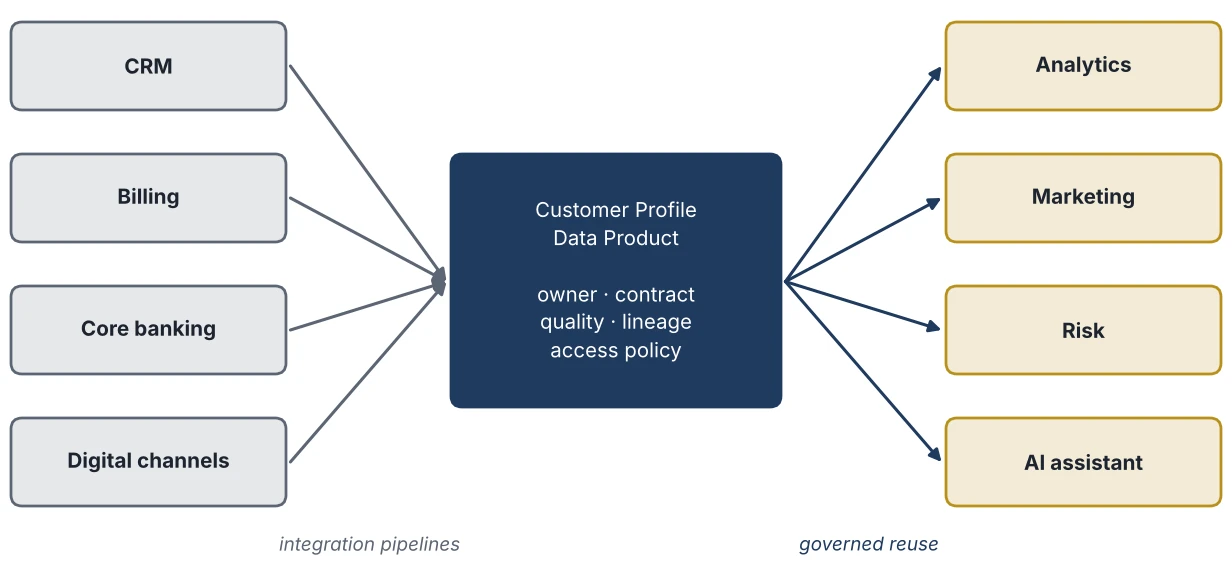
This does not eliminate pipelines. It changes their architectural purpose. Integration becomes part of the mechanism for producing reliable, reusable enterprise information.
8.14 Integration for AI and Generative AI
AI introduces new integration requirements. Traditional analytical integration primarily moves structured information. AI systems may need to combine:
- Structured data
- Documents
- APIs
- Events
- Metadata
- Business definitions
- Operational context
For example, an enterprise AI assistant answering a customer-service question may need:
- Customer profile information.
- Recent transactions.
- Product information.
- Relevant policies.
- Service history.
- Current account status.
This requires integration across multiple information domains. The architecture may include:
Enterprise Systems → Integration Layer → Retrieval and Context Services → AI Application
The integration architecture therefore becomes part of the AI architecture.
AI Requires Contextual Integration
AI systems often need information at inference time rather than only during scheduled analytical processing. This introduces new requirements for:
- Low-latency retrieval
- Semantic search
- APIs
- Event-driven updates
- Vector retrieval
- Knowledge graphs
- Metadata
These topics will be explored in later chapters. The important point here is that AI does not eliminate enterprise integration. It increases its importance.
Case study: Meridian Financial Group
8.15 Enterprise Integration at Meridian Financial Group
Meridian Financial Group’s integration environment evolved through multiple generations of technology. Its earlier architecture relied heavily on scheduled file transfers and point-to-point interfaces. As the company expanded, additional integration mechanisms were introduced. Some applications exposed APIs. Other systems used database replication. Newer platforms used event streaming. Cloud migration introduced managed integration services. The result was a highly capable but fragmented integration environment. The architecture team identified several problems. First, multiple systems maintained their own versions of customer information. Second, the same transformation logic was implemented in multiple pipelines. Third, interface ownership was sometimes unclear. Fourth, failures were not consistently visible across the enterprise. Fifth, AI initiatives were beginning to require access to information across multiple domains. Meridian responded by establishing an enterprise integration architecture based on several principles.
Principle One: Use the Simplest Appropriate Pattern
Batch was retained where business latency requirements were low. APIs were used for application and service interactions. CDC was used where operational database changes needed to be propagated efficiently. Events were used for meaningful business occurrences requiring asynchronous distribution. This prevented the organization from forcing every integration problem into one pattern.
Principle Two: Establish Enterprise Integration Standards
Meridian established common standards for:
- Authentication
- Schema management
- Error handling
- Monitoring
- Versioning
- Logging
- Ownership
The standards applied across technologies.
Principle Three: Treat Data Contracts as Architectural Assets
Critical domain interfaces received explicit data contracts. The contracts defined:
- Meaning
- Ownership
- Schema
- Quality expectations
- Versioning
Principle Four: Build Reusable Data Products
Rather than allowing every consumer to reconstruct customer or account information independently, Meridian established reusable domain data products.
Principle Five: Design for AI Consumption
Integration architecture was extended to support retrieval and contextual access for AI applications.
The transformation did not eliminate existing integration technologies. Instead, it established architectural rules governing when each pattern should be used. This distinction was important. Enterprise architecture became a mechanism for managing complexity rather than attempting to eliminate every form of technological diversity.
Practical Artifact: Enterprise Data Integration Architecture Assessment
A practical integration assessment should begin with business requirements and then examine the technical environment.
Step 1: Inventory Integration Flows
Identify the major ways information moves across the enterprise. Document:
- Source
- Destination
- Data domain
- Integration mechanism
- Frequency
- Volume
- Latency
- Owner
- Criticality
A simple inventory can reveal surprising levels of duplication.
Step 2: Classify Integration Patterns
Classify each integration as:
- Batch
- API
- CDC
- Event
- Streaming
- File
- Database replication
- Data sharing
- Other
The purpose is not to determine which pattern is universally best. The purpose is to understand why each pattern exists.
Step 3: Identify Business Latency Requirements
For every important integration, ask:
How quickly does the consumer actually need the information?
Possible categories include:
- Monthly
- Daily
- Hourly
- Near real-time
- Real-time
This prevents unnecessary real-time architecture.
Step 4: Assess Data Contracts
Determine whether critical integrations have explicit definitions for:
- Schema
- Semantics
- Ownership
- Quality
- Versioning
Where contracts are absent, identify the highest-risk interfaces.
Step 5: Assess Failure Management
Review how the architecture handles:
- Failed messages
- Unavailable systems
- Duplicate records
- Late events
- Malformed data
- Schema changes
- Retries
- Replay
A mature integration architecture assumes that failures will occur. The objective is not to prevent every failure. It is to make failures detectable, recoverable, and understandable.
Step 6: Assess Observability
The organization should be able to answer:
- Did the integration run?
- Did it complete?
- How much data moved?
- Were records rejected?
- Were downstream consumers affected?
- Where did the failure occur?
Observability is particularly important when data crosses many platforms.
Step 7: Assess Integration for AI
Determine whether AI applications can access the information they require through governed mechanisms. Assess:
- API access
- Document integration
- Event access
- Metadata access
- Retrieval
- Security controls
- Data freshness
Enterprise Integration Assessment Matrix
| Dimension | Key Question |
|---|---|
| Connectivity | Can required systems exchange information? |
| Pattern | Is the integration mechanism appropriate for the workload? |
| Semantics | Is the meaning of exchanged data clear? |
| Contract | Are producer and consumer expectations explicit? |
| Quality | Are data-quality controls present? |
| Security | Is information protected during movement? |
| Resilience | Can failures be detected and recovered? |
| Observability | Can integration behavior be monitored? |
| Ownership | Is responsibility clearly assigned? |
| Reuse | Can information be consumed without recreating integrations? |
| AI readiness | Can AI systems securely access required enterprise context? |
Remember these
Key Takeaways
- Integration is the connective tissue of enterprise data architecture.
- Modern enterprises require multiple integration patterns rather than a single integration technology.
- Point-to-point integration can create increasing dependency and maintenance complexity as the enterprise grows.
- Batch integration remains valuable when business latency requirements are low.
- APIs provide controlled interfaces for applications and business capabilities.
- Change Data Capture can efficiently propagate operational changes into analytical environments.
- Event-driven architecture enables systems to respond to meaningful business occurrences with reduced coupling.
- Data contracts help preserve semantic consistency as systems evolve.
- Integration architecture must address quality, security, observability, resilience, and ownership—not just data movement.
- Data products provide a way to turn integration pipelines into reusable enterprise information capabilities.
- AI increases the need for integrated access to structured, unstructured, semantic, and contextual information.
- The Enterprise Data Architect should establish principles for choosing integration patterns rather than forcing every problem into the same technical solution.
Think about your own organization
Architect’s Reflection
Integration is one of the areas where the complexity of the enterprise becomes most visible. Every application represents a local view of the business. Every database represents a particular implementation of information. Every interface creates a relationship between systems. As the enterprise grows, these relationships multiply. The architect’s challenge is not to make every system identical. That would be neither realistic nor desirable. The challenge is to create enough architectural coherence that systems can evolve independently while still participating in an enterprise information ecosystem. This requires a shift in perspective. Integration should not be viewed simply as moving data from Point A to Point B. The architect should ask:
- What information is being exchanged?
- What does it mean?
- Who owns it?
- Why does the consumer need it?
- How quickly is it needed?
- What quality is required?
- What happens if the exchange fails?
- How does the interface evolve?
- Can the same information be reused by other consumers?
These questions move integration from implementation into architecture. The rise of data products and AI makes this shift even more important. A data product requires reliable integration to assemble and publish information. An AI application requires reliable integration to retrieve enterprise context. A real-time decision requires reliable integration to bring current information into the decision process. A modern enterprise therefore cannot treat integration as background plumbing. Integration is part of the enterprise’s information architecture. The ultimate goal is not to create more connections. It is to create meaningful, governed, reusable connections between enterprise capabilities and enterprise information. That is what allows the enterprise data architecture to function as an integrated system rather than a collection of disconnected technologies.