Enterprise Data Architecture becomes tangible when an organization begins to define what its information actually means. The previous chapter established the principles that should guide enterprise data architecture. Those principles provide direction, but they must eventually be translated into models, domains, entities, relationships, information flows, and data structures. This is where Enterprise Information Architecture and Data Modeling become essential. An enterprise cannot effectively manage information if it does not understand the information itself:
- What is a customer?
- What is an account?
- What is a product?
- What constitutes a transaction?
- What is an order?
- What is a legal entity?
- What is a risk exposure?
- What is an employee?
These questions appear simple, but in large organizations they frequently produce different answers across business units and applications. One system may define a customer according to an active account relationship. Another may define a customer as any person who has interacted with the organization. A third may distinguish between individual customers and organizations. A fourth may maintain its own customer identifier. None of these definitions is necessarily wrong within its local context. The architectural problem arises when the enterprise needs to combine information across those contexts. This is the fundamental purpose of Enterprise Information Architecture:
To establish a coherent view of the information that the enterprise needs, the meaning of that information, the relationships among information concepts, and the way information is represented and used across the organization.
Data modeling provides the techniques through which that architecture can be expressed. In the modern enterprise, however, data modeling cannot be limited to relational database design. Enterprise information may exist in:
- Relational databases
- APIs
- Event streams
- Documents
- Object stores
- Analytical platforms
- Graph databases
- Knowledge graphs
- Data products
- AI retrieval systems
The architect therefore needs a broader perspective. The objective is not to create one enormous enterprise data model. The objective is to establish enough shared understanding and structure that information can remain coherent across business domains, applications, platforms, analytics, and AI.
5.1 From Data Architecture to Information Architecture
Data architecture and information architecture are closely related, but they are not identical. Data architecture focuses strongly on the structure, movement, management, storage, governance, and integration of data. Information architecture begins one level above the technology and asks:
What information does the enterprise have, what does it mean, how is it related, and how does it support the business?
This distinction is important. Consider the following concepts:
- Customer
- Account
- Product
- Transaction
- Employee
These are business concepts before they are database tables. A database may contain a table called CUSTOMER. But the table does not define the complete enterprise meaning of customer. The enterprise information architecture must establish the conceptual understanding first.
Information as a Business Representation
Information represents things that matter to the business. These may be:
- People
- Organizations
- Products
- Locations
- Assets
- Transactions
- Events
- Agreements
- Relationships
- Policies
- Documents
Information architecture establishes the relationships among these concepts. For example:
- Customer → owns → Account
- Customer → places → Order
- Order → contains → Product
- Transaction → affects → Account
- Employee → belongs to → Organization
These relationships are meaningful independently of whether the underlying implementation uses relational tables, APIs, events, documents, or graph structures.
The Importance of a Shared Information Language
Large enterprises often suffer from what can be called semantic fragmentation. Different teams use the same word to mean different things. Different words may be used to describe the same concept. Business terminology may differ from application terminology. Technical terminology may differ from business terminology. This creates friction in:
- Integration
- Reporting
- Analytics
- Governance
- Regulatory reporting
- Data products
- AI applications
Enterprise Information Architecture provides a mechanism for reducing that fragmentation. It does not require every team to use identical physical structures. It establishes a shared conceptual language where common understanding matters.
5.2 Business Domains and Information Domains
One of the most important decisions in enterprise information architecture is determining how information should be organized. A common approach is to organize information around business domains. A domain represents an area of business responsibility and knowledge. Examples in a financial services organization might include:
- Customer
- Account
- Product
- Payment
- Transaction
- Risk
- Finance
- Employee
- Compliance
- Marketing
The exact domains will differ by organization. The important point is that domains should reflect meaningful business responsibilities rather than simply mirroring application boundaries.
Why Application Boundaries Are Not Enough
Suppose an enterprise has five applications that each maintain customer information. A purely application-oriented architecture might treat these as five separate data domains. That can reinforce fragmentation. A business-oriented architecture instead asks:
What customer information does the enterprise need, and which parts of the organization are responsible for creating, maintaining, and consuming it?
This leads to a more durable architectural structure. Applications may change. Business domains tend to evolve more slowly.
Information Domains
An information domain can be thought of as a logical grouping of related enterprise information for which there is meaningful business ownership and architectural responsibility. A domain may contain:
- Core entities
- Attributes
- Relationships
- Events
- Reference data
- Documents
- Metrics
- Derived information
- Data products
For example, a Customer domain could include:
Core entities
- Individual
- Organization
- Customer Relationship
Supporting information
- Address
- Contact Method
- Customer Segment
Events
- Customer Created
- Customer Updated
- Customer Onboarded
- Customer Interaction
Data products
- Customer Master
- Customer Profile
- Customer Interaction History
This provides a much richer architectural view than simply identifying a customer database.
Domain Boundaries
Domain boundaries should answer practical questions:
- Who understands the information?
- Who creates it?
- Who is accountable for its quality?
- Who changes its definition?
- Who consumes it?
- What business processes depend on it?
The boundary should be clear enough to establish accountability but flexible enough to support collaboration.
Domain Ownership Does Not Mean Isolation
A domain should not become an information silo. A Customer domain may need to interact with:
- Account
- Product
- Payment
- Risk
- Marketing
- Compliance
The purpose of domain architecture is therefore not to eliminate relationships. It is to establish clear ownership while preserving interoperability.
5.3 Enterprise Entities and Business Concepts
Once information domains have been identified, the architect must determine the important business entities within those domains. An entity represents something about which the enterprise needs to maintain information. Examples include:
- Customer
- Account
- Product
- Order
- Payment
- Employee
- Supplier
- Contract
The challenge is that entities often have different representations in different systems.
Enterprise Entity versus System Entity
One system may have an entity called Customer. Another may have Client, another Party, and another may distinguish between Person and Organization. The architect must determine whether these represent:
- The same concept
- Related concepts
- Specialized concepts
- Fundamentally different concepts
This is a semantic question before it is a technical question.
The Importance of Identity
Entity identity is one of the most difficult challenges in enterprise information architecture. An enterprise may know the same real-world person through:
- A customer ID
- An account number
- An email address
- A loyalty number
- A policy number
- A digital identity
These identifiers may all represent different relationships with the same underlying entity. Enterprise architecture therefore needs to distinguish between the identity of the real-world entity and the identifiers used by individual systems.
This is one of the reasons Master Data Management becomes important in large enterprises.
Golden Records and Authoritative Attributes
Organizations often use the concept of a “golden record” to describe a trusted representation of an entity. However, architects should use this concept carefully. There may not be one system that is authoritative for every attribute. For example:
- Customer legal name may be mastered by one system.
- Contact preferences may be maintained by another.
- Risk classification may be owned by a risk system.
- Marketing segmentation may be derived analytically.
The enterprise therefore may need to establish attribute-level authority rather than assume that one system owns the entire entity.
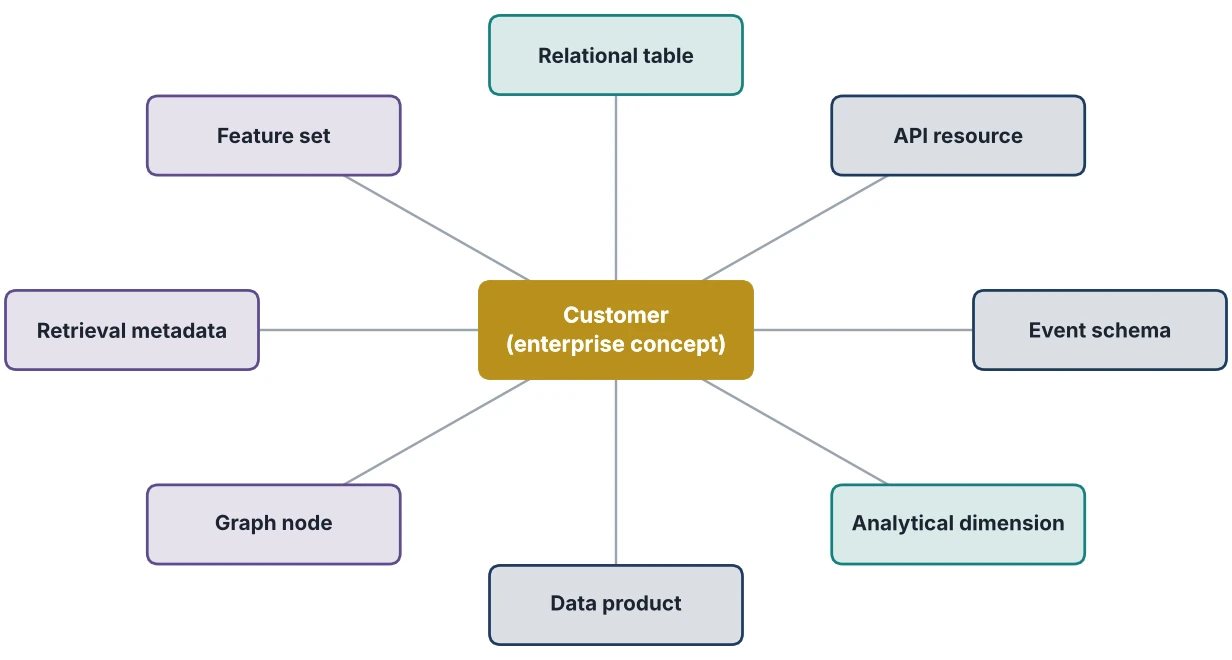
Business Concepts versus Physical Entities
A business concept can have multiple physical representations. For example, the business concept Customer may appear as:
- Relational tables
- API resources
- Event schemas
- Analytical dimensions
- Data-product structures
- Graph nodes
- AI retrieval metadata
The enterprise information architecture provides the conceptual anchor connecting these representations.
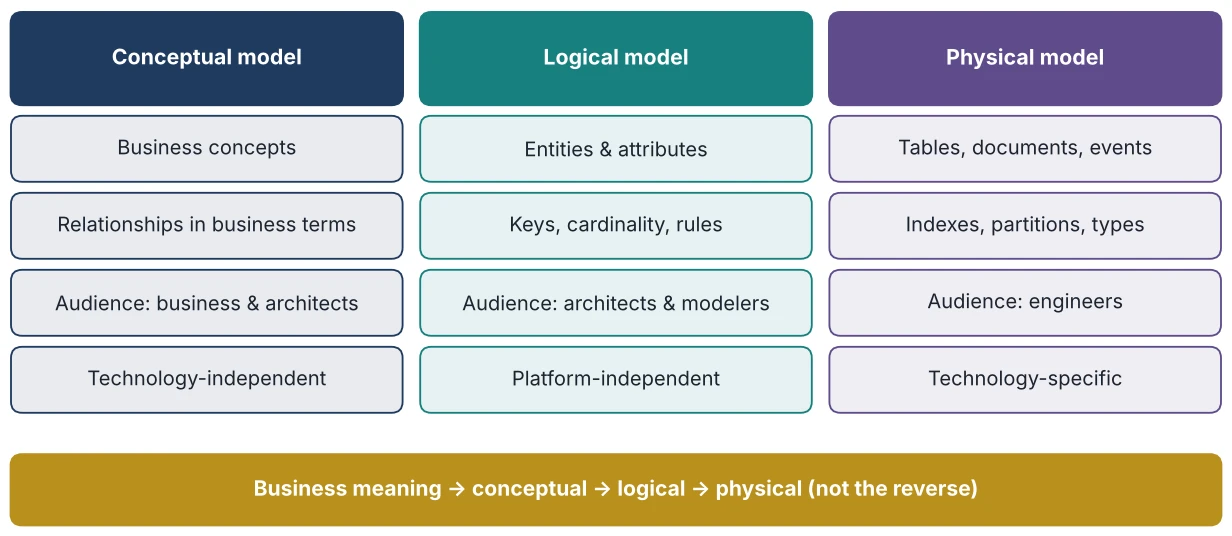
5.4 Conceptual, Logical, and Physical Data Models
Data modeling traditionally uses three complementary levels:
- Conceptual model
- Logical model
- Physical model
Each serves a different purpose.
Conceptual Data Model
The conceptual model describes the major business concepts and their relationships. For example: a Customer owns an Account, and an Account records Transactions.
The conceptual model is intentionally independent of technology. Its purpose is communication and shared understanding. It should be understandable to:
- Business leaders
- Subject-matter experts
- Architects
- Data professionals
Logical Data Model
The logical model adds greater detail. It may identify:
- Attributes
- Relationships
- Cardinality
- Keys
- Classifications
- Business rules
For example, the Customer entity might include:
- Customer ID
- Customer Type
- Customer Status
- Legal Name
- Preferred Name
- Effective Date
The logical model remains relatively independent of a specific database implementation.
Physical Data Model
The physical model represents how the information is implemented in a particular technology. It may define:
- Tables
- Columns
- Indexes
- Partitions
- Storage structures
- Data types
- Constraints
A physical model may differ across technologies while remaining aligned with the same logical model.
Why All Three Matter
The three levels provide different forms of architectural communication. The conceptual model answers:
What does the business care about?
The logical model answers:
How is that information logically organized?
The physical model answers:
How will this specific technology implement it?
Confusing these levels can create architectural problems. If physical structures become the primary representation of enterprise meaning, technology decisions begin to define business concepts. The preferred direction is:
Business meaning → Conceptual model → Logical model → Physical implementation
not:
Database structure → Inferred business meaning
5.5 Canonical Models and Shared Enterprise Concepts
Large enterprises frequently face another architectural question:
Should there be a canonical enterprise data model?
The answer requires nuance. A canonical model can provide significant value when the enterprise needs consistent representations for widely shared concepts. For example:
- Customer
- Product
- Account
- Location
- Legal Entity
- Currency
However, attempting to create one massive canonical model for every business concept can become difficult to maintain and disconnected from real business needs.
The Value of Canonical Concepts
Canonical models are most useful when they establish stable enterprise concepts for high-value shared information. For example, an enterprise may define Customer as a business concept with:
- Enterprise identity
- Customer type
- Lifecycle status
- Relationships
- Key attributes
Individual systems can then map their local representations to the enterprise concept. This creates a bridge between local autonomy and enterprise consistency.
Canonical Does Not Mean Identical
The goal is not necessarily to force every system to use the same physical structure. Instead, the enterprise can establish:
- Common meaning
- Common identifiers where appropriate
- Common definitions
- Mappings between local and enterprise representations
This approach allows local optimization while preserving enterprise interoperability.
When Canonical Models Become Counterproductive
A canonical model becomes problematic when:
- It attempts to represent every possible business concept
- It is controlled only by a central architecture team
- Changes require excessive governance
- Business domains cannot evolve independently
- Physical implementation is forced to match the canonical structure
A useful principle is:
Standardize shared meaning where it creates enterprise value; allow local implementation freedom where enterprise consistency is not required.
5.6 Reference Data, Master Data, and Transactional Data
Enterprise information architecture must also distinguish among different categories of enterprise information. Three important categories are:
- Master data
- Reference data
- Transactional data
Master Data
Master data represents important business entities that are shared across processes. Examples include:
- Customer
- Product
- Supplier
- Employee
- Legal Entity
Master data generally changes relatively slowly compared with transactional information, although this varies by domain.
Reference Data
Reference data provides controlled classifications and codes. Examples include:
- Country codes
- Currency codes
- Transaction types
- Customer classifications
- Risk categories
- Industry classifications
Reference data is often small in volume but high in semantic importance. A mismatch in reference values can make otherwise compatible datasets difficult to combine.
Transactional Data
Transactional data records business events and activities. Examples include:
- Payments
- Orders
- Purchases
- Transfers
- Claims
- Shipments
Transactions provide the history of what happened.
The Relationship Among Them
Consider a financial transaction. It may reference:
- Customer
- Account
- Product
- Currency
- Transaction Type
The transaction is therefore dependent on master and reference information. Together, master data, reference data, and transactional data provide the information necessary to understand business activity.
5.7 Data Modeling in the Modern Data Landscape
Traditional data modeling remains important, but modern data environments require a broader set of modeling approaches.
Relational Modeling
Relational modeling remains valuable for:
- Transactional systems
- Financial data
- Structured operational information
- Analytical workloads
Its strength lies in explicit structure and well-defined relationships.
Dimensional Modeling
Dimensional models remain useful for analytical consumption. They organize information around:
- Facts
- Dimensions
- Measures
For example, a Transaction fact may be analyzed by:
- Customer
- Product
- Date
- Location
- Channel
Data Vault and Historical Modeling
Some enterprises use specialized modeling approaches to manage historical integration and traceability across complex source environments. The architectural choice should be driven by the problem being solved rather than by methodology preference.
Event Modeling
Modern enterprises increasingly need to model events. Examples include:
- Customer Registered
- Payment Initiated
- Payment Completed
- Account Closed
Events are particularly important for streaming and event-driven architectures.
Document Modeling
Documents require different approaches to representation. A document may contain:
- Text
- Metadata
- Entities
- Relationships
- Versions
- Permissions
- Lifecycle information
For AI applications, additional metadata may be required to support:
- Retrieval
- Classification
- Chunking
- Source attribution
- Access control
Graph Modeling
Graph models are useful when relationships themselves are central to the business problem. Examples include:
- Customer relationships
- Ownership
- Organizational structures
- Supply chains
- Fraud networks
- Knowledge relationships
Graph structures become increasingly relevant as enterprises build knowledge graphs and semantic architectures.
AI-Oriented Representations
Modern AI introduces additional representations such as:
- Embeddings
- Vector representations
- Features
- Prompts
- Model inputs
- Evaluation datasets
- Retrieved context
These are not replacements for traditional enterprise models. They are additional representations built for particular computational purposes. The architect must therefore maintain a distinction between enterprise meaning and technology-specific representation.
5.8 Data Modeling for Analytics and AI
The emergence of AI adds a new dimension to enterprise data modeling. Traditional analytics often requires information to be structured for:
- Aggregation
- Filtering
- Historical analysis
- Statistical processing
AI applications may require information to be structured for:
- Retrieval
- Context
- Semantic similarity
- Reasoning
- Classification
- Generation
- Decision support
This does not mean that enterprises need to create completely separate information architectures for AI. Instead, AI creates new consumption patterns.
Contextual Modeling
An AI application may need to combine:
- Customer attributes
- Recent transactions
- Product information
- Policy documents
- Interaction history
- Business rules
These sources may have different structures. The architecture must therefore provide a mechanism for assembling them into meaningful context.
Metadata Becomes Increasingly Important
AI systems benefit from metadata that describes:
- What information represents
- Where it originated
- When it was created
- Who owns it
- How it can be used
- What restrictions apply
Metadata therefore becomes an important bridge between traditional data architecture and AI architecture.
Semantic Consistency Matters
Suppose an AI assistant is asked:
What products does this customer currently hold?
If one system defines an active product differently from another, the AI application may retrieve contradictory information. The model itself may not be the source of the problem. The underlying information architecture is. This is why AI readiness begins with enterprise information clarity.
5.9 From Enterprise Models to Data Products
Data modeling provides the foundation for data products. A data product should not simply expose a collection of tables. It should expose information with understandable business meaning. For example, a Customer Profile data product might provide:
- Enterprise customer identifier
- Customer type
- Status
- Contact information
- Segmentation
- Effective dates
- Quality indicators
- Lineage
- Ownership information
The model provides the structure. The data product provides the usable enterprise capability.
Data Contracts and Models
A data product should define an explicit contract with consumers. The contract may include:
- Schema
- Semantics
- Quality
- Availability
- Freshness
- Versioning
- Access rules
This reinforces an important architectural principle:
A data model should describe information; a data product should make that information reliably consumable.
Model Evolution
As data products evolve, their underlying models must also evolve. Changes should be managed carefully because consumers may include:
- Applications
- Analytical pipelines
- Dashboards
- Machine learning models
- AI agents
This makes data-model governance increasingly important.
Case study: Meridian Financial Group
5.10 Enterprise Information Architecture at Meridian Financial Group
Meridian Financial Group illustrates why enterprise information architecture is necessary. The organization has several customer-related applications resulting from years of growth and acquisitions. One application maintains customer information for retail banking. Another manages commercial customers. A third supports wealth management. A fourth manages digital customer interactions. Each system has its own customer identifier and representation. The result is a fragmented view of customer information. The architecture team begins by identifying the Customer as an enterprise information domain. It then identifies several important concepts:
- Person
- Organization
- Customer Relationship
- Account
- Product
- Interaction
The team distinguishes the conceptual model from the physical implementations. The enterprise concept of Customer does not require every application to use the same database structure. Instead, the architecture establishes:
- Common business definitions
- Enterprise identity relationships
- Ownership
- Mappings to local systems
- Authoritative attributes
- Data-product interfaces
Meridian then defines a Customer Profile data product that provides trusted information to authorized consumers. Analytics teams can use the product for segmentation. Digital applications can use it for customer context. Risk teams can use approved customer attributes. AI applications can retrieve authorized customer information together with relevant documents and interaction history. The architecture therefore creates a common information foundation without requiring every system to be replaced. This is a critical characteristic of effective Enterprise Data Architecture. The architecture creates coherence without requiring uniformity everywhere.
Practical Approach: Building an Enterprise Information Model
An enterprise information model should be developed incrementally. A useful approach consists of the following steps.
Step 1: Identify Strategic Business Capabilities
Start with the capabilities that matter most to the enterprise strategy. Examples might include:
- Customer management
- Product management
- Financial management
- Risk management
- Supply-chain management
Step 2: Identify Major Information Domains
Determine the information domains that enable those capabilities.
Step 3: Identify Core Business Concepts
Within each domain, identify the major entities and concepts.
Step 4: Establish Definitions
Define the concepts in business language. Avoid beginning with database structures.
Step 5: Establish Relationships
Determine how the concepts relate.
Step 6: Identify Ownership
Determine who is accountable for each important domain or information asset.
Step 7: Map Existing Systems
Identify how current applications represent the concepts.
Step 8: Identify Authoritative Sources
Determine which systems or processes are authoritative for important information and attributes.
Step 9: Identify Reusable Data Products
Determine which information should be exposed as reusable enterprise capabilities.
Step 10: Connect to Analytics and AI
Identify how the information will support:
- Reporting
- Analytics
- Machine learning
- Generative AI
- Intelligent applications
This approach avoids attempting to model the entire enterprise in one exercise. Instead, the model evolves around business priorities.
Remember these
Key Takeaways
Enterprise Information Architecture provides the conceptual foundation for Enterprise Data Architecture. Several principles are particularly important.
- Information architecture begins with business meaning. Enterprise concepts should be defined independently of individual applications and technologies.
- Business domains provide useful boundaries for organizing information. Domains establish responsibility while allowing interoperability across the enterprise.
- Entities must be distinguished from their application-specific representations. A business entity may exist in many systems without requiring those systems to use identical structures.
- Conceptual, logical, and physical models serve different purposes. The conceptual model establishes business understanding, the logical model establishes structure, and the physical model describes implementation.
- Canonical models should be used selectively. Shared concepts are valuable where enterprise consistency creates value, but excessive centralization can become a constraint.
- Master data, reference data, and transactional data must be understood together. They provide different but interconnected forms of enterprise information.
- Modern data modeling extends beyond relational structures. Events, documents, graphs, data products, and AI-oriented representations are increasingly important.
- Enterprise information architecture is a foundation for AI. AI applications depend on meaningful, governed, contextualized enterprise information.
Think about your own organization
Architect’s Reflection
Data modeling is sometimes treated as a technical discipline that belongs primarily to database specialists. That view is too narrow. At the enterprise level, data modeling is fundamentally an exercise in making the business understandable through information. When an architect defines Customer, Account, Product, Transaction, or Risk, the architect is not merely defining database entities. The architect is helping the organization establish a shared understanding of how the business works. That is why enterprise information architecture deserves executive attention. A database can be redesigned. An application can be replaced. A cloud platform can be migrated. But if the enterprise has fundamentally different understandings of its most important business concepts, technology modernization alone will not solve the problem. The modern Enterprise Data Architect therefore has to operate across three worlds:
- Business meaning: What does the organization mean by the information?
- Architectural structure: How should the information be organized and related?
- Technology representation: How should the information be implemented for a particular workload?
Keeping those three perspectives connected is one of the most important architectural disciplines in the modern enterprise. The objective is not to create the largest data model. It is to create the right level of shared understanding. That understanding becomes the foundation for integration, data products, analytics, governance, and ultimately enterprise intelligence.