Cloud computing has fundamentally changed how enterprises design, build, operate, and evolve their data architectures. The change is larger than moving databases and applications from company-owned data centers to cloud infrastructure. Cloud introduces new architectural capabilities: elastic computing, virtually unlimited storage, managed services, distributed processing, event-driven architectures, automation, infrastructure as code, and consumption-based economics.
At the same time, cloud introduces new architectural responsibilities. Data may be distributed across regions, accounts, subscriptions, providers, and services. Security boundaries become more dynamic. Costs become closely tied to architectural decisions. Platform teams must balance standardization with developer and domain autonomy. Enterprises must also determine which capabilities should be centralized, which should be distributed, and which should remain portable.
For the Enterprise Data Architect, cloud therefore represents both an implementation environment and an architectural paradigm. The central question is no longer:
Where should the enterprise store its data?
It becomes:
How should the enterprise design data capabilities so that information can be securely stored, processed, governed, shared, and used at enterprise scale in an increasingly cloud-based environment?
This chapter examines the architectural principles and patterns required to answer that question.
6.1 From Traditional Data Architecture to Cloud-Native Architecture
Traditional enterprise data architecture evolved around infrastructure that was relatively fixed. Organizations typically purchased database servers, storage systems, networking equipment, backup infrastructure, and specialized appliances. Capacity planning was performed months or years in advance. Database platforms were carefully selected because changing them could be expensive and disruptive.
Architectural decisions were consequently shaped by physical constraints. Storage capacity mattered because storage had to be purchased. Compute capacity mattered because processors had to be provisioned. Network bandwidth mattered because physical network infrastructure had finite capacity. Data centers mattered because applications and data had to be located within physical facilities. Cloud computing changes these assumptions.
Compute and storage can be provisioned programmatically. Infrastructure can scale dynamically. Managed services can replace portions of infrastructure operations. Data can be replicated across locations. Processing can be distributed across clusters and services. This does not eliminate architectural constraints. It changes them. The Enterprise Data Architect must now consider:
- Service selection
- Scalability
- Elasticity
- Distributed data
- Cloud security
- Identity and access
- Network architecture
- Data residency
- Resilience
- Observability
- Cost management
- Service dependencies
- Automation
- Portability
- Operational ownership
Cloud-native architecture therefore should not be confused with simply using cloud services. A system can run in the cloud and still behave like a traditional data-center architecture. A cloud-native architecture takes advantage of cloud characteristics while deliberately managing their consequences.
Cloud Migration versus Cloud-Native Architecture
These concepts are related but not equivalent.
| Concept | Primary objective |
|---|---|
| Cloud migration | Move existing workloads to cloud environments |
| Cloud modernization | Improve existing workloads using cloud capabilities |
| Cloud-native architecture | Design systems around cloud-native operating characteristics |
| Cloud data architecture | Organize enterprise data capabilities across cloud environments |
| Cloud-native data architecture | Design data capabilities to exploit cloud elasticity, automation, distribution, and managed services |
A database moved from an on-premises server to a virtual machine in the cloud may technically be a cloud workload. It is not necessarily a cloud-native data architecture. The distinction matters because migration without architectural redesign can simply reproduce existing limitations in a different infrastructure environment.
6.2 Cloud as an Enterprise Data Architecture Foundation
Cloud provides a broad set of capabilities that can become foundational components of an enterprise data architecture. At a high level, these capabilities can be grouped into several architectural layers.
6.2.1 Storage
Cloud storage provides highly scalable repositories for structured, semi-structured, and unstructured information. Examples include:
- Object storage
- Managed relational databases
- Distributed databases
- File systems
- Analytical storage
- Specialized data stores
Object storage has become particularly important in modern data architectures because it provides a durable foundation for large-scale data estates. However, the Enterprise Data Architect should avoid treating storage as architecture. A storage service is a capability. Architecture determines how that capability is used.
6.2.2 Compute
Cloud provides multiple computing models:
- Virtual machines
- Containers
- Serverless functions
- Managed distributed processing
- Specialized analytical compute
- GPU and accelerator infrastructure
The architectural decision is not simply which compute service to use. The more important question is:
What processing characteristics does the workload require?
For example, an ingestion workload may require event-driven processing, while a large analytical transformation may require distributed compute. An AI inference workload may have very different compute characteristics from a nightly financial reporting process.
6.2.3 Networking
Modern enterprise data architectures depend heavily on networking. Data platforms increasingly integrate:
- Applications
- APIs
- Event streams
- Databases
- Analytical platforms
- AI services
- External partners
- SaaS applications
Network architecture therefore becomes part of data architecture. Latency, bandwidth, isolation, routing, private connectivity, and cross-region traffic can directly affect data-platform performance, security, and cost.
6.2.4 Identity
Identity is one of the most important foundations of cloud data architecture. Traditional architectures often relied heavily on network boundaries. Cloud architectures increasingly rely on identity-based controls. The architect must therefore understand:
- Human identities
- Application identities
- Service identities
- Roles
- Policies
- Privileged access
- Workload identity
- Machine-to-machine authentication
A modern data architecture should make access decisions based on who or what is requesting access, what they are trying to access, and under what conditions.
6.2.5 Managed Services
Cloud providers offer managed capabilities for many data functions. These may include:
- Databases
- Data warehouses
- Streaming
- Integration
- Orchestration
- Cataloging
- Monitoring
- Machine learning
- AI services
Managed services can significantly reduce operational burden. However, they also create architectural dependencies. The architect must therefore evaluate both the capability and the dependency it creates.
6.3 Cloud Data Architecture Patterns
There is no single cloud data architecture suitable for every enterprise. Different organizations require different combinations of platforms, services, integration patterns, and governance models. Nevertheless, several recurring architectural patterns have emerged.
Pattern 1: Centralized Enterprise Data Platform
In this model, the enterprise establishes a central data platform that provides common capabilities for many business domains. The platform may provide:
- Ingestion
- Storage
- Transformation
- Analytics
- Metadata
- Governance
- Security
- Data quality
- Data sharing
Business teams consume the platform while a central platform organization operates the underlying capabilities. This model can provide strong consistency and control. Its primary architectural risk is excessive centralization. If every data request must pass through one central team, the platform can become a bottleneck.
Pattern 2: Federated Data Platform
A federated model distributes data capabilities across business domains while maintaining enterprise-wide standards and shared services. Domains may own:
- Domain data
- Domain pipelines
- Domain data products
- Domain quality rules
Central architecture teams may provide:
- Common security
- Identity
- Platform capabilities
- Governance frameworks
- Metadata standards
- Enterprise integration patterns
This approach aligns naturally with domain-oriented architecture and data-product principles discussed later in the book.
Pattern 3: Hub-and-Spoke Architecture
A hub-and-spoke model combines centralized and distributed characteristics. A central platform provides common infrastructure and governance while domain teams operate specialized capabilities. The model can be useful when an organization wants domain autonomy without allowing every domain to create completely independent technology ecosystems.
Pattern 4: Event-Driven Data Architecture
In an event-driven architecture, business events become important mechanisms for moving information between systems. For example, a Customer Created event may trigger:
- Customer-profile processing
- Risk evaluation
- Marketing segmentation
- Notification
- Analytics
- Downstream synchronization
This can reduce point-to-point integration and improve responsiveness. However, event-driven architectures introduce their own complexity:
- Event design
- Schema evolution
- Ordering
- Duplication
- Replay
- Failure handling
- Observability
- Eventual consistency
Events therefore need architectural governance just as APIs and data models do.
6.4 Storage, Compute, and Separation of Concerns
One of the most important architectural changes enabled by cloud platforms is the ability to separate storage from compute. Traditional data platforms frequently coupled the two. A database appliance might contain:
- Processors
- Memory
- Storage
- Database software
Scaling the platform could therefore require scaling the entire system. Cloud architectures can separate these concerns. Data can reside in durable storage while processing capacity is provisioned according to workload requirements. This creates several benefits.
Independent Scaling
Storage and compute can scale independently. A platform may retain large volumes of data while only provisioning significant compute resources when analytical workloads execute.
Workload Isolation
Different workloads can use different compute resources. For example:
- Reporting
- Data engineering
- Machine learning
- Exploratory analytics
- Operational processing
This reduces competition for shared resources.
Elasticity
Compute capacity can increase when demand rises and decrease when demand falls. This is particularly useful for variable workloads.
Economic Flexibility
Separating storage and compute allows organizations to optimize each independently. However, separation also introduces new considerations. Architects must understand:
- Data movement
- Compute startup time
- Caching
- Concurrency
- Workload isolation
- Network traffic
- Query performance
- Cost behavior
The architectural objective is not maximum separation. It is appropriate separation.
6.5 Data Platforms and Cloud Services
The modern enterprise data platform increasingly consists of multiple specialized services rather than one monolithic technology stack. A conceptual cloud data platform may contain the following capabilities:
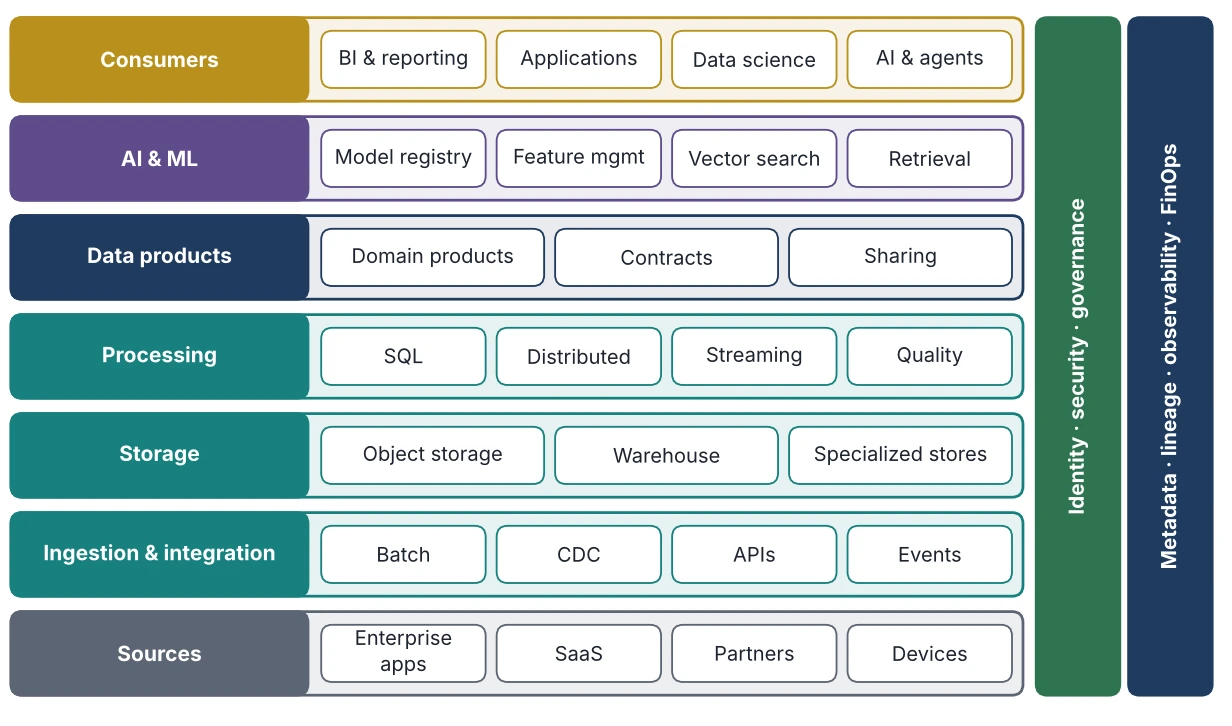
Source Systems
Sources may include:
- Enterprise applications
- SaaS platforms
- Operational databases
- Partner systems
- IoT devices
- Files
- APIs
- Event streams
Ingestion and Integration
The platform must provide mechanisms for:
- Batch ingestion
- Change data capture
- APIs
- Event streaming
- File transfer
- Application integration
Data Storage
Different storage patterns may coexist. For example:
- Object storage
- Relational stores
- Analytical warehouses
- Specialized databases
- Vector stores
- Graph databases
Data Processing
Processing capabilities transform and enrich data. These may include:
- SQL processing
- Distributed processing
- Streaming
- Orchestration
- Transformation
- Data quality processing
Data Products
The platform should enable the publication and consumption of trusted data products. This is where the technical platform connects to the information architecture discussed in Chapter 5.
Semantic and Metadata Services
Metadata becomes increasingly important as the number of data assets grows. Capabilities may include:
- Business glossary
- Catalog
- Lineage
- Technical metadata
- Data classification
- Semantic models
- Policy metadata
AI and Machine Learning
Cloud data platforms increasingly integrate with:
- Machine learning platforms
- Model registries
- Feature management
- Vector search
- Retrieval systems
- Generative AI services
- Agent frameworks
This creates an important architectural convergence. Data platforms are no longer designed only for reporting and analytics. They increasingly become foundations for enterprise intelligence.
6.6 Hybrid and Multi-Cloud Data Architecture
Most large enterprises do not operate in a perfectly homogeneous environment. They may have:
- Legacy data centers
- Private cloud
- One or more public clouds
- SaaS platforms
- Regional infrastructure
- Acquired systems
Hybrid architecture therefore remains an important reality.
Hybrid Cloud
Hybrid architecture connects on-premises and cloud environments. Common reasons include:
- Legacy applications
- Regulatory requirements
- Latency
- Migration sequencing
- Specialized infrastructure
- Contractual constraints
- Organizational strategy
The Enterprise Data Architect must avoid creating unnecessary dependencies between environments. A poorly designed hybrid architecture can result in:
- Excessive data movement
- High network costs
- Synchronization complexity
- Inconsistent security controls
- Operational fragmentation
Multi-Cloud
Multi-cloud architecture involves using services from multiple cloud providers. Organizations may pursue multi-cloud strategies for several reasons:
- Business requirements
- Acquisitions
- Geographic requirements
- Provider-specific capabilities
- Resilience
- Negotiation leverage
- Existing investments
But multi-cloud is not automatically more resilient or more flexible. It can also multiply:
- Platform complexity
- Skills requirements
- Security models
- Monitoring systems
- Governance processes
- Integration mechanisms
- Operating costs
The architect should therefore distinguish between intentional multi-cloud architecture and accidental multi-cloud complexity.
Architectural Principle
Use multiple environments when there is a clear business, regulatory, technical, or resilience rationale—not simply because multiple technologies are available.
6.7 Security, Governance, and Resilience in the Cloud
Cloud does not remove enterprise security and governance responsibilities. It changes where those responsibilities are implemented. A modern cloud data architecture should address security across multiple dimensions.
Identity and Access
Access should be governed through:
- Least privilege
- Role-based or attribute-based controls
- Workload identities
- Privileged-access management
- Strong authentication
- Policy enforcement
Data Protection
Data may require protection:
- At rest
- In transit
- During processing
- During sharing
- During backup and recovery
Sensitive information should also be classified so that security controls can be applied according to risk.
Network Security
Network architecture should consider:
- Segmentation
- Private connectivity
- Ingress and egress controls
- Service-to-service communication
- Network monitoring
Data Residency
Global enterprises may need to manage where data is:
- Stored
- Processed
- Replicated
- Backed up
- Accessed
Data residency requirements should therefore be incorporated into architecture decisions rather than treated as an operational afterthought.
Governance
Governance should extend across the cloud data lifecycle. This includes:
- Ownership
- Classification
- Retention
- Lineage
- Quality
- Access
- Policy
- Compliance
Resilience
Cloud provides many resilience capabilities, but resilience still requires architecture. The architect should consider:
- Availability zones
- Regions
- Backup
- Replication
- Disaster recovery
- Recovery time objectives
- Recovery point objectives
- Failure isolation
A cloud service being highly available does not automatically make the overall enterprise data architecture highly resilient. Resilience must be designed across dependencies.
6.8 Cost, Performance, and FinOps Considerations
One of the defining characteristics of cloud is that architecture and economics become closely connected. In a traditional data center, infrastructure costs may be largely capitalized and relatively fixed. In cloud environments, costs can become variable and usage-dependent. This changes the Enterprise Data Architect’s responsibilities. Architectural decisions can directly influence:
- Storage costs
- Compute costs
- Network costs
- Query costs
- Data transfer
- Backup
- Replication
- Managed-service consumption
Cost Is an Architectural Attribute
Performance, security, scalability, and cost should not be treated as completely independent concerns. Consider two designs.
Architecture A
- Stores large amounts of data
- Processes it frequently
- Replicates it across several environments
- Maintains multiple copies
Architecture B
- Stores similar information
- Processes only required subsets
- Minimizes unnecessary movement
- Uses workload-specific compute
The difference may have little effect on the logical information model but can have a substantial effect on operating economics. Therefore:
Cost behavior should be considered during architecture design, not after implementation.
FinOps and Data Architecture
FinOps practices help connect technology consumption to financial accountability. The Enterprise Data Architect should understand:
- Cost allocation
- Tagging
- Chargeback or showback
- Workload optimization
- Storage lifecycle policies
- Compute utilization
- Data duplication
- Network traffic
- Platform utilization
Architects do not necessarily own the enterprise cloud budget. They do, however, influence many of the decisions that create it.
6.9 Designing for Portability and Avoiding Cloud Lock-in
Cloud platforms provide powerful capabilities, but extensive dependence on provider-specific services can create switching costs. This is commonly described as cloud lock-in. Cloud lock-in is not inherently negative. Using a provider-specific service may be entirely appropriate when it delivers significant business value. The architectural question is:
Is the dependency intentional and economically justified?
Portability can be considered at multiple levels.
Data Portability
Can data be exported in usable formats?
Application Portability
Can applications be moved without major redesign?
Processing Portability
Can transformations and workloads run on alternative platforms?
Metadata Portability
Can:
- Definitions
- Lineage
- Classifications
- Ownership
- Policies
be transferred between environments?
Identity Portability
Can security models be maintained when workloads move?
Skill Portability
Does the architecture depend on a small set of highly specialized technologies?
A mature cloud architecture distinguishes between capabilities that should be standardized and capabilities where strategic differentiation is worth provider-specific dependency.
Avoiding the Wrong Kind of Abstraction
Architects sometimes attempt to eliminate lock-in by creating an abstraction layer over every cloud capability. This can create another problem. The abstraction may:
- Reduce access to valuable native capabilities
- Increase engineering complexity
- Create an internal platform that is difficult to maintain
- Slow innovation
The objective should therefore not be zero lock-in. It should be managed dependency.
Case study: Meridian Financial Group
6.10 Cloud-Native Data Architecture at Meridian Financial Group
Meridian Financial Group provides a useful example of the architectural transition. The fictional enterprise operates across multiple regions and has accumulated data infrastructure through decades of growth and acquisitions. Its environment includes:
- Legacy relational databases
- Enterprise applications
- Regional data warehouses
- SaaS applications
- File-based integration
- On-premises infrastructure
- Cloud platforms
- Analytical workloads
- Emerging AI initiatives
The organization initially approached cloud migration as a technology modernization program. Individual applications and databases were migrated to cloud infrastructure. However, several problems emerged.
Problem 1: Data Duplication
Different business units created independent copies of customer, account, and transaction data.
Problem 2: Increasing Integration Complexity
Cloud migration introduced additional environments rather than eliminating existing ones.
Problem 3: Cost Visibility
Business teams could not easily determine which workloads were responsible for increasing cloud consumption.
Problem 4: Governance Fragmentation
Security and data policies varied between platforms.
Problem 5: AI Readiness
Meridian’s AI teams required access to trusted enterprise data, but data remained fragmented across multiple environments. The Enterprise Data Architecture team responded by establishing several architectural principles.
Principle 1: Separate Information Architecture from Platform Location
Meridian defined enterprise information domains independently from where the data was physically stored. For example, the Customer domain could span:
- Legacy databases
- Operational applications
- Cloud storage
- Analytical platforms
This preserved enterprise meaning while allowing technology platforms to evolve.
Principle 2: Establish Shared Cloud Data Capabilities
Meridian created common services for:
- Identity
- Ingestion
- Metadata
- Security
- Observability
- Data quality
- Data product publication
Principle 3: Support Domain Ownership
Business domains increasingly became responsible for the quality and meaning of their data products.
Principle 4: Introduce Cost Accountability
Cloud workloads were associated with business ownership and cost centers. Architects and platform teams could therefore identify expensive workloads and evaluate whether the architectural value justified the consumption.
Principle 5: Design for AI Consumption
The platform architecture was extended to support:
- Analytical workloads
- Machine learning
- Retrieval systems
- Semantic services
- Generative AI
This shifted the cloud platform from being primarily an infrastructure modernization program to becoming an enterprise information and intelligence platform.
The lesson from Meridian is important. Cloud transformation did not succeed simply because workloads moved to cloud infrastructure. It became strategically valuable when the enterprise redesigned the relationship among business domains, information, platforms, governance, and intelligence.
Practical Artifact: Cloud-Native Enterprise Data Architecture Assessment
A useful way for an Enterprise Data Architect to evaluate an organization’s cloud data architecture is to assess it across several dimensions.
Step 1: Establish the Current-State Landscape
Document:
- Major data platforms
- Applications
- Databases
- Data stores
- Integration mechanisms
- Cloud environments
- On-premises environments
- Analytical platforms
- AI platforms
The objective is to establish architectural visibility.
Step 2: Assess Cloud Adoption
For each major workload, classify its current state.
| State | Description |
|---|---|
| Traditional | Primarily dependent on legacy infrastructure |
| Cloud-hosted | Workload moved to cloud infrastructure |
| Cloud-modernized | Workload uses selected cloud capabilities |
| Cloud-native | Architecture designed around cloud characteristics |
| Cloud-optimized | Architecture continuously optimized for performance, resilience, security, and cost |
This prevents the organization from equating cloud migration with cloud maturity.
Step 3: Evaluate Data Architecture
Assess:
- Storage
- Compute
- Ingestion
- Integration
- Processing
- Analytics
- Metadata
- Data products
- AI/ML capabilities
Identify duplicated or overlapping capabilities.
Step 4: Evaluate Governance
Assess whether the organization has consistent mechanisms for:
- Ownership
- Classification
- Security
- Privacy
- Lineage
- Quality
- Retention
- Access
Step 5: Evaluate Resilience
Review:
- Backup
- Replication
- Disaster recovery
- Regional resilience
- Failure isolation
- Recovery objectives
Step 6: Evaluate Economics
Analyze:
- Storage utilization
- Compute utilization
- Network costs
- Duplicated data
- Idle resources
- Expensive workloads
- Cost allocation
The objective is not simply to reduce cloud spending. The objective is to understand the relationship between architectural value and architectural cost.
Step 7: Evaluate AI Readiness
Determine whether the cloud data architecture can support:
- Machine learning
- Enterprise search
- RAG
- Vector retrieval
- Semantic services
- Generative AI
- Agentic applications
Questions should include:
- Is trusted data discoverable?
- Can data be accessed securely?
- Is metadata available?
- Can information be retrieved in context?
- Are sensitive data controls enforced?
- Can AI workloads operate at enterprise scale?
Cloud-Native Architecture Assessment Matrix
| Dimension | Key Question | Evidence |
|---|---|---|
| Platform | Are cloud capabilities used intentionally? | Platform architecture |
| Data | Is enterprise information organized coherently? | Information model |
| Integration | Can systems exchange information reliably? | Integration architecture |
| Security | Are access and protection controls consistent? | Security architecture |
| Governance | Is ownership and policy enforceable? | Governance model |
| Resilience | Can critical workloads recover from failure? | DR architecture |
| Cost | Can consumption be understood and optimized? | FinOps data |
| AI readiness | Can trusted information support AI workloads? | AI/data architecture |
| Portability | Are dependencies understood and intentional? | Technology decisions |
| Operating model | Can teams operate the architecture effectively? | Organization and processes |
This assessment should not become a maturity-score exercise for its own sake. Its purpose is to identify architectural decisions that require attention.
Remember these
Key Takeaways
- Cloud is an architectural paradigm, not merely an infrastructure destination.
- Cloud migration and cloud-native architecture are different concepts.
- Modern data architectures increasingly separate storage, compute, and workload execution.
- Cloud platforms enable centralized, federated, hub-and-spoke, and event-driven architectural patterns.
- Hybrid and multi-cloud architectures require deliberate governance and operating models.
- Identity, security, governance, resilience, and data residency must be designed into the architecture.
- Cloud economics are an architectural concern. Cost behavior should be considered during design.
- Cloud lock-in should be managed rather than automatically eliminated.
- The logical enterprise information architecture should remain coherent even when physical platforms change.
- Cloud data architecture increasingly serves analytics, machine learning, generative AI, and enterprise intelligence—not just traditional reporting.
Think about your own organization
Architect’s Reflection
Cloud changes the physical environment in which enterprise data architecture operates. But the deeper transformation is conceptual. The architect is no longer designing a relatively fixed collection of databases, warehouses, interfaces, and servers. The architect is designing a continuously evolving ecosystem of capabilities. Data may move between platforms. Compute may appear and disappear according to workload demand. New services may be introduced without replacing the entire platform. Business domains may publish and consume data products. AI systems may retrieve and reason over enterprise information. Security policies may be enforced through identity and automation rather than physical network boundaries. And every one of these capabilities has architectural, operational, and financial consequences. This makes the role of the Enterprise Data Architect more important, not less. The architect must understand the technology deeply enough to make sound platform decisions, but must also maintain the enterprise perspective established in earlier chapters. The goal is not to build the most sophisticated cloud platform. The goal is to create an enterprise data environment in which information can be trusted, governed, shared, analyzed, and intelligently used.
Cloud is the environment. Architecture is the discipline. Enterprise intelligence is the outcome.