Enterprise data architecture cannot be understood simply by looking at databases, data platforms, or integration technologies. The modern enterprise is a continuously changing data environment in which information is generated by business applications, digital channels, connected devices, external partners, employees, analytical processes, and increasingly, artificial intelligence systems.
The enterprise data landscape has therefore become broader, more distributed, more dynamic, and more interconnected than the environments that shaped traditional data architecture.
For the Enterprise Data Architect, this creates a fundamental challenge. The objective is no longer merely to determine where data should be stored. The architect must understand where data originates, how it moves, how it changes, who owns it, how it is consumed, how it is governed, and how it ultimately contributes to business decisions and intelligent applications.
The modern data landscape also introduces a degree of architectural ambiguity. Operational databases coexist with analytical platforms. Data lakes coexist with warehouses and lakehouses. Batch processing operates alongside event streams and real-time applications. Cloud platforms coexist with on-premises environments. Enterprise data products are emerging alongside traditional centralized data repositories. AI platforms increasingly depend on the same enterprise data that supports reporting, analytics, and operational decision-making.
The result is not one enterprise data platform but an interconnected enterprise data ecosystem. Understanding that ecosystem is one of the foundational responsibilities of the modern Enterprise Data Architect.
3.1 The Evolution of Enterprise Data Ecosystems
Enterprise data environments have evolved alongside enterprise technology and business models. In early enterprise computing environments, data was usually closely coupled to individual applications. An application owned its database, and access to that data was primarily determined by the requirements of the application itself. A finance system stored financial transactions. A customer management system stored customer information. A manufacturing system stored production information. A human resources system stored employee information. This model worked reasonably well when applications were relatively independent and the primary requirement was to automate individual business processes.
As organizations grew, however, the limitations became increasingly visible. The same customer might exist in multiple systems. Product definitions could differ between business units. Financial information might be represented differently in operational and reporting environments. Data could be copied from one system into another without clear ownership or lineage. Organizations responded by introducing enterprise data warehouses, master data management programs, enterprise integration platforms, metadata repositories, and other architectural capabilities intended to create greater consistency. The enterprise data warehouse became particularly important because it provided a centralized environment for analytical reporting and decision support.
Over time, however, enterprise data requirements expanded again. Organizations began collecting large volumes of web activity, application logs, machine-generated data, documents, images, social interactions, sensor information, and other forms of information that did not fit naturally into traditional relational models. This contributed to the emergence of data lakes and cloud-based data platforms. The architectural progression can therefore be viewed broadly as a movement through several patterns:
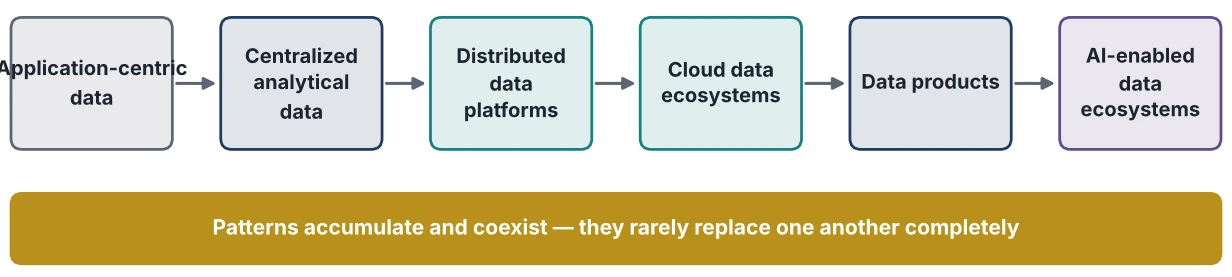
These patterns have not replaced one another completely. They coexist. That is an important architectural observation. The modern enterprise is not typically a clean progression from one architecture to another. Instead, it is a layered accumulation of technologies, platforms, applications, data stores, integration mechanisms, and architectural practices. A bank may still operate a decades-old transaction processing system while simultaneously using cloud-native applications, streaming platforms, lakehouse technologies, data products, machine learning services, and generative AI applications.
The Enterprise Data Architect therefore has to design for coexistence and evolution, not assume that older architectural patterns will simply disappear.
From Repositories to Ecosystems
One of the most important conceptual changes is the shift from thinking about data repositories to thinking about data ecosystems. A repository-oriented view asks:
Where is the data stored?
An ecosystem-oriented view asks:
How does information move through the enterprise, who creates it, who owns it, how is it transformed, how is it governed, and how does it create value?
This distinction is significant. A data warehouse may contain important enterprise information, but it is only one component of a broader ecosystem involving source applications, integration pipelines, transformation processes, metadata, governance, users, analytical models, downstream applications, and increasingly AI systems. The architect must therefore understand the relationships among these components.
The Rise of Distributed Data
Cloud computing accelerated the distribution of enterprise data. Instead of concentrating all data in a single enterprise-controlled environment, organizations increasingly distribute workloads across:
- Cloud databases
- Cloud data warehouses
- Data lakes
- Lakehouses
- SaaS applications
- Operational databases
- Streaming platforms
- Object storage
- Specialized analytical systems
- External data services
- Partner ecosystems
- AI and machine learning platforms
Distribution can create flexibility and scalability, but it also increases architectural complexity. More platforms mean more interfaces. More copies of data mean more synchronization challenges. More data consumers mean more governance requirements. More locations mean greater security and compliance complexity. The modern Enterprise Data Architect therefore has to balance distribution with coherence. The goal is not necessarily to centralize all data. The goal is to create an environment in which distributed data remains understandable, trusted, governed, accessible, and fit for purpose.
3.2 Structured, Semi-Structured, and Unstructured Data
One of the most fundamental characteristics of the modern enterprise data landscape is the diversity of data formats. Traditional enterprise architecture was heavily influenced by structured relational data. Modern enterprises operate across structured, semi-structured, and unstructured information. Understanding the differences is important because data structure affects storage, integration, processing, governance, search, analytics, and AI consumption.
Structured Data
Structured data has a defined schema and predictable organization. Examples include:
- Customer records
- Account records
- Invoices
- Financial transactions
- Product records
- Employee records
- Inventory balances
- Policy records
- Payment transactions
Relational databases remain highly effective for many structured-data workloads because they provide strong capabilities for transactions, integrity, indexing, querying, and consistency. For example, a banking transaction may contain attributes such as:
- Transaction identifier
- Account identifier
- Transaction date
- Transaction type
- Amount
- Currency
- Branch
- Channel
- Status
These attributes can be represented using well-defined relational structures. Structured data is generally easier to validate and integrate because its schema is explicit. However, structured does not automatically mean high quality. A perfectly structured customer table can still contain:
- Duplicate customers
- Incorrect addresses
- Outdated contact information
- Inconsistent classifications
- Missing values
- Incorrect business definitions
Structure and quality are different architectural concepts.
Semi-Structured Data
Semi-structured data contains organizational characteristics but does not necessarily conform to a rigid relational schema. Examples include:
- JSON
- XML
- Event messages
- Application logs
- API payloads
- Configuration files
- Telemetry records
- Document metadata
Modern applications generate large quantities of semi-structured information. For example, an online transaction event might contain common attributes such as transaction ID and customer ID but also include additional attributes that vary depending on the channel or transaction type. This flexibility is valuable for application development, but it creates challenges for enterprise data architecture. Questions arise such as:
- Which fields are mandatory?
- Which fields are optional?
- How are schema changes managed?
- Which version of an event contract is current?
- How are different representations mapped?
- Which attributes are authoritative?
- How are semantic definitions maintained?
Consequently, the architect must consider not only physical schemas but also data contracts and semantic consistency.
Unstructured Data
Unstructured data does not naturally fit into conventional tabular structures. Examples include:
- Documents
- Contracts
- Emails
- Presentations
- Images
- Audio
- Video
- Scanned records
- Engineering drawings
- Textual correspondence
Historically, unstructured information was often treated as a separate information-management problem. The growth of machine learning and generative AI has changed that perspective. Documents that were previously difficult to integrate into enterprise analytics can now become valuable sources for search, retrieval, classification, summarization, knowledge extraction, and AI-assisted decision support. This creates an important architectural shift. Unstructured data is no longer simply content that sits outside the enterprise data architecture. It can become an active component of the enterprise information environment.
The Convergence of Data Types
The boundaries among structured, semi-structured, and unstructured data are becoming increasingly fluid. Consider a customer interaction. It might begin as a structured customer record. A customer may then submit a semi-structured API request. The interaction may generate a text conversation. The customer may upload a document. An AI system may analyze the conversation and document. The resulting insights may be stored as structured attributes. The enterprise therefore has a continuous information flow across multiple data forms. This is why modern data architecture must address information relationships, not simply database schemas.
The architect needs to understand how different data types relate to one another and how they contribute to a common business context.
3.3 Operational Data versus Analytical Data
Another foundational distinction in enterprise data architecture is the difference between operational and analytical data. The distinction is not merely technical. It reflects different business purposes.
Operational Data
Operational data supports the execution of business processes. Examples include:
- Processing a payment
- Opening an account
- Placing an order
- Updating a customer address
- Managing an insurance policy
- Recording a shipment
- Authorizing a transaction
Operational systems typically prioritize characteristics such as:
- Transaction integrity
- Availability
- Predictable response time
- Concurrency
- Consistency
- Process reliability
The data is closely associated with the current state of the business.
Analytical Data
Analytical data supports activities such as:
- Reporting
- Trend analysis
- Forecasting
- Performance measurement
- Business intelligence
- Experimentation
- Machine learning
- Decision support
Analytical workloads generally have different requirements. They may involve:
- Large-scale scans
- Historical analysis
- Aggregation
- Complex joins
- Statistical processing
- Feature engineering
- Model development
The architecture that works well for an operational workload is therefore not necessarily optimal for analytical workloads.
The Distinction Is About Purpose
The Enterprise Data Architect should avoid treating operational and analytical data as simply two different database categories. The more important distinction is purpose. The same business entity can exist in both operational and analytical contexts. Consider a customer. The operational customer record might represent the current customer profile needed to execute business transactions. The analytical representation might contain historical customer attributes, behavioral information, interactions, segmentation, and derived measures. Neither representation is inherently the “real” customer. Each serves a different purpose. This leads to a useful architectural principle:
Data should be designed according to the business purpose it serves while maintaining clear relationships to authoritative sources and enterprise definitions.
Data Movement Between Operational and Analytical Environments
The relationship between operational and analytical environments creates one of the most important integration patterns in enterprise architecture. Information may move from operational systems into analytical platforms through:
- Batch extraction
- Change data capture
- Event streaming
- APIs
- Replication
- Application integration
- Managed data pipelines
The architect must consider several questions:
- How quickly must the information become available?
- How much historical information is required?
- What transformations are permitted?
- Which system remains authoritative?
- How are corrections propagated?
- How is lineage maintained?
- How are failures handled?
- How is sensitive information protected?
These questions become even more important when analytical data is subsequently used by AI systems.
From Analytical Data to Intelligent Data
Traditional analytics often consumed historical data to produce reports and dashboards. Modern AI applications may consume the same enterprise information to generate predictions, recommendations, classifications, summaries, or actions. This means that analytical architecture increasingly becomes part of the foundation for intelligent applications. The distinction between:
operational → analytical → AI
is therefore becoming less rigid. Instead, the enterprise is moving toward an interconnected information lifecycle.
3.4 Batch, Streaming, and Real-Time Processing
Time is another fundamental dimension of the enterprise data landscape. Not every business process requires information immediately. A monthly financial report may not require millisecond processing. A fraud-detection system may. A customer notification may require seconds. A regulatory reporting process may operate on a scheduled basis. The architect must therefore understand the different temporal requirements of enterprise data.
Batch Processing
Batch processing handles data in groups at scheduled or triggered intervals. Examples include:
- Nightly financial processing
- Daily reporting
- Monthly reconciliation
- Scheduled data transformations
- Periodic customer segmentation
- Regulatory reporting
Batch processing remains important because many enterprise processes do not require continuous processing. It can also be efficient for large-scale transformations where immediate results are unnecessary. The existence of real-time technologies does not make batch architecture obsolete.
Streaming Processing
Streaming architecture processes events continuously as they are generated. Examples include:
- Payment events
- Application events
- IoT telemetry
- Customer interactions
- Security events
- Market events
- System monitoring information
Streaming architectures can support use cases where the business needs to respond to events as they occur. For example, a financial institution may need to evaluate a transaction immediately rather than wait for a nightly batch process.
Real-Time Processing
The term “real time” is often used loosely. From an architectural perspective, it is more useful to define the required latency explicitly. A business requirement might specify:
- Milliseconds
- Seconds
- Minutes
- Near real time
- Hourly
- Daily
The architect should therefore avoid designing for “real time” merely because the technology makes it possible. Instead, the requirement should be based on business value. If a business decision does not benefit from millisecond information, implementing a highly complex low-latency architecture may introduce cost and operational complexity without meaningful benefit.
Event-Driven Enterprise Architecture
The growth of streaming technologies is closely associated with event-driven architecture. An event represents something that has happened. For example:
- Customer submitted application
- Payment completed
- Account balance changed
- Shipment dispatched
- Fraud score exceeded threshold
Events can become important enterprise information assets. They can be consumed by multiple systems without requiring every consumer to directly query the originating application. This creates opportunities for greater decoupling. However, event-driven architecture also introduces new challenges:
- Event ownership
- Schema evolution
- Ordering
- Duplication
- Replay
- Retention
- Security
- Observability
- Idempotency
- Event semantics
The Enterprise Data Architect must therefore treat events as architectural contracts rather than simply technical messages.
Choosing the Right Processing Model
A useful decision framework is to ask:
- What business event or process is being supported?
- What is the required latency?
- How much data must be processed?
- How frequently does the information change?
- What happens if processing is delayed?
- What consistency requirements exist?
- What is the cost of continuous processing?
- Can the business requirement be satisfied with batch processing?
This prevents technology preferences from driving architecture. The correct question is not:
Should we use streaming?
It is:
What temporal behavior does the business capability require?
3.5 Cloud, Hybrid, and Multi-Cloud Environments
Cloud computing has significantly changed the enterprise data landscape. Organizations can provision storage, compute, databases, analytical platforms, integration services, AI capabilities, and other infrastructure through cloud environments without owning all of the underlying physical infrastructure. This has enabled new architectural patterns but has also introduced new forms of complexity.
Cloud Environments
Cloud environments can provide:
- Elastic infrastructure
- Managed data services
- Global availability options
- Rapid provisioning
- Consumption-based economics
- Integrated security capabilities
- Access to advanced analytical and AI services
For the Enterprise Data Architect, however, cloud adoption is not simply a technology migration exercise. It changes architectural responsibilities. The architect must consider:
- Data residency
- Security
- Identity
- Network architecture
- Cost management
- Resilience
- Service dependencies
- Portability
- Operational ownership
- Vendor dependencies
Hybrid Environments
Many enterprises operate hybrid environments in which some workloads remain on premises while others operate in one or more cloud environments. This may occur because of:
- Legacy systems
- Regulatory constraints
- Latency requirements
- Existing investments
- Specialized infrastructure
- Migration sequencing
- Organizational considerations
Hybrid architecture should therefore be treated as a legitimate architectural state rather than automatically as an intermediate stage that must quickly disappear. For many large enterprises, hybrid environments may persist for years. The architectural challenge is to make the environment coherent. This requires consistent approaches to:
- Identity
- Security
- Integration
- Metadata
- Data movement
- Observability
- Governance
- Workload placement
Multi-Cloud Environments
Some organizations operate across multiple cloud providers. Multi-cloud may result from acquisitions, business-unit autonomy, specialized service requirements, geographic considerations, or strategic choices. However, multi-cloud should not automatically be interpreted as architectural freedom. Each additional environment can introduce:
- Additional skills requirements
- Different security models
- Different data services
- Different operational processes
- Different cost structures
- Additional integration complexity
The architect must therefore distinguish between intentional multi-cloud architecture and accidental technology fragmentation.
Data Gravity and Workload Placement
One of the important concepts in distributed cloud architecture is data gravity. Large and heavily used datasets tend to attract processing, applications, and other dependent workloads because moving large volumes of data can be expensive, slow, or operationally complex. This means that architectural decisions about where data resides can influence where applications and analytical workloads are deployed. The architect should therefore evaluate:
- Data volume
- Latency
- Network costs
- Regulatory requirements
- Application dependencies
- Processing requirements
- Resilience
- Portability
The goal is not to place every workload in the same environment. The goal is to create a rational relationship among data location, processing location, business requirements, and architectural constraints.
Cloud Does Not Eliminate Architecture
A common misconception is that managed cloud services reduce the need for enterprise architecture. In reality, they shift the nature of the responsibility. The architect may spend less time designing physical infrastructure and more time designing:
- Service boundaries
- Data flows
- Security boundaries
- Integration patterns
- Platform standards
- Governance
- Cost controls
- Workload placement
Cloud therefore changes the architect’s work rather than eliminating it.
3.6 The Emergence of Data Products
The concept of data products represents an important evolution in enterprise data architecture. Traditional enterprise data environments often treated data as something produced by systems and consumed by downstream teams. Data products introduce a stronger concept of ownership and usability. A data product is generally intended to provide a trusted, discoverable, understandable, and usable data capability for a defined consumer group or business purpose. The exact implementation can vary. A data product might be:
- A curated analytical dataset
- An API
- A governed data service
- An event stream
- A domain-oriented data model
- A reusable business metric
- A feature set for machine learning
- A trusted collection of documents and metadata for AI retrieval
The important concept is not the physical form. It is the combination of ownership, purpose, quality, documentation, accessibility, and governance.
From Data Assets to Data Products
A traditional data asset might simply exist. A data product is intentionally designed for consumption. This changes the questions the architect asks. Instead of:
Where is the customer data?
the architect asks:
What customer information is available as a trusted enterprise capability, who owns it, what does it mean, how current is it, who can consume it, and under what conditions?
This is a more business-oriented perspective.
Data Product Characteristics
A mature enterprise data product should generally have:
- A clearly defined purpose
- An accountable owner
- Defined consumers
- Documented semantics
- Quality expectations
- Metadata
- Lineage
- Access controls
- Service-level expectations
- Mechanisms for change management
These characteristics make the data product more predictable for consumers.
Data Products and Domains
Data products are closely related to business domains. For example, a financial institution might identify domains such as:
- Customer
- Account
- Product
- Transaction
- Risk
- Payment
- Employee
- Finance
A domain may produce multiple data products. The Customer domain, for example, could provide:
- Customer Master
- Customer Profile
- Customer Interaction History
- Customer Risk Attributes
- Customer Segmentation
The objective is not to create hundreds of disconnected datasets. The objective is to create meaningful, governed information capabilities aligned to business responsibilities.
Data Products and Data Mesh
The emergence of data products is often associated with data mesh thinking. However, the Enterprise Data Architect should avoid treating “data mesh” as a requirement to decentralize everything. The underlying architectural question is more fundamental:
Where should ownership and responsibility for data reside to create sustainable business value while preserving enterprise-wide governance?
In some organizations, strong domain ownership may be appropriate. In others, centralized platforms may remain important. In many enterprises, a hybrid approach will be necessary. The architect’s responsibility is to design the operating boundaries and interoperability mechanisms rather than adopt a fashionable organizational pattern without considering context.
Data Products and AI
Data products become particularly important as AI adoption increases. AI applications require reliable access to:
- Customer information
- Product information
- Policies
- Transactions
- Historical records
- Operational events
- Documents
- Business definitions
If these assets are fragmented and poorly understood, AI systems inherit the same problems. If they are treated as governed information products, they can become reusable foundations for intelligent applications. This is one of the reasons data product architecture is becoming increasingly relevant to Enterprise Data Architecture.
3.7 The Convergence of Data and AI Platforms
The most significant recent development in the enterprise data landscape is the growing convergence between data platforms and AI platforms. Historically, data architecture and AI architecture were often treated as separate disciplines. Data platforms supported:
- Reporting
- Business intelligence
- Analytics
- Data engineering
AI platforms supported:
- Model development
- Training
- Inference
- Machine learning operations
That separation is becoming less practical. Modern intelligent applications require both.
AI Depends on Enterprise Information
An AI system may require access to:
- Structured enterprise data
- Operational events
- Analytical datasets
- Documents
- Knowledge bases
- Metadata
- Business rules
- Policies
- Customer context
Therefore, AI architecture depends heavily on enterprise data architecture. An AI application that does not have reliable access to enterprise information will often be constrained regardless of the sophistication of its underlying model.
The Emergence of the AI Data Layer
Modern AI applications introduce new architectural components such as:
- Embedding pipelines
- Vector indexes
- Retrieval systems
- Model-serving infrastructure
- Prompt and context management
- Evaluation datasets
- Feature stores
- Model metadata
- AI observability
- Agent memory
- Knowledge graphs
These components increasingly interact with traditional enterprise data platforms. For example, a retrieval-augmented generation application may retrieve information from enterprise documents and structured databases, transform that information into context, provide it to a model, and then return an answer to an employee. The architecture therefore spans:
enterprise data → information retrieval → context → model → application → decision or action
This is not exclusively an AI architecture problem. It is an enterprise information architecture problem.
The Enterprise Data Platform Becomes an Intelligence Platform
As AI becomes embedded into enterprise processes, the data platform increasingly serves as a foundation for intelligence. The platform may provide:
- Trusted datasets
- Historical information
- Streaming events
- Semantic definitions
- Documents
- Metadata
- Features
- Knowledge
- Retrieval capabilities
The AI platform provides:
- Models
- Inference
- Orchestration
- Evaluation
- Agent capabilities
The boundary between these environments is increasingly interconnected. The architect should therefore think in terms of an enterprise data and intelligence ecosystem, rather than two isolated technology stacks.
Context Becomes an Architectural Asset
Generative AI has introduced an important architectural concept: context. An AI model may be powerful, but it does not automatically understand an organization’s:
- Products
- Policies
- Customers
- Processes
- Terminology
- Regulatory requirements
- Internal knowledge
Enterprise context must be supplied. That context can come from:
- Structured data
- Documents
- Metadata
- Knowledge graphs
- Business glossaries
- APIs
- Search systems
- Databases
- Event streams
This creates a direct connection between data architecture and AI quality. The Enterprise Data Architect therefore increasingly has responsibility for ensuring that enterprise information can be transformed into trusted, governed, machine-consumable context.
Data Quality Becomes AI Quality
The convergence of data and AI also changes the consequences of poor data quality. A data-quality problem in a traditional report might result in an incorrect number on a dashboard. The same underlying problem in an AI application could influence:
- Generated responses
- Recommendations
- Classifications
- Automated decisions
- Workflow actions
This does not mean that AI eliminates traditional data-quality concerns. It makes them more consequential. The EDA-IQ perspective therefore becomes increasingly important. The enterprise requires not simply data that exists, but information that is:
- Trustworthy
- Understandable
- Governed
- Accessible
- Contextualized
- Fit for intelligent consumption
Practical Artifact: Enterprise Data Landscape Assessment
A modern Enterprise Data Architect needs a systematic way to understand the current enterprise data landscape before designing its future state. The purpose of an Enterprise Data Landscape Assessment is not to create a catalog of every technology in the organization. Its purpose is to create an architectural view of how enterprise information is created, stored, transformed, governed, consumed, and connected to business capabilities. A useful assessment should answer seven questions:
- Where does enterprise data originate?
- What forms of data exist?
- Which systems are operational and which are analytical?
- How does data move?
- Where does data reside?
- Who owns and governs it?
- How is the data used for analytics and AI?
Step 1: Identify Major Data Sources
Begin by identifying the major sources of enterprise information. Typical categories include:
| Source Category | Examples | Primary Role |
|---|---|---|
| Operational applications | ERP, CRM, core banking, policy systems | Execute business processes |
| Digital channels | Web, mobile, portals | Capture customer interactions |
| External sources | Market, partner, regulatory data | Enrich enterprise information |
| Events | Transactions, application events, telemetry | Capture changes and activity |
| Documents | Contracts, policies, reports | Provide unstructured knowledge |
| Devices | Sensors, machines, IoT | Generate telemetry |
| AI systems | Prompts, outputs, feedback, evaluations | Generate and consume intelligent information |
The objective is to identify the information-producing landscape rather than simply list applications.
Step 2: Classify Data by Structure
For each major source, classify the information as:
- Structured
- Semi-structured
- Unstructured
- A combination
This immediately identifies architectural requirements that may otherwise be overlooked. For example, a customer domain may contain:
- Structured customer master data
- Semi-structured customer interaction events
- Unstructured correspondence
- Images and documents
A single domain can therefore require multiple data-management patterns.
Step 3: Map Operational and Analytical Environments
Identify where operational data is stored and where analytical processing occurs. Document:
- Source systems
- Operational databases
- Integration platforms
- Data warehouses
- Data lakes
- Lakehouses
- Analytical marts
- AI data stores
The objective is to understand the major information flows.
Step 4: Assess Data Movement
Map the primary mechanisms through which data moves. Examples include:
- APIs
- Batch pipelines
- ETL/ELT
- Replication
- Change data capture
- Event streaming
- File transfer
- Application integration
For each important flow, capture:
- Source
- Destination
- Frequency
- Latency
- Transformation
- Ownership
- Security classification
This helps identify unnecessary duplication and fragile dependencies.
Step 5: Assess Cloud and Deployment Patterns
Document where major data workloads operate. For example:
| Environment | Data Workloads | Architectural Considerations |
|---|---|---|
| On premises | Legacy operational systems | Stability, modernization, integration |
| Private cloud | Sensitive workloads | Control, security, connectivity |
| Public cloud | Analytics and data platforms | Elasticity, managed services, cost |
| Multiple clouds | Specialized workloads | Interoperability, governance, portability |
| SaaS | Business applications | Data access, integration, ownership |
The objective is not to determine that one environment is universally preferable. It is to understand why workloads exist where they do and whether the placement remains appropriate.
Step 6: Identify Emerging Data Products
Determine which enterprise data assets are already being treated as reusable products. For each candidate data product, identify:
- Business domain
- Owner
- Consumers
- Data content
- Quality expectations
- Interface
- Metadata
- Lineage
- Access mechanism
- Service expectations
This provides an initial view of the organization’s data-product maturity.
Step 7: Assess AI Data Readiness
Finally, evaluate whether enterprise data can support intelligent applications. Consider:
| Assessment Area | Key Question |
|---|---|
| Data availability | Can required information be accessed? |
| Data quality | Is the information sufficiently reliable? |
| Metadata | Can consumers understand what the data means? |
| Lineage | Can the origin and transformation of information be traced? |
| Semantics | Are business concepts consistently defined? |
| Unstructured data | Can enterprise documents and content be discovered and retrieved? |
| Security | Can sensitive information be controlled appropriately? |
| Context | Can enterprise information be provided to AI systems effectively? |
| Observability | Can data and AI pipelines be monitored? |
This final step connects the traditional enterprise data landscape to the emerging intelligent enterprise.
Case study: Meridian Financial Group
Worked Example: Meridian Financial Group
Meridian Financial Group is a fictional global financial services organization used throughout this book to illustrate architectural concepts. Meridian has grown through multiple acquisitions and operates a mixture of legacy and modern technology environments. Its landscape includes:
- Legacy core banking platforms
- Regional customer management systems
- Cloud-based digital banking applications
- Enterprise data warehouses
- Cloud data platforms
- Streaming infrastructure
- External market data
- Regulatory data
- Large document repositories
- Analytical models
- Emerging generative AI applications
An initial landscape assessment reveals several architectural characteristics. First, customer information exists across multiple operational systems. Second, transaction data is available in both operational and analytical environments. Third, customer interactions generate both structured and unstructured information. Fourth, some business processes rely on batch processing while others require near-real-time event processing. Fifth, different business units have begun creating their own analytical datasets. Sixth, AI teams have started building applications that require access to enterprise documents and structured customer information. The assessment therefore reveals that Meridian does not have a single “data platform problem.” It has an enterprise data ecosystem problem. The architectural challenge is to establish a coherent relationship among:
business domains → operational systems → data platforms → data products → semantic context → analytics → AI applications
This observation becomes important in later chapters because the solution cannot be achieved by selecting a single new technology. It requires architectural alignment across the enterprise.
Remember these
Key Takeaways
- Enterprise data is an ecosystem rather than a collection of databases. Data architecture must consider sources, platforms, movement, consumers, governance, semantics, and business purpose.
- Structured, semi-structured, and unstructured information must be architected together. The growth of AI makes unstructured enterprise content increasingly important to enterprise information architecture.
- Operational and analytical data serve different purposes but remain interconnected. The architect must design the relationships between operational systems and analytical environments rather than treating them as isolated worlds.
- Batch, streaming, and real-time processing should be selected according to business requirements. Technology capability should not become a substitute for architectural reasoning.
- Cloud, hybrid, and multi-cloud environments require architectural coherence. Cloud adoption does not eliminate the need for architecture. It changes the nature of architectural decisions.
- Data products introduce a stronger orientation toward ownership, usability, and business value. Data becomes something intentionally designed for consumption rather than simply stored.
- Data and AI architectures are converging. Enterprise data increasingly provides the foundation for intelligent applications, while AI introduces new requirements for context, retrieval, semantics, evaluation, and governance.
The modern Enterprise Data Architect must therefore understand not only where enterprise data lives, but how it becomes trusted information, reusable data products, analytical insight, and ultimately enterprise intelligence.
Think about your own organization
Architect’s Reflection
When assessing a modern enterprise data landscape, the temptation is to begin with technology. Architects may immediately ask:
- Which cloud platform should we use?
- Should we build a lakehouse?
- Do we need streaming?
- Should we implement a data mesh?
- Which vector database should we select?
- Which AI platform should we adopt?
These are legitimate questions, but they are not the first questions. The first questions are architectural:
- What information does the enterprise need?
- Where does that information originate?
- Which business capabilities depend on it?
- Who owns it?
- How does it move?
- What does it mean?
- How quickly is it required?
- How trustworthy is it?
- How will it be consumed by people, applications, analytics, and AI?
Technology should provide the mechanisms for answering those questions, not replace the questions themselves. The modern data landscape is complex because the modern enterprise is complex. The role of the Enterprise Data Architect is not to eliminate that complexity through centralization or technology standardization alone. It is to make the complexity understandable, intentional, governed, and capable of supporting business value. That is the foundation upon which the intelligent enterprise must be built.