Enterprise Data Architecture provides the structural foundation through which an organization manages information as an enterprise asset.
The previous chapters examined the changing role of the Enterprise Data Architect, the structure of the modern enterprise, and the increasingly complex data landscape in which organizations operate. Those chapters establish an important premise: modern enterprise data architecture cannot be reduced to databases, data platforms, integration technologies, or individual architectural patterns.
Architecture requires a set of enduring decisions about how the enterprise will create, manage, share, protect, and use information. Those decisions are expressed through architecture principles. Principles provide direction when technology choices change, organizational structures evolve, and new business requirements emerge. They help architects distinguish between decisions that are foundational and decisions that are merely implementation choices. A good principle should help answer questions such as:
- What should the enterprise optimize for?
- What should be consistent across business units?
- What should remain flexible?
- Who is accountable for information?
- How should data be shared?
- What makes data trustworthy?
- How should security and privacy be incorporated?
- How should architecture evolve over time?
Principles are particularly important in modern data environments because technology changes faster than architectural governance can be rewritten. Cloud services evolve. Data platforms evolve. Integration technologies evolve. AI capabilities evolve. Yet the enterprise still needs consistent answers to fundamental questions about ownership, trust, security, interoperability, and business value. This chapter establishes the principles and practices that provide that continuity.
4.1 The Purpose of Enterprise Data Architecture
Enterprise Data Architecture exists to establish a coherent relationship between business strategy, information, technology, and organizational responsibility. Its purpose is not simply to document where data is stored. Its broader purpose is to ensure that enterprise information can support business operations, analytics, decision-making, regulatory obligations, digital experiences, and intelligent applications. A useful way to express the purpose is:
Enterprise Data Architecture defines how an organization structures, manages, governs, integrates, protects, and enables its information assets to support business outcomes.
This definition contains several important ideas.
Architecture Connects Business and Information
Business strategies depend on information. A customer strategy depends on customer information. A supply-chain strategy depends on supplier, inventory, order, and logistics information. A risk strategy depends on exposure, transaction, customer, market, and regulatory information. An AI strategy depends on many of the same information assets. Therefore, data architecture must begin with business needs rather than technology capabilities.
Architecture Establishes Coherence
Large enterprises rarely have the luxury of designing their information environment from scratch. They inherit:
- Legacy applications
- Acquired companies
- Departmental databases
- Cloud services
- Spreadsheets
- External data sources
- Analytical platforms
- Duplicated information
- Inconsistent definitions
Enterprise architecture provides a mechanism for making this complexity understandable. The objective is not necessarily to eliminate every difference. The objective is to establish sufficient coherence that the organization can operate and evolve without creating uncontrolled fragmentation.
Architecture Creates Decision Boundaries
Enterprise architecture also determines where consistency is required and where local flexibility is appropriate. For example, an organization may require a common definition of:
- Customer
- Legal entity
- Product
- Currency
- Country
- Financial account
At the same time, individual business units may be allowed to choose different analytical tools or implementation technologies. This distinction is essential. Enterprise architecture should not attempt to standardize everything. It should standardize what creates enterprise value or reduces material risk.
Architecture Is an Enabling Discipline
Architecture is sometimes perceived as a control function whose primary purpose is to prevent technology teams from making inconsistent decisions. That is only part of the role. Good architecture should enable teams to move faster within clearly understood boundaries. When standards, principles, reusable services, data contracts, security patterns, and reference architectures are available, project teams do not need to reinvent fundamental decisions repeatedly. Architecture therefore creates both control and acceleration.
4.2 Core Principles of Enterprise Data Architecture
Architecture principles are enduring statements that guide architectural decisions. They should be sufficiently broad to survive technology change but sufficiently specific to influence real decisions. The following principles form a foundation for modern Enterprise Data Architecture.
Principle 1: Data Is an Enterprise Asset
Enterprise data should be managed as an organizational asset rather than as the private property of individual applications or departments. This does not mean every team must have unrestricted access to every dataset. It means that information should be managed according to its enterprise value, business ownership, risk, and intended use. A customer record may be created by one application but consumed by many parts of the enterprise. Therefore, architectural responsibility should extend beyond the system in which the data happens to reside.
Principle 2: Business Meaning Precedes Technical Representation
The enterprise should define important business concepts independently of the technology used to store them. For example, the concept of “Customer” should not exist only as a table called CUSTOMER in one application. The enterprise needs to understand:
- What a customer means
- What qualifies an entity as a customer
- Which attributes describe the customer
- Which systems create or update those attributes
- Which business processes depend on them
This is the foundation of semantic consistency.
Principle 3: Data Ownership Must Be Explicit
Important enterprise information should have accountable ownership. Ownership does not necessarily mean that a business owner personally manages databases. It means that someone is accountable for decisions concerning:
- Meaning
- Quality
- Access
- Lifecycle
- Usage
- Policy
- Change
Without ownership, data problems tend to become everyone’s responsibility and therefore nobody’s responsibility.
Principle 4: Data Should Be Fit for Purpose
There is no universal definition of perfect data. Data quality should be evaluated against its intended business use. A dataset used for financial reporting may require extremely high accuracy and reconciliation. A dataset used for exploratory experimentation may tolerate greater uncertainty. The architectural objective is therefore not perfection for its own sake. It is fitness for purpose.
Principle 5: Data Should Be Discoverable and Understandable
Data that cannot be found or understood has limited enterprise value. Users and applications need sufficient metadata to answer questions such as:
- What is this data?
- Who owns it?
- Where did it originate?
- What does each field mean?
- How current is it?
- What are the quality expectations?
- Who can access it?
- How has it been transformed?
Discovery and understanding are therefore architectural capabilities, not documentation afterthoughts.
Principle 6: Security and Privacy Are Designed In
Security should not be added after the data architecture has been implemented. The architecture should establish appropriate controls for:
- Identity
- Authorization
- Encryption
- Sensitive data
- Data classification
- Access
- Retention
- Masking
- Monitoring
- Auditability
Privacy requirements should similarly influence architecture from the beginning.
Principle 7: Reuse Should Be Preferred over Unnecessary Duplication
When appropriate, trusted enterprise data capabilities should be reused rather than repeatedly recreated. However, reuse should not become an excuse for building an enormous centralized repository that satisfies nobody’s requirements. The principle is better expressed as:
Reuse trusted capabilities where doing so creates business value and reduces unnecessary duplication.
Principle 8: Interoperability Is a Design Requirement
Enterprise data must be capable of moving across organizational and technological boundaries. Interoperability includes:
- APIs
- Events
- Data contracts
- Common semantics
- Metadata
- Integration standards
- Exchange formats
A data product that cannot be understood or consumed outside the team that created it has limited enterprise value.
Principle 9: Architecture Must Support Change
Enterprise architecture should assume that change will occur. Business models change. Applications change. Cloud services change. Regulations change. Data products change. AI capabilities change. Therefore, architectures should avoid unnecessary coupling and should provide mechanisms for controlled evolution.
Principle 10: Trust Must Be Measurable
Trust should not be treated simply as a subjective perception. Where possible, organizations should establish measurable indicators such as:
- Completeness
- Accuracy
- Timeliness
- Consistency
- Validity
- Availability
- Lineage coverage
- Policy compliance
This creates a foundation for data observability and trust engineering.
Principle 11: Architecture Decisions Should Reflect Business Value
Architectural decisions have costs. A highly sophisticated architecture may provide little value if the business problem is simple. Conversely, under-engineering a critical data capability can create substantial operational and regulatory risk. The architect should therefore consider:
value + risk + cost + complexity + change
rather than optimizing a single technical dimension.
Principle 12: AI Is a Consumer and Producer of Enterprise Data
Modern Enterprise Data Architecture must recognize AI as part of the enterprise information ecosystem. AI systems consume:
- Structured data
- Documents
- Metadata
- Events
- Knowledge
- Business rules
They may also produce:
- Classifications
- Predictions
- Generated content
- Recommendations
- Decisions
- Embeddings
- Extracted knowledge
These outputs should be governed according to their business purpose and risk.
4.3 Architecture Principles versus Standards and Patterns
One of the most common sources of architectural confusion is the failure to distinguish principles, standards, patterns, and technologies. They operate at different levels.
Principles
Principles describe what the organization believes should generally be true. Example:
Enterprise data must have accountable ownership.
Standards
Standards specify how consistency will be achieved in a defined area. Example:
Enterprise APIs must use the organization’s approved authentication and authorization mechanisms.
Patterns
Patterns describe repeatable architectural approaches to common problems. Examples include:
- Event-driven integration
- Change data capture
- Hub-and-spoke integration
- Publish-subscribe
- Data product architecture
- API-based data access
Technologies
Technologies provide specific implementation mechanisms. Examples include:
- Cloud databases
- Streaming platforms
- Object storage
- Data warehouses
- Lakehouse platforms
- API gateways
- Orchestration tools
The relationship can be represented as:
Principle → Standard → Pattern → Technology
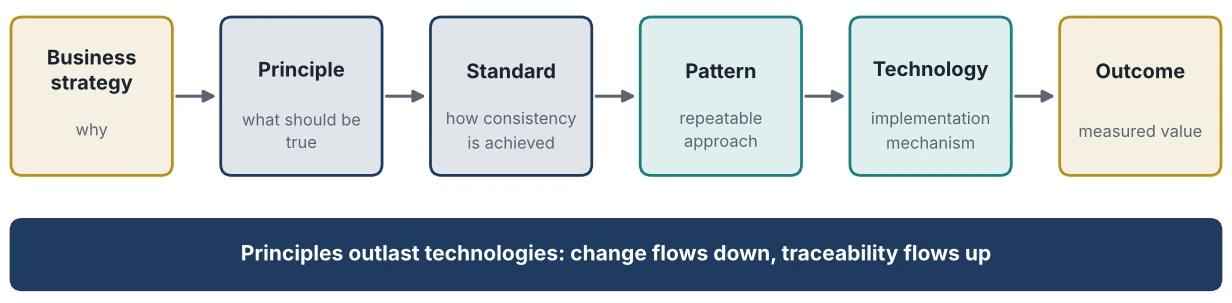
For example:
- Principle: Data should be interoperable.
- Standard: Enterprise data exchanges must use approved interface and contract standards.
- Pattern: Publish-subscribe event architecture.
- Technology: An approved event-streaming platform.
This hierarchy is important because technologies change faster than principles. An architecture principle should not become obsolete simply because an implementation technology changes.
Avoiding Technology-Driven Principles
Consider the statement:
“The enterprise should use Platform X for all analytical workloads.”
This is not really a principle. It is a technology decision. A more durable principle might be:
“Analytical platforms should provide scalable processing, governed access, appropriate security, and measurable cost transparency.”
A particular technology can then be selected based on those requirements. This distinction protects the architecture from becoming overly dependent on current technology trends.
4.4 Designing for Data Quality and Trust
Data quality is one of the most persistent challenges in enterprise architecture. Organizations often respond to data-quality problems through isolated cleansing projects. While cleansing can be useful, it does not address the underlying architectural causes. Data quality problems can originate from:
- Unclear definitions
- Poor source-system design
- Manual processes
- Inconsistent validation
- Duplicate data
- Integration failures
- Transformation errors
- Outdated reference data
- Uncontrolled schema changes
Therefore, data quality should be treated as an architectural property.
Dimensions of Data Quality
Common dimensions include:
- Accuracy: Does the data correctly represent the real-world entity or event?
- Completeness: Are required values present?
- Consistency: Does the information agree across relevant systems?
- Timeliness: Is the data available when it is required?
- Validity: Does the data conform to defined rules and constraints?
- Uniqueness: Are duplicate records appropriately controlled?
Different use cases may place different levels of importance on each dimension.
Quality at the Source
A critical principle is that data quality should be addressed as close to the source as practical. If a customer address is repeatedly entered incorrectly in an operational system, correcting it every night in the analytical environment treats the symptom rather than the cause. This does not mean every quality problem must be solved in the source system. Some transformations are legitimately analytical. But architects should distinguish between correcting source problems and transforming data for a specific purpose.
Data Quality and Trust
Trust is broader than quality. A user may trust a dataset because they know:
- Where it came from
- Who owns it
- How it is transformed
- How current it is
- What quality controls exist
- What limitations apply
This means metadata and lineage contribute directly to trust. A high-quality dataset that nobody understands may still be underused.
Trust as an Architectural Capability
Modern data platforms should increasingly provide mechanisms for:
- Quality monitoring
- Lineage
- Metadata
- Anomaly detection
- Freshness monitoring
- Schema monitoring
- Usage monitoring
This moves the organization from periodic data-quality projects toward continuous trust management.
4.5 Designing for Security, Privacy, and Compliance
Enterprise data architecture must recognize that information carries different levels of business value and risk. A public product description is not equivalent to sensitive customer information. An internal operational metric is not equivalent to confidential financial information. Architectural controls should therefore be based on data classification and business context.
Security Begins with Identity
A modern data architecture must establish clear answers to:
- Who is requesting access?
- What are they allowed to access?
- Under what conditions?
- For what purpose?
- How is access monitored?
Identity and access management are therefore foundational architectural capabilities.
Least Privilege
Users and applications should receive only the access required for legitimate business purposes. This principle becomes particularly important in distributed data environments because a single platform may contain information from many domains. Access should be governed based on:
- Role
- Responsibility
- Sensitivity
- Purpose
- Regulatory requirements
- Business context
Protecting Sensitive Information
Sensitive information may require controls such as:
- Encryption
- Masking
- Tokenization
- Anonymization
- Pseudonymization
- Row-level security
- Column-level security
- Controlled environments
The correct control depends on the business and regulatory context.
Privacy as an Architectural Concern
Privacy should influence decisions about:
- Data collection
- Data minimization
- Retention
- Access
- Sharing
- Downstream use
- Analytics
- AI consumption
A common architectural mistake is to collect and retain information simply because storage is inexpensive. The better question is:
What legitimate business purpose does this information serve, and what responsibilities arise from retaining and using it?
Compliance and Architecture
Compliance requirements should not be treated solely as legal or audit activities. They often translate into concrete architectural requirements. For example:
- Retention requirements influence lifecycle architecture
- Residency requirements influence workload placement
- Audit requirements influence logging and lineage
- Privacy requirements influence access and masking
- Regulatory reporting requirements influence data lineage and reconciliation
Architecture therefore provides the mechanisms through which policy becomes operational.
4.6 Designing for Interoperability and Reuse
Modern enterprises operate across many technologies and organizational boundaries. Interoperability is therefore one of the central responsibilities of Enterprise Data Architecture.
Semantic Interoperability
Two systems can technically exchange data while still failing to understand one another. For example, one system may use Customer, another Client, and a third Account Holder. The terms may or may not represent the same business concept. Technical integration without semantic alignment can therefore create false interoperability. The Enterprise Data Architect must address both syntactic interoperability and semantic interoperability.
Data Contracts
Data contracts provide an explicit agreement about the information exchanged between producers and consumers. A contract may define:
- Schema
- Semantics
- Required fields
- Quality expectations
- Versioning
- Ownership
- Compatibility
- Security requirements
Contracts become increasingly important in distributed data environments because they reduce implicit dependencies.
Reusable Enterprise Capabilities
The enterprise should identify capabilities that are valuable across multiple business areas. Examples may include:
- Customer identity
- Product reference data
- Location reference data
- Enterprise classification
- Authentication
- Metadata
- Lineage
- Event services
These capabilities can become shared architectural building blocks.
Reuse versus Centralization
Reuse does not necessarily require a centralized architecture. A reusable capability can be:
- A centralized service
- A domain-owned data product
- An API
- An event stream
- A governed shared dataset
The architectural question is:
What is the most sustainable way to provide this capability to multiple consumers?
This avoids the false choice between “centralize everything” and “decentralize everything.”
4.7 Designing for Change and Evolution
The modern enterprise data environment must be designed for continuous change. This is particularly important in an era of rapid AI and cloud evolution. An architecture that works today may become constrained tomorrow if it creates excessive coupling.
Loose Coupling
Systems should depend on explicit contracts rather than undocumented internal implementation details. This makes it possible to change one component without forcing simultaneous changes across the enterprise.
Versioning
Interfaces and data products need mechanisms for controlled evolution. A change to a field definition can affect:
- Pipelines
- Reports
- Applications
- AI systems
- Regulatory processes
Versioning allows change to be introduced deliberately.
Backward Compatibility
Where practical, producers should avoid breaking existing consumers without a controlled migration path. This becomes particularly important in event-driven and API-based architectures.
Architectural Fitness
Architecture should be evaluated continuously. Questions include:
- Does the architecture still support the business?
- Are costs increasing faster than value?
- Are dependencies becoming excessive?
- Are quality problems increasing?
- Can new use cases be implemented efficiently?
- Is the architecture supporting AI requirements?
- Are governance controls still effective?
Architecture should therefore be treated as a living system rather than a document produced once.
Designing for Technological Uncertainty
Enterprise architects rarely know which technologies will dominate several years into the future. The response should not be to predict the future perfectly. Instead, architects should create optionality. Examples include:
- Open interfaces
- Portable data formats where practical
- Clear contracts
- Modular services
- Separation of business semantics from implementation
- Well-defined architecture boundaries
The goal is not complete technology independence. The goal is to avoid unnecessary dependence on any single technology where that dependence creates strategic risk.
4.8 Architecture Governance and Decision-Making
Architecture principles are valuable only when they influence actual decisions. Governance provides the mechanism for translating principles into practice.
Governance Is Decision-Making
Architecture governance should not become a process of reviewing every technical decision. Its purpose is to make important architectural decisions explicit. Examples include:
- Which data is authoritative?
- Who owns a domain?
- Which integration pattern should be used?
- What security classification applies?
- Where should a workload operate?
- What information should become a data product?
- Which capabilities should be shared?
- Which technology exceptions are justified?
Architecture Decision Records
A useful practice is to capture significant decisions in concise architecture decision records. A decision record should explain:
- The problem
- The context
- Options considered
- Decision
- Rationale
- Consequences
- Assumptions
- Review conditions
This is valuable because organizations otherwise lose architectural knowledge when people or projects change.
Architecture Review Should Be Risk-Based
Not every decision requires the same level of governance. A low-risk internal application should not require the same architectural process as:
- A critical customer platform
- A regulatory data capability
- A highly sensitive information system
- An enterprise-wide data product
- An AI system influencing significant business decisions
Governance should therefore be proportional to risk and enterprise impact.
Exceptions Are Part of Governance
No enterprise architecture principle can be applied perfectly in every circumstance. Legacy systems may prevent immediate compliance. A specialized business requirement may justify an exception. An acquisition may introduce a temporary architectural inconsistency. The existence of an exception is not necessarily a governance failure. The failure occurs when exceptions are:
- Undocumented
- Permanent by accident
- Invisible
- Repeated without learning
- Allowed to undermine the principle itself
A mature governance model records exceptions, establishes ownership, and defines review conditions.
Practical Artifact: Enterprise Data Architecture Principles Catalog
The following catalog can be used as a starting point for an enterprise architecture team. It should be adapted to the organization’s strategy, risk profile, regulatory environment, and technology landscape.
| Principle | Intent | Architectural Implication | Typical Evidence |
|---|---|---|---|
| Data is an enterprise asset | Treat information as an enterprise capability | Ownership and lifecycle must extend beyond individual applications | Data ownership model |
| Business meaning precedes technical representation | Establish consistent enterprise semantics | Business concepts should be defined independently of physical storage | Glossary, conceptual models |
| Data ownership is explicit | Establish accountability | Critical domains and products have accountable owners | Ownership register |
| Data is fit for purpose | Align quality with business use | Quality requirements are defined according to use cases | Quality rules and metrics |
| Data is discoverable | Make information usable | Metadata and catalog capabilities are required | Data catalog |
| Security and privacy are designed in | Protect information throughout its lifecycle | Classification and access controls are architectural requirements | Security model |
| Reuse trusted capabilities | Reduce unnecessary duplication | Shared capabilities and products should be identified | Reuse assessment |
| Interoperability is designed in | Enable enterprise information flow | APIs, events, contracts, and semantics are explicitly designed | Interface standards |
| Architecture supports change | Enable controlled evolution | Versioning and loose coupling are required | Versioning strategy |
| Trust is measurable | Make data reliability visible | Quality, lineage, freshness, and observability should be measured | Trust dashboard |
| Architecture reflects business value | Balance value, risk, cost, and complexity | Architecture decisions require business context | Decision records |
| AI is part of the data ecosystem | Prepare information for intelligent use | Data architecture must support AI consumption and governance | AI data-readiness assessment |
How to Use the Catalog
The catalog should not remain a document stored on an architecture team’s shared drive. It should become part of the organization’s architecture practice. For each principle, the architecture team should determine:
- What does the principle mean in this organization?
- Which business areas does it apply to?
- What standards support it?
- Which architectural patterns implement it?
- How is compliance measured?
- What exceptions are permitted?
- Who owns the principle?
- How often should it be reviewed?
This transforms principles from statements of intent into operational architecture.
Case study: Meridian Financial Group
Applying the Principles: Meridian Financial Group
Meridian Financial Group provides a useful example of why principles matter. Meridian’s architecture team has historically operated in a decentralized environment. Different business units have selected different technologies. Different applications maintain customer information. Analytical teams have created their own datasets. Cloud adoption has accelerated the number of data environments. AI teams are beginning to build applications using enterprise information. The organization therefore needs more than a target-state diagram. It needs architectural principles that help teams make consistent decisions. Consider the question of customer data. Meridian could establish the principle:
Customer information is an enterprise asset with accountable domain ownership.
That principle would lead to several architectural consequences. The enterprise would need to define the meaning of customer. A business domain would need accountable ownership. Authoritative customer attributes would need to be identified. Data products could expose approved customer information to consumers. Applications could continue maintaining operational customer records where appropriate, but their relationship to enterprise customer information would become explicit. Similarly, Meridian could apply the principle:
Data products must provide sufficient metadata, lineage, quality information, and access controls for their intended consumers.
This would change the organization’s definition of a “dataset.” A dataset would no longer be considered complete merely because it could be queried. It would need to be understandable and governable. For AI, Meridian might apply:
Enterprise AI applications must consume appropriately governed enterprise information and maintain traceable relationships to the information used to generate business outputs.
This creates a direct architectural connection between traditional data governance and AI architecture. The principles therefore become the bridge between strategic intent and technical implementation.
Remember these
Key Takeaways
Enterprise Data Architecture requires more than technology standards and reference architectures. It requires enduring principles that guide decisions across changing environments. The most important lessons are:
- Architecture exists to connect business strategy with information and technology. The architect’s starting point should be business value, not technology selection.
- Data should be treated as an enterprise asset. Applications may create and manage data, but important information often has value far beyond a single system.
- Business meaning must remain distinct from physical implementation. Enterprise semantics provide stability even when technologies and applications change.
- Ownership, quality, security, and trust must be explicit. These characteristics should be designed into the architecture rather than addressed only after problems appear.
- Interoperability and reuse are strategic capabilities. Data must be capable of moving across domains and technologies while preserving meaning and governance.
- Architecture must be designed for change. Cloud, AI, business models, and regulatory requirements will continue to evolve.
- Governance should enable decisions rather than create bureaucracy. Architecture governance should focus attention on decisions that materially affect enterprise value, risk, and long-term flexibility.
- Architecture principles provide continuity in an environment of technological change. The specific platforms used by an enterprise may change repeatedly. The architectural principles should provide the stable foundation from which those changes can be evaluated.
Think about your own organization
Architect’s Reflection
The strongest Enterprise Data Architects are not necessarily the people who know the largest number of technologies. They are the people who can establish clarity when the organization faces competing priorities. A business unit wants speed. Security wants control. Finance wants cost discipline. Data teams want flexibility. Application teams want autonomy. Executives want measurable business value. AI teams want rapid access to information. Regulators want accountability. All of these requirements are legitimate. Architecture exists partly to create a coherent way of balancing them. That is why principles matter.
A principle such as “data is an enterprise asset” sounds simple. Its real value appears when an organization must decide whether a business unit should create another independent customer database. A principle such as “security and privacy are designed in” becomes meaningful when a new AI application requests access to sensitive customer information. A principle such as “architecture supports change” becomes meaningful when a critical platform must be replaced without disrupting dozens of dependent systems. Architecture principles are therefore not statements for presentation slides. They are decision tools. The Enterprise Data Architect should constantly ask:
What decision would change if we truly believed this principle?
If the answer is “nothing,” the principle may not be sufficiently actionable. A mature architecture practice turns principles into standards, standards into patterns, patterns into implementations, and implementations into measurable outcomes. That is how Enterprise Data Architecture moves from documentation to organizational capability.