Why this chapter matters
Purpose
Enterprise data architecture does not begin with a platform, a database, or a technology decision. It begins with an understanding of the enterprise: what the organization is trying to achieve, how it operates, how it creates value, and how information supports its decisions and activities.
This distinction is important because data architecture is often approached as a technology discipline. Teams may begin by reviewing platforms, identifying data sources, or designing integration patterns before they have a shared understanding of the business capabilities and information needs those designs must support.
The result can be technically sound architecture that solves the wrong problem, duplicates existing capabilities, or fails to address the organizational conditions required for success. The modern enterprise is a connected system of business capabilities, people, processes, information, applications, technology platforms, partners, and controls. Its data architecture must reflect this reality.
This chapter establishes the enterprise context needed for effective data architecture. It examines business strategy, operating models, business capabilities, information domains, organizational structures, and the relationship between enterprise architecture and data architecture. It also introduces a practical method for understanding an enterprise before designing its data landscape.
By the end of this chapter, readers should be able to:
- Describe the enterprise as a system of connected business and technology capabilities.
- Explain how business strategy and operating models influence data architecture.
- Understand business capabilities, value streams, and information domains.
- Recognize how organizational structures affect data ownership and interoperability.
- Connect enterprise architecture with enterprise data architecture.
- Apply a structured approach to understanding an enterprise before making architecture decisions.
2.1 The Enterprise as a Connected System
An enterprise is more than a collection of applications, departments, databases, and infrastructure. It is an organization that combines people, processes, information, technology, assets, and relationships to deliver products or services and achieve defined outcomes. These elements are interdependent.
A customer onboarding process, for example, may involve sales, identity verification, risk assessment, legal review, account creation, communications, and ongoing servicing. Each activity may be supported by different teams and applications. Yet the customer experiences the process as one interaction with the organization.
The data architecture must account for both the individual activities and the information that connects them.
A common architectural mistake is to view the enterprise through its technology inventory alone. An application inventory can reveal systems and dependencies, but it does not necessarily explain why those systems exist, what business outcomes they support, or which information must be consistent across them.
A more useful enterprise view considers several connected layers.
Business Strategy and Outcomes
Strategy describes the direction an organization intends to pursue and the outcomes it seeks to achieve. Examples may include improving customer experience, increasing operational efficiency, expanding into new markets, reducing risk, or developing new products. Data architecture should be connected to these outcomes. The relevance of a data capability depends partly on the business need it supports.
Business Capabilities
Capabilities describe what an organization must be able to do. Examples include customer management, product development, payments, underwriting, supply chain management, financial planning, and regulatory reporting. Capabilities provide a relatively stable way to understand the enterprise, even as organizational structures and applications change.
Business Processes and Value Streams
Processes describe how work is performed. Value streams describe the sequence of activities through which an organization delivers value to a customer or other stakeholder. A capability may be used by many processes, and a process may depend on multiple capabilities. Understanding these relationships helps architects identify where information is created, changed, shared, and consumed.
Information and Data
Information represents the concepts and facts the organization uses to operate. It includes customer, product, account, transaction, employee, supplier, asset, location, and other business information. Data architecture defines how this information is represented, managed, integrated, protected, and made available.
Applications and Technology
Applications support business activities, while technology platforms provide the infrastructure and services on which applications and data capabilities operate. The relationship between business capabilities and technology should be deliberate. A business capability may be supported by several applications, and an application may support multiple capabilities. The architect must understand these relationships rather than assume that each system maps neatly to one business function.
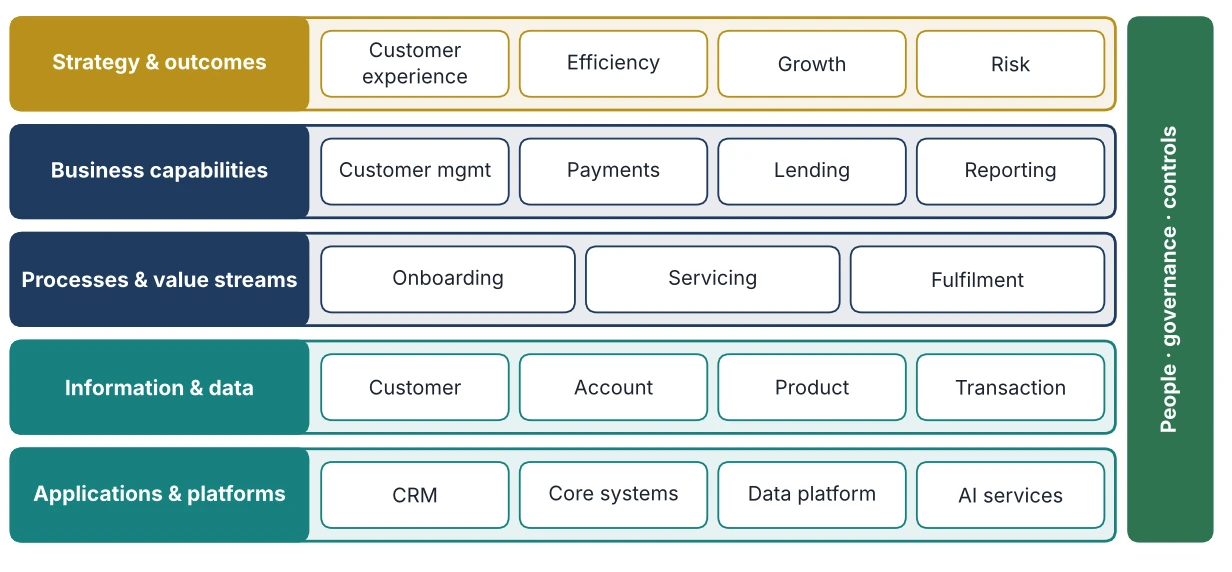
The purpose of this view is not to create a rigid hierarchy. It is to help the architect see the enterprise as a system of relationships.
A change in one area can have consequences elsewhere. A new customer service model may change the information required by employees. A new regulatory requirement may affect data retention, lineage, and reporting. A new AI capability may introduce new access paths to information and new expectations for data quality.
The Enterprise Data Architect must understand enough of this system to make decisions that work beyond the boundaries of an individual project.
2.2 Business Strategy as the Starting Point
Data architecture should support business strategy rather than exist as an independent technology agenda. This does not mean every data platform decision must be directly traceable to a single strategic objective. Organizations need foundational capabilities that support many activities. However, the architecture should have a clear rationale connected to enterprise needs. Consider an organization pursuing three strategic outcomes:
- A more consistent customer experience
- Faster development of new products
- Improved risk management
Each outcome creates different information requirements. A consistent customer experience may require better customer identity resolution, shared customer definitions, and reliable information across channels. Faster product development may require reusable product data, accessible analytical environments, and clearer data ownership. Improved risk management may require traceable data, consistent calculations, controlled access, and the ability to explain how information was produced. A single architecture initiative may support several of these outcomes, but the business rationale should remain visible.
Translating Strategy into Architecture Questions
A practical way to connect strategy with data architecture is to translate strategic objectives into questions.
| Strategic objective | Questions for the data architect |
|---|---|
| Improve customer experience | Which customer information is needed across channels? Where are definitions inconsistent? |
| Increase operational efficiency | Which processes depend on manual data reconciliation? Where can information be reused? |
| Accelerate product development | Which information capabilities should be shared? What data must be available earlier? |
| Strengthen risk management | What information must be traceable, controlled, and explainable? |
| Expand AI adoption | Which data and knowledge sources are suitable for AI use? What controls and evaluation are required? |
The table is not a universal mapping. It is a starting point for conversations with business stakeholders.
The architect should seek to understand the outcome behind a request. A business leader asking for a “customer 360 platform,” for example, may actually be seeking faster service resolution, improved sales effectiveness, more reliable risk assessment, or a combination of these.
The architecture will differ depending on the intended outcome.
Avoiding Technology-Led Strategy
A technology-led initiative often begins with a platform or product and then searches for business problems it can solve. There are cases where technology exploration is valuable, particularly when an organization is evaluating emerging capabilities. But broad platform adoption without a clear business context can lead to duplicated services, underused investments, and unclear accountability. The data architect should ask:
- What business outcome is expected?
- Which capabilities must improve?
- Which information is required?
- Who will use the information?
- What constraints must be respected?
- How will value be measured?
- What must change in the operating model?
These questions help ensure that technology decisions are grounded in enterprise needs.
2.3 Understanding Business Capabilities
A business capability describes what an organization does, independent of the specific people, processes, or applications used to perform it. For example, a financial services organization may have capabilities such as:
- Customer relationship management
- Product management
- Account management
- Payments
- Credit assessment
- Fraud management
- Financial reporting
- Regulatory compliance
- Customer servicing
A manufacturing organization may have capabilities such as product design, procurement, production planning, inventory management, logistics, and quality management. Capabilities provide a useful structure for enterprise analysis because they are generally more stable than organization charts or application portfolios.
Why Capabilities Matter to Data Architecture
Capabilities help identify where information is required and where responsibility may belong. For example, a customer relationship capability may depend on customer identity, preferences, interactions, products, and account information. Some of this information may be created in one system and consumed by many others. The architect can use capability analysis to identify:
- Critical information used by each capability.
- Data dependencies between capabilities.
- Repeated or overlapping information requirements.
- Opportunities for shared data services or products.
- Areas where inconsistent information creates operational risk.
- Capabilities that may be affected by a proposed architecture change.
This is particularly useful when an enterprise has many applications and teams. Instead of beginning with a list of systems, the architect begins with what the organization needs to do.
Capability Maps
A capability map is a visual representation of the capabilities required by an organization. It may be organized into levels, from broad capability areas to more specific capabilities. For data architecture, a capability map can be annotated with information needs, data ownership, criticality, and technology support.
A capability map is not a replacement for a data model. It provides a business-oriented view that helps determine where deeper information analysis is needed.
Capability versus Organization Structure
A capability should not be confused with a department. A department is an organizational unit. A capability is something the enterprise must be able to do. One department may support several capabilities. A single capability may span several departments. This distinction matters because data ownership assigned solely according to reporting lines may become unstable when the organization restructures. Capability-based analysis encourages architects to consider the enduring business responsibility behind information, rather than relying only on current organizational boundaries.
2.4 Value Streams and the Flow of Information
A value stream describes how an organization delivers value through a sequence of activities. For example, a customer onboarding value stream may include:
- Customer expresses interest.
- Required information is collected.
- Identity and eligibility are verified.
- Risk checks are completed.
- The relationship or account is established.
- The customer receives confirmation.
- Ongoing service begins.
Each stage creates, consumes, or changes information. The information may move between applications, teams, and external parties. Some information is entered by the customer, some is obtained from authoritative sources, and some is derived through business rules or analytical processes.
Why Value Streams Matter
A system-by-system view can hide the experience of the business process.
A value-stream view helps the architect understand where delays, handoffs, duplication, and information gaps occur.
For example, if customer information is collected during onboarding but must be entered again during account servicing, the issue may not be a missing interface alone. It may reflect unclear ownership, inconsistent data definitions, or a process that was designed around separate applications rather than a continuous customer relationship.
Value-stream analysis helps identify the business impact of data fragmentation.
Mapping Information to Activities
For each activity in a value stream, the architect can ask:
- What information is required to perform this activity?
- Where does the information originate?
- Who or what is authorized to change it?
- What information is produced?
- Which downstream activities depend on it?
- What quality or timeliness is required?
- What evidence or lineage must be retained?
- What happens when the information is missing or inconsistent?
The answers can inform data models, integration patterns, data products, and governance requirements.
This analysis is especially valuable for AI-enabled processes. If an AI assistant supports customer onboarding, it must understand the process context, the information required at each stage, and the limits of its authority. The same information may be appropriate for one activity but not another. The value stream therefore provides context for both data access and AI workflow design.
2.5 Enterprise Information Domains
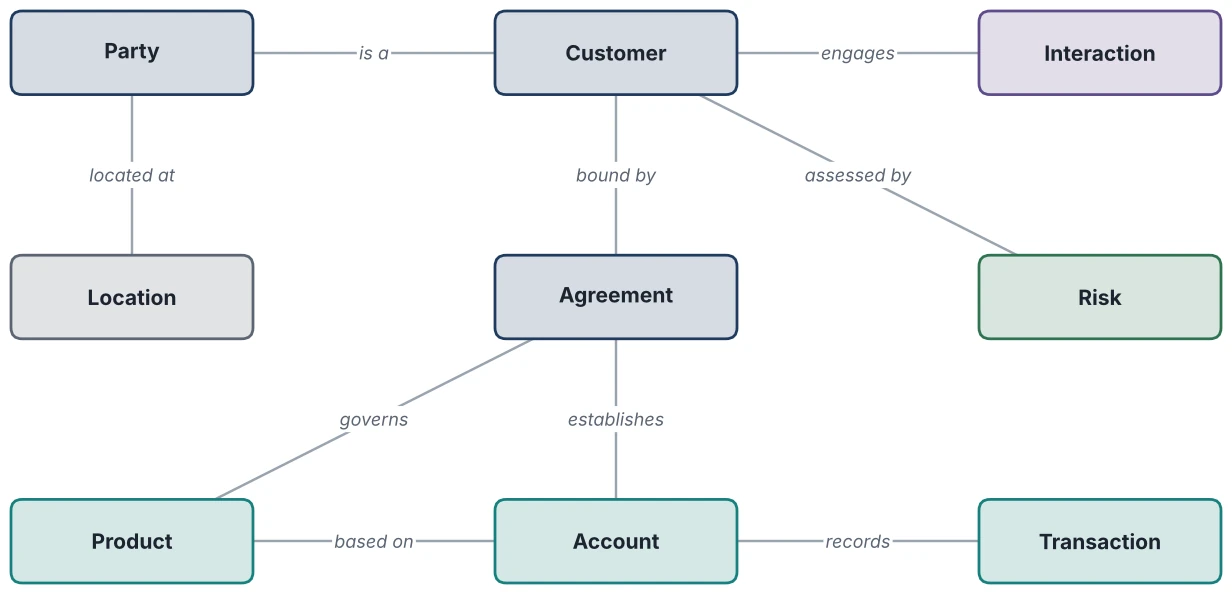
An information domain is a coherent area of business information, usually organized around a significant business concept or responsibility. Examples include:
- Customer
- Product
- Account
- Transaction
- Employee
- Supplier
- Asset
- Location
- Financial
- Risk
- Regulatory
Information domains provide a useful way to organize enterprise data architecture. They help answer questions such as:
- What major categories of information does the enterprise manage?
- Which business areas understand and maintain that information?
- Where are shared definitions needed?
- Which systems create or update the information?
- Which consumers depend on it?
- What controls apply?
Domains Are Not Necessarily Systems
A common mistake is to equate an information domain with a single application or database. A customer domain may span customer relationship management, onboarding, account servicing, billing, and analytical systems. Similarly, a single application may contain information from several domains. The domain is a business-oriented way of organizing information. It does not automatically determine where the information is physically stored.
Identifying Domain Boundaries
Domain boundaries require judgment. For example, should customer and account be treated as separate domains? In many organizations, they represent distinct concepts with different ownership and lifecycle rules. In other contexts, the relationship between them may be modeled differently. The architect should consider:
- Business meaning
- Lifecycle and change patterns
- Accountability
- Regulatory and privacy requirements
- Reuse across capabilities
- Relationships with other domains
- Operational and analytical needs
The objective is not to create the largest possible number of domains. Excessive fragmentation can make the architecture difficult to govern. Overly broad domains can obscure ownership and business meaning.
Shared Concepts and Local Context
Enterprise-wide consistency does not mean every business area must use identical physical structures. A concept such as customer may have a common enterprise meaning while being represented differently for specific operational purposes. A sales application may need prospect information. A servicing platform may need verified customer identity and communication preferences. A risk process may need relationships among individuals, organizations, and accounts. The architecture should distinguish between:
- Shared business concepts.
- Domain-specific representations.
- Authoritative sources.
- Derived or analytical views.
- Data products designed for specific consumers.
This distinction allows the enterprise to promote consistency without forcing every system into one physical model.
2.6 The Enterprise Operating Model
An operating model describes how an organization structures and coordinates its people, processes, technology, governance, and decision-making to deliver its business strategy. For data architecture, the operating model influences who creates data, who owns it, who maintains quality, who approves access, and who provides shared capabilities. Two organizations may use similar technologies but require different architectures because their operating models differ.
Centralized Operating Model
In a centralized model, a central team may own much of the data platform, integration, modeling, governance, and delivery process. Potential benefits include shared standards, consolidated expertise, and consistent platform management. Potential challenges include bottlenecks, distance from domain knowledge, and competing priorities across business units.
Federated Operating Model
In a federated model, central and domain teams share responsibility. A central function may define enterprise principles, standards, shared services, and governance expectations, while domain teams manage data within their areas. This can improve alignment with business context, but it requires clear decision rights and mechanisms for resolving conflicts.
Decentralized or Domain-Oriented Model
In a more decentralized model, business domains may own substantial portions of their data capabilities and delivery. This can increase local autonomy and responsiveness. It can also create fragmentation if domains do not agree on shared concepts, interoperability, security, and enterprise-level controls. No operating model is automatically appropriate for every enterprise. The architecture must reflect the organization’s size, regulatory context, culture, capabilities, risk profile, and business strategy.
The Operating Model Must Be Designed, Not Assumed
A data architecture may define a data product owner, but the organization must still establish what that person is accountable for and how the role works with engineering, governance, security, and consumers. Likewise, a policy may state that data quality is a domain responsibility, but the operating model must provide time, tools, authority, and escalation paths to make that responsibility practical. Architecture and operating model must therefore be designed together.
2.7 Organizational Boundaries, Ownership, and Accountability
Information often crosses organizational boundaries. A customer may interact with sales, operations, finance, risk, and service teams. Each team may use the information for a different purpose. This creates a distinction between data use and data accountability. A team may consume information without owning its definition or quality. Another team may maintain the source but not understand every downstream use. Without explicit accountability, problems can persist because each team assumes another is responsible.
Ownership Is More Than a Label
Assigning an owner to a data domain or product is useful only when the role has clear responsibilities. These may include:
- Defining business meaning.
- Establishing quality expectations.
- Approving appropriate uses.
- Coordinating changes.
- Resolving definition conflicts.
- Supporting consumers.
- Participating in governance and risk processes.
Ownership does not necessarily mean that one person performs every operational task. It means that accountability is clear.
Data Producers and Consumers
A producer creates or provides data. A consumer uses it. In a complex enterprise, a team may be both. For example, a customer onboarding team may produce verified identity information and consume product eligibility data. A risk team may consume transaction data and produce risk classifications. Understanding producer-consumer relationships helps architects identify dependencies, contracts, and the impact of change.
Decision Rights
Organizations should clarify who can make decisions about:
- Enterprise-wide definitions
- Domain-specific definitions
- Data quality thresholds
- Access and permitted use
- Changes to shared data products
- Technology standards
- Exceptions to architecture principles
Not every decision belongs to a central architecture board. Some decisions should be made close to the business context, while others require enterprise coordination. The architecture should make these boundaries visible.
2.8 Enterprise Architecture and Enterprise Data Architecture
Enterprise architecture provides a broad view of how an organization is structured and how its business, information, applications, and technology fit together. Enterprise data architecture is a focused discipline within this broader context. It concentrates on the information assets and capabilities that support the enterprise. The relationship is complementary. Enterprise architecture helps establish strategic alignment, business capability context, architectural principles, and cross-domain dependencies. Enterprise data architecture provides deeper guidance on information structures, data movement, data platforms, governance, metadata, and data use.
A Shared Architecture Conversation
Consider a proposal to introduce a new digital customer service capability. Enterprise architecture may examine:
- Which business capabilities are affected?
- What business processes will change?
- Which applications are involved?
- What technology capabilities are required?
- What strategic and operational risks must be addressed?
Enterprise data architecture may examine:
- Which customer and account information is required?
- Which sources are authoritative?
- How should information be integrated?
- What definitions and identifiers must be shared?
- What quality, lineage, privacy, and access controls apply?
- How should the information be exposed to applications and analytics?
Neither view is sufficient alone. A solution may fit the technology strategy but fail because its information dependencies are unresolved. Conversely, a well-designed data model may not be viable if it conflicts with application constraints or the enterprise operating model.
Architecture Principles
Enterprise principles guide decisions across initiatives. Examples relevant to data architecture include:
- Treat data as an enterprise asset.
- Assign clear accountability for important information.
- Prefer reusable and well-defined interfaces.
- Protect information according to its sensitivity and permitted use.
- Make important data discoverable and understandable.
- Design for interoperability and controlled change.
- Align platform decisions with business needs and operational capabilities.
Principles should be specific enough to guide decisions but not so prescriptive that they prevent context-sensitive design. A principle should also have implications. If an organization states that data should be reusable, it should define what reuse requires: metadata, quality expectations, access mechanisms, ownership, and support.
Architecture Governance
Architecture governance provides mechanisms for making and reviewing decisions. It may include principles, standards, design reviews, exception processes, architecture decision records, and periodic assessment. The goal is not to centralize every technical decision. It is to ensure that decisions with enterprise consequences are made transparently and that local choices remain compatible with agreed direction.
2.9 Understanding the Enterprise Before Designing the Architecture
An effective architect does not need to understand every detail of an enterprise before beginning work. However, the architect needs a structured way to discover the context that materially affects the design. The following approach can be used at the beginning of an architecture engagement.
Step 1: Understand the Business Outcomes
Start with the reason for the initiative. Ask:
- What is the organization trying to improve or enable?
- Which business outcomes matter?
- Who is affected?
- What is driving the timing?
- How will success be measured?
- What constraints are already known?
Avoid accepting a proposed technology solution as a complete statement of the business problem.
Step 2: Identify Relevant Capabilities and Value Streams
Determine which business capabilities and value streams are affected. Identify the activities, stakeholders, handoffs, and information dependencies involved. This helps establish the scope of the architecture in business terms.
Step 3: Identify Information Domains
Determine the major information domains involved. For each domain, identify important concepts, business definitions, likely owners, sources, consumers, and sensitivity. At this stage, the objective is to understand the landscape, not to finalize every data model.
Step 4: Understand the Current Application and Platform Landscape
Identify the systems and platforms that create, maintain, process, and consume the relevant information. Capture important interfaces, dependencies, constraints, and known limitations. Distinguish between what is documented and what has been confirmed with system owners.
Step 5: Understand Governance and Control Requirements
Identify the policies, regulations, contractual obligations, security requirements, privacy expectations, and operational controls relevant to the initiative. Engage the appropriate business and control stakeholders early. The architect should not independently interpret every legal or regulatory obligation. Instead, the architect should ensure that requirements are understood, assigned, and reflected in the design.
Step 6: Understand the Operating Model
Determine how responsibilities are distributed across enterprise teams, domains, platform teams, and control functions. Identify decision rights, escalation paths, and operational ownership. A design that depends on responsibilities no team can perform is not a sustainable architecture.
Step 7: Identify Gaps and Architectural Questions
Compare the required capabilities with the current state. Potential gaps may include:
- Missing or inconsistent definitions.
- Unclear data ownership.
- Limited lineage or discoverability.
- Duplicated integration.
- Weak data quality controls.
- Inadequate access mechanisms.
- Platform limitations.
- Unclear support for AI use cases.
Separate confirmed issues from assumptions and open questions.
Step 8: Define the Architecture Scope and Principles
Based on the discovery, define what the architecture will address and what it will not address. Establish relevant principles and decision criteria. This creates a foundation for evaluating options without prematurely selecting technologies.
Case study: Meridian Financial Group
2.10 Applying the Enterprise View: Meridian Financial Group
Meridian Financial Group is preparing to modernize how it manages customer information and to support AI-enabled customer services. The initial proposal is to create a unified customer data platform. The proposal appears straightforward, but the Enterprise Data Architect begins by examining the enterprise context.
Understanding the Business Objective
Meridian’s leadership wants relationship managers and service employees to have a more consistent understanding of customer relationships. The intended outcome is not simply to consolidate records. It is to reduce the effort required to assemble relevant information and improve the consistency of customer interactions. This distinction matters. A consolidated database may not address inconsistent definitions, unclear access rights, or differences in business processes.
Mapping Capabilities and Value Streams
The architect identifies several relevant capabilities:
- Customer relationship management
- Customer onboarding
- Account management
- Product management
- Risk assessment
- Customer servicing
- Regulatory compliance
The customer lifecycle spans several of these capabilities. Information is collected, validated, enriched, and reused at different stages.
Identifying Information Domains
The initial domain analysis identifies customer, party, account, product, transaction, interaction, and risk information. The architect discovers that the term customer is used differently across several business areas. In one context, it refers to an individual. In another, it may refer to a legal entity or a broader commercial relationship. The team therefore needs to clarify the business concepts and relationships before defining a consolidated information model.
Understanding the Operating Model
Meridian has central data platform teams, domain-aligned business teams, and separate governance and risk functions. However, responsibilities for customer definitions and data quality are not consistently understood. The architecture must therefore address accountability and decision rights as well as technology.
Reframing the Architecture Problem
The initial proposal focused on creating a unified platform. The broader enterprise analysis reframes the problem:
Meridian needs a governed customer information capability that can connect relevant sources, preserve business meaning, support authorized use, and serve operational, analytical, and AI-enabled consumers.
A platform may be part of the solution, but it is not the complete solution. This reframing changes the architecture conversation. It brings business owners, data stewards, platform teams, security, and AI specialists into a shared discussion about information, responsibility, and outcomes. The lesson is transferable: understanding the enterprise can change not only how a solution is designed, but what problem the organization believes it is solving.
2.11 Common Enterprise Understanding Mistakes
Several recurring mistakes can weaken data architecture before detailed design begins.
Starting with the Technology Inventory
A technology inventory is useful, but it should not be the only view of the enterprise. Without business context, architects may optimize existing systems rather than address the underlying information need.
Treating the Organization Chart as the Architecture
Departments and reporting lines change. Business capabilities and information relationships may persist across those changes. Use organizational structure to understand accountability, but do not assume it defines the ideal information architecture.
Assuming Shared Data Means One Physical Database
Enterprise consistency does not always require physical centralization. Shared definitions, identifiers, contracts, and governance may be more important than storing every record in one place. The appropriate physical design depends on the business and technical context.
Treating Governance as a Separate Workstream
Governance requirements affect data design, access, integration, metadata, quality, and operations. If governance is postponed until after implementation, the architecture may need substantial rework.
Assuming Business and Technical Stakeholders Use the Same Language
Terms such as customer, product, account, transaction, and active may have different meanings across teams. The architect should surface these differences rather than assume that familiar words have consistent definitions.
Ignoring the Operating Model
A design may assign ownership or operational responsibilities that the organization has not established. The result can be unclear accountability, unsupported data products, and persistent quality problems.
Designing for an Imagined Future State
Modernization often involves a desired future architecture, but the organization must transition from its current state. Legacy constraints, skills, contracts, processes, and risk requirements affect what can be delivered and in what sequence. The architect should understand both the target and the path toward it.
Remember these
2.12 Key Takeaways
- Enterprise data architecture begins with enterprise understanding. Technology choices should be connected to business outcomes, capabilities, information needs, and constraints.
- The enterprise is a connected system. Strategy, capabilities, processes, information, applications, people, and technology influence one another.
- Business capabilities provide a stable lens. They help architects understand what the organization must do without relying exclusively on departments or systems.
- Value streams reveal information dependencies. They show where information is created, consumed, changed, and handed between activities.
- Information domains organize business meaning. They help clarify concepts, accountability, and relationships without requiring every domain to map to one system.
- The operating model shapes the architecture. Ownership, decision rights, and operational responsibilities must be explicit and practical.
- Enterprise architecture and data architecture are complementary. Business and technology context should inform detailed information and platform decisions.
- Discovery should be structured. Understanding outcomes, capabilities, domains, platforms, controls, and operating models helps prevent technology-led designs that miss the real problem.
- The architecture problem may change as the enterprise is understood. A platform request may reveal a broader need involving information consistency, governance, or business accountability.
Think about your own organization
Architect’s Reflection
Think about an enterprise you know well.
- Can its business strategy be translated into clear information and data capabilities?
- Are business capabilities understood independently of departments and applications?
- Which value streams depend on information that crosses multiple organizational boundaries?
- Which information domains have clear ownership, and which have ambiguous accountability?
- Does the operating model support the data architecture the organization wants to build?
- Are architecture decisions driven primarily by business outcomes, existing technology, or a combination of both?
- If the organization introduced an AI-enabled service tomorrow, would its business concepts, information sources, and access responsibilities be clear enough to support it?
The central question for this chapter is:
Do we understand the enterprise well enough to design the data architecture it needs—not merely the technology architecture we know how to build?
Chapter 3 will build on this enterprise perspective by examining the modern enterprise data landscape: the platforms, patterns, and architectural components that organizations use to manage data across cloud, lakehouse, integration, engineering, and consumption environments.