Why this chapter matters
Chapter Purpose
Enterprise data architecture is at an inflection point. For decades, the discipline has focused on organizing, integrating, storing, protecting, and making enterprise data available for reporting and operational use. Those responsibilities remain essential. But the environment in which organizations create and use data is changing.
Cloud platforms have altered how infrastructure is acquired and operated. Data lakes and lakehouse architectures have expanded the ways organizations store and process information. Streaming technologies have made timely data more accessible. Data products and domain-oriented approaches have challenged centralized ownership models. Generative AI has introduced new ways to retrieve, interpret, and act on enterprise information.
These developments do not make traditional data architecture obsolete. They make it more consequential.
An organization cannot build reliable analytics, machine learning, or AI capabilities on top of data that is poorly understood, inconsistently defined, inaccessible, or untrusted. Nor can it achieve enterprise-wide intelligence simply by deploying a new platform or connecting a large language model to internal documents. The underlying architecture—its data, semantics, controls, operating model, and decision processes—still matters.
This chapter examines how the role of the Enterprise Data Architect is evolving: from designing data structures and movement to shaping the information foundations of an intelligent enterprise. By the end of this chapter, readers should be able to:
- Explain the evolution of enterprise data architecture and the responsibilities traditionally associated with the role.
- Describe how cloud, modern data platforms, lakehouse architectures, and generative AI are changing the architectural landscape.
- Understand the end-to-end data lifecycle, from ingestion through consumption, and the importance of governing it as an integrated system.
- Identify the broader responsibilities emerging for Enterprise Data Architects.
- Distinguish data architecture from the wider discipline of enterprise intelligence architecture.
1.1 The Evolution of Enterprise Data Architecture
Enterprise data architecture has evolved in response to changes in business needs, technology, and the scale at which organizations operate.
In the early stages of enterprise computing, data was closely associated with individual applications. Each application maintained the information required to support its own processes. As organizations grew, this application-centric approach created duplication, inconsistent definitions, and difficulty sharing information across business functions.
A customer, for example, might be represented differently in a billing system, a sales application, and a customer service platform. Each system could be correct within its own context while the organization as a whole lacked a consistent view of the customer.
Data architecture emerged as a way to address these challenges. Its purpose was not merely to design databases. It was to establish structures, standards, and patterns that helped an organization manage data as an enterprise asset. The discipline developed through several overlapping stages.
Application-Centric Data
In application-centric environments, data structures were designed primarily around the needs of individual systems. The application team determined what information to capture, how to represent it, and how to store it. This approach supported focused delivery, but it often produced tightly coupled systems. Sharing information required point-to-point interfaces, custom transformations, or manual reconciliation. The enterprise architect increasingly had to look beyond individual applications and understand how information moved across the organization.
Enterprise Data Warehousing
As organizations sought integrated reporting and business intelligence, enterprise data warehouses became important architectural components. Data from operational systems was extracted, transformed, and loaded into analytical structures. Data modeling, integration, historical retention, and reporting consistency became central concerns.
The data warehouse introduced a more deliberate enterprise view of information. It also made the work of data architecture more visible: architects had to understand source systems, define common structures, establish integration patterns, and help ensure that reports were based on consistent definitions.
However, traditional warehouse approaches could be costly or slow to adapt when new data sources, analytical requirements, or business questions emerged.
Distributed and Big Data Architectures
The growth of web-scale systems, machine-generated data, and diverse data formats created demand for architectures that could handle larger volumes and broader varieties of information. Data lakes and distributed processing platforms expanded the range of possible storage and processing patterns. Organizations could retain data in forms closer to their original structure and apply different processing approaches for different workloads. This increased flexibility, but it also introduced new challenges. Without clear ownership, metadata, quality controls, and lifecycle management, a data lake could become difficult to navigate and trust.
The architectural question shifted from “Where should the warehouse store this data?” to “How should the organization manage, understand, process, and make this data usable across multiple environments?”
Cloud and Platform-Based Architecture
Cloud computing changed the economics and operating model of data platforms. Organizations could provision services on demand, scale resources, and use managed capabilities rather than building and maintaining every component themselves. The architect’s work expanded. Decisions increasingly involved service selection, integration across platforms, security configuration, cost management, resilience, portability, and the distribution of responsibilities between technology providers and internal teams. Cloud did not remove architectural complexity. It changed where that complexity appeared.
The AI-Enabled Enterprise
The current stage adds another dimension. Organizations increasingly want to use data not only to describe what has happened, but also to predict, recommend, generate, and support actions. Machine learning and generative AI depend on data, but they also introduce additional architectural requirements: context, retrieval, semantic consistency, model integration, evaluation, access controls, and oversight. The Enterprise Data Architect is therefore operating in a broader environment. The role still includes the design of data structures and platforms, but it also increasingly influences how enterprise knowledge is represented, accessed, and used by intelligent systems.
The central evolution is this: enterprise data architecture is moving from the management of data assets toward the design of trusted information and knowledge capabilities that support enterprise decisions and actions.
1.2 The Traditional Role of the Enterprise Data Architect
The traditional Enterprise Data Architect (EDA) was responsible for defining how data should be structured, integrated, stored, governed, and made available across the enterprise. The role connected business needs with information structures and technology implementation. It required an understanding of both the meaning of data and the systems that managed it. Although organizations define the role differently, its traditional responsibilities commonly included the following.
Data Modeling and Information Design
The architect translated business concepts into logical and physical data structures. This involved understanding entities, attributes, relationships, business rules, and the distinctions between conceptual, logical, and physical models. A customer, account, product, transaction, or location might have different representations across systems. The architect helped identify where those representations should be aligned and where differences were necessary because of business context. Good data modeling was never only about tables and columns. It was about expressing the organization’s understanding of its information in a form that could guide systems and processes.
Data Integration
The architect helped define how data moved between applications, platforms, and analytical environments. Integration patterns could include batch processing, file exchange, application programming interfaces, message-based integration, and event-driven approaches. The objective was to enable information sharing while managing dependencies, consistency, latency, reliability, and change.
Data Platform and Storage Design
The architect contributed to decisions about databases, data warehouses, data lakes, and other storage technologies. These decisions required an understanding of workload characteristics, performance, scalability, availability, data structures, operational constraints, and cost. The architect also had to consider how platform decisions affected the broader enterprise architecture rather than evaluating each technology in isolation.
Data Governance and Standards
The architect helped establish and apply standards for data definitions, modeling, metadata, naming, quality, ownership, and lifecycle management. Governance was not simply a set of documents or approval meetings. It was the system of accountability and decision-making that helped ensure data was managed appropriately throughout its lifecycle.
Data Quality and Consistency
The architect worked with business and technology stakeholders to define data quality expectations and address structural causes of inconsistency. For example, if two systems calculated customer status differently, the problem might not be solved by adding another transformation. It might require clarification of the business definition, ownership, and rules governing the information.
Architecture Alignment
Finally, the EDA helped ensure that data decisions supported enterprise strategy and fit within broader technology architecture. This included collaboration with solution architects, application architects, infrastructure teams, security specialists, data engineers, business analysts, and data governance leaders. The traditional role was therefore already multidisciplinary. The change underway is not that the EDA is suddenly expected to collaborate or think strategically. It is that the scope and consequences of data architecture decisions are expanding.
1.3 The Modern Enterprise Technology Landscape
The modern enterprise rarely operates on a single data platform or within a single technology environment. It may combine legacy applications, packaged business systems, cloud-native services, operational databases, analytical platforms, streaming infrastructure, external data sources, and AI services. These components have different purposes, lifecycles, security requirements, and operating models. They may be owned by different teams and supported by different providers. The result is a complex architecture in which data must remain understandable and usable across organizational and technological boundaries.
The End-to-End Data Lifecycle
A useful way to understand this environment is to examine the end-to-end data lifecycle:
- Ingestion — bringing data into a platform or environment from operational systems, applications, devices, partners, or external sources.
- Storage — retaining data in forms appropriate to its purpose, access patterns, performance needs, and lifecycle.
- Processing — transforming, validating, enriching, combining, and preparing data for use.
- Serving — making data available through interfaces, analytical structures, APIs, events, data products, or other access mechanisms.
- Governance — establishing accountability, policies, controls, definitions, metadata, lineage, and quality expectations across the lifecycle.
- Consumption — using data in operational processes, reporting, analytics, machine learning, AI applications, and human decision-making.
These are not necessarily sequential stages in a single pipeline. In a modern architecture, data may move through multiple paths, be processed repeatedly, or be shared across platforms. Governance is not a final step; it applies throughout the lifecycle.
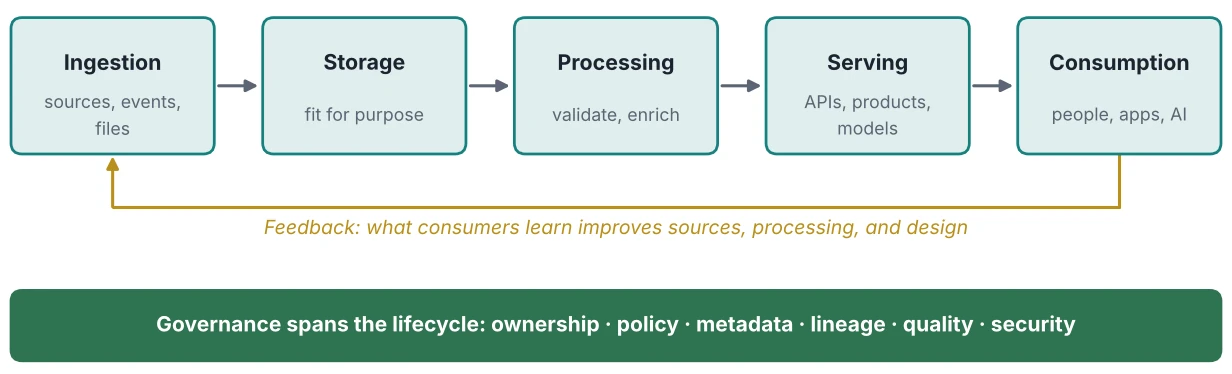
The lifecycle provides a useful architectural lens because it prevents teams from optimizing one component while overlooking the consequences elsewhere. For example, selecting a low-cost storage service may appear attractive. But if the data is difficult to discover, poorly described, or expensive to process, the overall architecture may not deliver the expected value. Likewise, a fast ingestion mechanism does not guarantee timely business insight. Data may still require complex transformations, quality checks, access approvals, and semantic alignment before it can be used.
The architect must therefore evaluate the whole system, not simply the technology at each stage.
Complexity Is Not Only Technical
Modern enterprise complexity also arises from organizational structure. Different business units may own similar data. Platform teams may provide shared services, while domain teams build their own data products. Security, risk, compliance, and legal functions may impose requirements that vary by data type and use case. The architecture must account for these boundaries. A technically elegant solution can fail if ownership is unclear, teams cannot operate it, or business users do not understand the data it provides. The modern EDA must therefore consider technology, information, people, process, accountability, and economics as connected architectural concerns.
1.4 Cloud Computing and the Shift in Architectural Responsibilities
Cloud computing has changed how organizations acquire and operate data capabilities. Instead of purchasing and maintaining all infrastructure directly, organizations can use managed services, elastic resources, and platform capabilities offered by cloud providers. This can accelerate delivery and reduce the need to operate certain infrastructure components. It also creates new architectural choices and responsibilities.
From Infrastructure Selection to Service Composition
In traditional environments, architecture decisions often involved selecting hardware, database products, storage systems, and integration technologies that would be installed and operated within organizational data centers. In cloud environments, the architect may instead select and combine managed services. The design question becomes broader:
- Which capabilities should be managed services?
- Which services should be shared across the enterprise?
- Which workloads belong in which environments?
- How will identity, networking, encryption, and access policies be applied?
- How will data move between cloud and non-cloud environments?
- How will resilience and recovery be designed?
- How will usage and cost be monitored?
- How will the organization manage dependencies on specific providers?
These are not merely infrastructure questions. They affect data access, platform interoperability, security, operational ownership, and long-term flexibility.
Shared Responsibility
Cloud services do not eliminate the need for internal accountability. The provider and customer have different responsibilities, and the exact division depends on the service model and contractual arrangement. The enterprise architect must understand which controls are provided by the platform and which must be designed, configured, monitored, and operated by the organization. For data architecture, this includes questions such as:
- Who is accountable for data classification?
- How are access policies defined and enforced?
- How is sensitive data protected in storage and in use?
- How are data movement and external sharing monitored?
- Who manages retention and deletion?
- How are recovery requirements established and tested?
The answers must be reflected in architecture and operating procedures, not left as assumptions.
Cost Becomes an Architectural Concern
Cloud consumption models make it possible to provision resources quickly, but they can also make costs difficult to predict. Storage, processing, data movement, orchestration, and managed services may each contribute to total cost. The EDA does not need to become a finance specialist, but must understand how architectural decisions affect consumption and operational expense. For example, copying the same data into multiple platforms may improve local convenience while increasing storage, processing, and governance costs. Moving large volumes of data between environments may also introduce cost and latency.
Cost should therefore be considered alongside performance, resilience, security, and usability.
Portability and Dependency
Managed services can provide valuable capabilities, but they may also create dependencies on provider-specific technologies and interfaces. The architect should not assume that every workload must be portable across providers. Portability has a cost, and sometimes a provider-specific capability is justified. The important task is to make the trade-off explicit. A sound architecture identifies where standard interfaces, open formats, abstraction layers, or exit strategies are important—and where using a managed capability provides sufficient value to justify the dependency.
The architectural objective is not to avoid cloud dependency at all costs. It is to understand, govern, and deliberately manage it.
1.5 The Rise of Lakehouse and Modern Data Platforms
Modern data platforms have expanded the architectural options available to enterprises.
Data warehouses remain important for structured analytical workloads and governed reporting. Data lakes support the storage and processing of diverse data at scale. Lakehouse approaches seek to combine aspects of these patterns, supporting broader data types and analytical workloads while providing capabilities associated with data management and reliability.
The term lakehouse is used in different ways across the industry. It should not be treated as one universally fixed architecture or product category.
For the Enterprise Data Architect, the more useful question is: what capabilities does the organization need, and how should those capabilities be composed?
Beyond the Platform Label
A platform label does not determine whether an architecture is effective. An organization may adopt a lakehouse platform and still struggle with inconsistent business definitions, duplicated data, unclear ownership, weak quality controls, or limited discoverability. Conversely, an organization may use a combination of warehouse, lake, streaming, and operational platforms in a coherent architecture if the responsibilities and interfaces are clearly defined. The architect should assess the platform in terms of:
- Supported workloads and data types.
- Data ingestion and integration patterns.
- Storage and processing options.
- Metadata, catalog, and lineage capabilities.
- Security and access controls.
- Reliability and operational management.
- Interoperability with other platforms.
- Cost and consumption patterns.
- Support for data sharing and data products.
- Suitability for analytical and AI-related workloads.
Architecture Is More Than a Platform Diagram
A platform diagram typically shows technologies and connections. An enterprise data architecture must also explain the purpose and responsibility of each component. For example:
- Which platform is authoritative for a particular data domain?
- Where are transformations performed?
- Which data is curated and certified for enterprise use?
- How are business definitions maintained?
- Who owns the quality of a data product?
- How is data access approved and monitored?
- How are changes communicated to downstream consumers?
These questions are essential regardless of whether the organization uses a warehouse, lake, lakehouse, or a combination.
The modern Enterprise Data Architect must resist the temptation to treat platform adoption as the end state. A platform is an enabling capability. The architecture must connect it to business information, ownership, governance, and measurable outcomes.
1.6 Generative AI as an Architectural Disruptor
Generative AI has brought new attention to enterprise data architecture because it creates new ways to interact with information. Traditional analytical systems commonly depend on predefined data structures, queries, dashboards, and models. Generative AI systems can accept natural-language prompts and produce summaries, explanations, recommendations, or generated content. This changes the user experience, but it does not remove the need for reliable information. An AI application may produce a fluent answer even when its supporting information is incomplete, outdated, contradictory, or irrelevant. The quality of the output depends on more than the language model itself.
It may depend on:
- The quality and relevance of source data.
- The way information is organized and described.
- The ability to retrieve the appropriate content.
- The context supplied to the model.
- The access rights of the user and application.
- The design of prompts, tools, and workflows.
- The evaluation of outputs and the handling of uncertainty.
- The controls applied to sensitive or regulated information.
These requirements bring data architecture directly into AI solution design.
Enterprise Data Is Not Automatically Enterprise Knowledge
An organization may possess large volumes of documents, records, reports, and databases. That does not mean an AI system can reliably interpret them. Information may be duplicated, fragmented, poorly indexed, or expressed using inconsistent terminology. Important context may exist only in business rules, process documentation, or the experience of employees. The architect must help establish how enterprise information is prepared, connected, described, governed, and made available for AI use.
This may involve document processing, metadata, semantic models, knowledge graphs, retrieval systems, vector search, APIs, and other capabilities. The appropriate design depends on the use case; no single technology pattern solves every enterprise knowledge problem.
Retrieval and Context
Many enterprise AI applications need to retrieve relevant information before generating a response. Retrieval-augmented generation (RAG), for example, combines retrieval from an external knowledge source with generation by a language model. Its effectiveness depends on the quality of the retrieval process and the information supplied as context. A data architect may need to consider:
- How source information is identified and approved.
- How documents and records are chunked, indexed, and updated.
- How metadata and business context are preserved.
- How permissions are applied during retrieval.
- How conflicting or outdated information is handled.
- How source references are made available to users.
- How retrieval and generated responses are evaluated.
These are architectural questions, not merely prompt-writing tasks.
AI Introduces New Data Flows
An AI solution may send prompts, retrieved content, user inputs, tool outputs, and generated responses through multiple services. Each movement may have implications for privacy, security, retention, auditability, and cost. The architect must understand what information is being sent, where it is processed, how it is retained, and which controls apply.
The same principle applies to AI agents that can invoke tools or initiate actions. Their architecture must account for the data and permissions available to them, the boundaries of their authority, and the mechanisms used to monitor and review their activity.
Generative AI does not replace enterprise data architecture. It increases the number of ways enterprise information can be used—and the importance of controlling those uses.
1.7 The Expanding Responsibilities of the Modern EDA
The modern Enterprise Data Architect continues to perform foundational work in modeling, integration, platform design, and governance. But the role increasingly reaches into areas that were once treated as separate disciplines. The expansion can be understood across several dimensions.
From Data Structures to Business Meaning
A data model describes how information is represented. Enterprise architecture must also address what that information means to the business. Consider the term customer. It may refer to an individual, a household, a legal entity, an account holder, or a commercial relationship, depending on context. An AI application that retrieves information about a customer must understand which meaning applies. Otherwise, it may combine information that should remain distinct or overlook relationships that matter. The EDA increasingly works with business architects, data stewards, domain experts, and semantic specialists to align technical structures with business meaning.
From Integration to Interoperability
Integration connects systems. Interoperability enables different systems, teams, and applications to exchange and use information consistently. This requires attention to interfaces, contracts, identifiers, semantics, metadata, and change management. The goal is not to force every system into one model. It is to establish enough shared understanding and predictable interaction to support enterprise-wide use.
From Platform Design to Data Product Architecture
In some organizations, data is increasingly managed as a product: a defined, supported, and reusable offering with an owner, intended consumers, quality expectations, and access mechanisms. This approach can improve accountability and usability, but it requires more than assigning a product label to a dataset. The architect helps define how data products fit into the enterprise: how they are discovered, governed, composed, secured, monitored, and changed.
From Governance Policies to Embedded Controls
Governance is most effective when it is reflected in the architecture and daily operation of data systems. That means connecting policies to practical mechanisms such as access controls, metadata, lineage, quality checks, retention rules, and audit records. The EDA helps translate governance expectations into design requirements and technical patterns, while working with accountable business and control functions.
From Analytics Enablement to AI Readiness
AI readiness is not simply a measure of whether data is available in a cloud platform. It includes whether the data is understandable, relevant, appropriately governed, discoverable, and suitable for the intended use. The architect may help assess readiness across data quality, semantics, access, lineage, metadata, integration, and operating capabilities.
From Technical Delivery to Value and Risk
Architecture decisions affect more than implementation complexity. They influence how quickly the organization can respond to business needs, how much it spends, how reliably it operates, and how effectively it manages risk. The EDA must be able to explain these trade-offs in language that business leaders can understand. This does not mean every architect must own business strategy or risk management. It means the architect must connect technical choices to the outcomes and constraints that matter to the enterprise.
1.8 From Data Architecture to Enterprise Intelligence Architecture
The expansion of the EDA role points toward a broader architectural perspective: enterprise intelligence architecture. This book uses the term Enterprise Intelligence Architecture to describe the coordinated design of data, information, semantics, platforms, AI capabilities, governance, and operating models that enable an organization to turn information into trusted decisions and actions. It is not intended to replace enterprise architecture, data architecture, or AI architecture. It connects them around a shared objective: enabling the enterprise to use its information responsibly and effectively.
Five Connected Architectural Dimensions
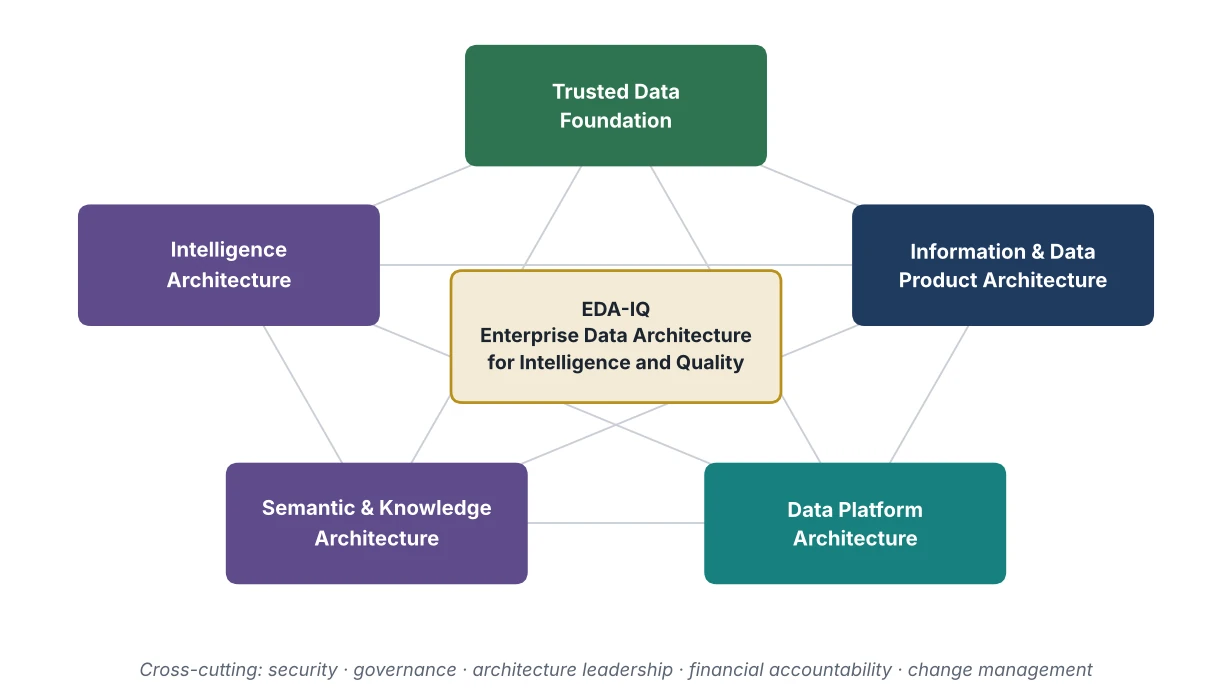
The book introduces a working framework called EDA-IQ: Enterprise Data Architecture for Intelligence and Quality. EDA-IQ is the author’s conceptual model rather than an established industry standard. It describes five connected dimensions.
1. Trusted Data Foundation
The foundation includes data quality, governance, metadata, lineage, security, privacy, master and reference data, and stewardship. Its purpose is to establish confidence in the information being used.
2. Information and Data Product Architecture
This dimension addresses business domains, information models, data products, ownership, interfaces, and interoperability. Its purpose is to make information understandable, reusable, and accountable across the enterprise.
3. Data Platform Architecture
This dimension includes cloud environments, warehouses, lakes, lakehouses, integration, streaming, processing, orchestration, and platform operations. Its purpose is to provide the technical capabilities required to manage and use data at enterprise scale.
4. Semantic and Knowledge Architecture
This dimension addresses business vocabulary, semantic models, ontologies, knowledge graphs, metadata, and the context required to interpret information. Its purpose is to connect data structures with business meaning and relationships.
5. Intelligence Architecture
This dimension includes analytics, machine learning, generative AI, retrieval, vector search, agents, and decision intelligence. Its purpose is to enable information to support prediction, generation, recommendation, and action.
These dimensions are not a technology stack. They are a way to reason about the capabilities an enterprise must coordinate. Security, governance, architecture leadership, financial accountability, and change management cut across all five.
Why the Dimensions Must Work Together
Consider an enterprise AI assistant designed to answer questions about customer relationships.
The intelligence layer may include a language model and retrieval mechanism. The platform layer may provide storage, processing, indexing, and APIs. The information architecture must define customer-related data products and their ownership. The semantic layer must clarify what customer, account, relationship, and status mean. The trusted foundation must ensure that information is accurate, access is appropriate, and use is governed.
If any dimension is weak, the overall solution may be affected. A sophisticated model cannot compensate for ambiguous business definitions. A well-designed data platform cannot independently resolve unclear ownership. Strong governance policies cannot protect information if they are not reflected in access mechanisms and operational processes. Enterprise intelligence emerges from the coordination of these capabilities.
1.9 The Skills and Mindset Required for the Future
The evolving role requires a combination of enduring architectural skills and new areas of knowledge. The objective is not for every EDA to become a specialist in every technology. It is to develop enough breadth to make sound architectural decisions, recognize dependencies, and work effectively with specialists.
Enduring Skills
Several capabilities remain central:
- Business understanding: the ability to understand business processes, objectives, information needs, and constraints.
- Information modeling: the ability to represent business concepts, relationships, rules, and structures clearly.
- Systems thinking: the ability to understand how local design decisions affect the wider enterprise.
- Communication: the ability to explain complex architectural issues to technical and nontechnical stakeholders.
- Governance and risk awareness: the ability to translate requirements into architecture and controls.
- Decision-making: the ability to compare options, make trade-offs explicit, and document architectural rationale.
These skills remain valuable regardless of technology trends.
Emerging Areas of Knowledge
The modern EDA should also develop working knowledge of:
- Cloud-native data services and platform operating models.
- Lakehouse and distributed data processing patterns.
- Streaming and event-driven architectures.
- Data products and domain-oriented ownership.
- Metadata, lineage, cataloging, and observability.
- Semantic models, knowledge graphs, and enterprise context.
- Machine learning and generative AI architecture.
- Retrieval-augmented generation and vector search.
- AI security, evaluation, and governance.
- FinOps and the economics of data platforms.
Depth will vary by organization and role. An architect working in a highly regulated enterprise may need greater emphasis on governance and controls. An architect supporting real-time operations may focus more on event-driven integration and resilience. An architect leading AI enablement may need deeper knowledge of retrieval, semantics, and model integration.
The Mindset Shift
The most important change may be a shift in how the architect frames problems. Instead of asking only, “Where should this data be stored?” the architect asks, “Who needs this information, what does it mean, and how will it be trusted and used?” Instead of asking only, “Which platform should we adopt?” the architect asks, “Which capabilities are required, how will they work together, and what operating model will sustain them?”
Instead of asking only, “Can we connect an AI model to our data?” the architect asks, “What information should the system access, under what authority, with what context, and how will its outputs be evaluated?” These questions move architecture from component selection toward enterprise capability design.
Architecting Through Trade-Offs
There is rarely one design that is optimal across every dimension.
A highly centralized platform may simplify some forms of control while creating bottlenecks for delivery. Domain ownership may improve local accountability while increasing the need for shared standards and interoperability. A managed service may accelerate implementation while creating provider dependency. More extensive data replication may improve access while increasing cost and governance complexity.
The architect’s responsibility is not to eliminate trade-offs. It is to make them visible, assess them in context, and help the organization choose deliberately.
Case study: Meridian Financial Group
1.10 The Enterprise Data Architect in Practice: Meridian Financial Group
Throughout this book, we will use a fictional organization called Meridian Financial Group to explore architectural decisions in a realistic enterprise setting. Meridian is a global financial services organization with a mixture of legacy applications, data warehouses, cloud platforms, and business-managed data environments. Its leadership wants to improve analytics, modernize data capabilities, and introduce AI-enabled services. At the same time, the organization must address regulatory obligations, sensitive customer information, operational resilience, and the need for consistent business definitions. Meridian’s challenges are familiar:
- Customer information is distributed across multiple systems.
- Business units use different definitions for some shared concepts.
- Data movement has evolved through a combination of established and point-to-point integrations.
- Some analytical data is difficult to discover or reuse.
- Ownership and quality expectations vary by domain.
- AI opportunities are emerging faster than enterprise standards and controls.
- Technology teams are under pressure to modernize without disrupting critical operations.
These are not problems that can be solved by selecting a single platform.
The First Architectural Conversation
Suppose Meridian proposes an AI assistant to help relationship managers prepare for customer meetings. A narrow technology discussion might begin with model selection, document ingestion, and a user interface. The Enterprise Data Architect broadens the discussion.
What does Meridian mean by a customer relationship? Which systems contain relevant customer and account information? Which sources are authoritative? What information may the relationship manager access? How current must the information be? How should conflicting records be handled? What context is needed to interpret the data? What should the assistant cite? How will the organization monitor usage and investigate errors?
These questions do not delay architecture. They establish the conditions under which the solution can be useful and trusted. The architect may work with business owners to define the use case, data stewards to clarify meaning, security teams to establish access requirements, platform teams to design retrieval and integration, and AI specialists to evaluate the application. The outcome is not simply an AI solution. It is an architectural pattern that can inform future solutions.
This is the kind of contribution the modern EDA is expected to make: connecting business intent, enterprise information, technology capabilities, and control requirements.
Remember these
1.11 Key Takeaways
- Enterprise data architecture has evolved, not disappeared. Its foundations in modeling, integration, governance, and platform design remain essential.
- The modern data environment is interconnected. Ingestion, storage, processing, serving, governance, and consumption must be understood as parts of an end-to-end lifecycle.
- Cloud changes architectural responsibilities. It introduces new choices involving managed services, shared responsibility, cost, resilience, security, and provider dependency.
- A modern platform is an enabler, not an architecture by itself. Warehouses, lakes, and lakehouses must be connected to clear information structures, ownership, governance, and business outcomes.
- AI increases the importance of trusted enterprise information. Data quality, semantics, context, retrieval, permissions, and evaluation all influence whether AI applications can be used responsibly.
- The EDA role is expanding. The architect increasingly works across data products, semantic architecture, AI integration, operating models, and enterprise decision-making.
- Enterprise intelligence requires coordinated capabilities. Data foundations, information architecture, platforms, semantics, and intelligence must work together.
- The architect’s value lies in connecting decisions. The role is not to select technologies in isolation, but to help the enterprise make coherent, sustainable, and accountable choices.
Think about your own organization
Architect’s Reflection
Consider your own organization or an enterprise with which you are familiar.
- How is enterprise data architecture currently defined? Is it primarily focused on platforms and integration, or does it also address business meaning, ownership, and use?
- Can the organization trace important information from its source through processing and serving to the people, applications, and AI systems that consume it?
- Where do inconsistent definitions or unclear ownership create friction?
- Are cloud and modern data platform decisions being made as part of an enterprise architecture, or primarily as individual technology choices?
- What would need to change for the organization to make trusted enterprise information available to AI applications?
- Which capabilities should the Enterprise Data Architect strengthen to contribute more effectively to enterprise strategy?
The central question for this chapter is:
Is the organization designing data platforms—or is it designing the trusted information capabilities required to operate and evolve as an intelligent enterprise?
The distinction will shape the architecture decisions explored throughout this book.