This chapter examines how enterprises move beyond treating data quality as a periodic cleanup activity and establish trust as an engineered, measurable property of data products and platforms. It connects quality practices with observability, operational reliability, governance, and the requirements of analytics and AI.
Why this chapter matters
Introduction
Enterprise data architecture is not successful simply because data can be collected, stored, integrated, and made available. Data must also be sufficiently accurate, complete, timely, consistent, understandable, and appropriate for its intended use. When these properties are uncertain, downstream teams compensate through manual checks, duplicated logic, reconciliation exercises, and cautious interpretation. The resulting architecture may be technically operational while remaining difficult to trust.
The challenge becomes more consequential as organizations expand their use of self-service analytics, data products, machine learning, generative AI, and automated decision-making. A delayed dashboard can frustrate a business user; an inaccurate customer attribute can distort a risk model; an incomplete document collection can weaken a retrieval-augmented generation system; and an unobserved pipeline failure can propagate incorrect information across multiple domains. In each case, the issue is not merely a defect in a dataset. It is a failure to make the data lifecycle sufficiently observable and controlled.
This chapter presents data quality, observability, and trust engineering as connected architectural capabilities. Data quality defines the properties that information must satisfy. Observability provides evidence about the behavior and condition of data systems and products. Trust engineering combines expectations, controls, accountability, and operational feedback so that users can understand whether data is suitable for a particular purpose.
The chapter uses Meridian Financial Group, a fictional global financial services organization, to illustrate how these capabilities can be designed across a complex enterprise. Its experience demonstrates that trust cannot be established through a single tool or central quality team. It requires clear ownership, measurable expectations, reusable platform capabilities, and a practical connection between technical signals and business impact.
19.1 From Data Quality to Trust Engineering
Data quality has traditionally been approached as a set of validation activities performed during data integration, warehouse loading, or report development. Teams define rules, identify records that fail those rules, and correct or exclude the affected data. These activities remain important, but they are not sufficient for a modern enterprise.
Data now moves through distributed platforms, domain-owned products, streaming services, cloud storage, analytical environments, and AI applications. A dataset can be valid at ingestion and become stale later. A field can satisfy a technical constraint while representing the wrong business meaning. A pipeline can complete successfully while silently omitting a source population. A model can produce a plausible result using information that is outdated or unauthorized for the requesting user.
Trust engineering broadens the problem. Instead of asking only whether a dataset passed a set of tests, the architect asks whether the enterprise can establish, communicate, and maintain confidence in the data for a defined use. That confidence must be supported by evidence. It cannot depend solely on a producer’s assertion that a dataset is reliable.
Trust is also contextual. A customer address may be adequate for broad geographic reporting but unsuitable for a regulated communication process. A transaction feed that arrives every hour may support operational monitoring but not a use case requiring near-real-time fraud detection. A document collection may be appropriate for internal search but not for an automated decision unless its authority, permissions, and currency are established.
The architectural implication is that quality expectations should be connected to intended use. The same data asset may have multiple consumers with different requirements. Those requirements should be explicit, owned, measurable, and visible to consumers. Trust engineering therefore combines four activities: defining expectations, implementing controls, observing actual behavior, and responding when evidence indicates a problem. These activities form a continuous lifecycle rather than a final validation step.
19.2 Understanding the Dimensions of Data Quality
Data quality is multidimensional. Organizations often begin with familiar dimensions such as accuracy, completeness, consistency, timeliness, validity, and uniqueness. These dimensions provide a useful vocabulary, but their definitions must be adapted to business context.
Accuracy concerns whether a value correctly represents the real-world entity or event it is intended to describe. Completeness concerns whether required information is present, including whether expected records or populations are represented. Consistency concerns whether values and relationships align across systems, datasets, and business rules. Timeliness concerns whether information is available within the period required by its intended use. Validity concerns whether values conform to defined formats, domains, and business constraints. Uniqueness concerns whether records that should represent distinct entities or events are duplicated.
These dimensions are related but not interchangeable. A dataset may be complete but inaccurate, valid but stale, or unique but inconsistent with an authoritative source. A single score can conceal these distinctions. For architecture and governance, it is more useful to preserve the individual measures and explain how they affect the consumer’s use case.
Consider a customer dataset containing one million records. A completeness measure might show that 99.8 percent of records contain a country code. That result does not establish that the codes are accurate, current, or aligned with the organization’s reference values. Nor does it indicate whether the remaining 0.2 percent are concentrated in a particular region or customer segment. A useful quality assessment must interpret the measurement in context.
The architect should also distinguish intrinsic data properties from service expectations. Completeness and validity describe characteristics of the data. Availability and freshness may describe the behavior of the data product or platform that provides it. Both matter to trust, but they should not be conflated. A technically available product can expose poor-quality information; a high-quality dataset can be inaccessible when a consumer needs it.
19.3 Defining Quality Requirements Around Business Use
Quality rules are most meaningful when derived from business processes, decisions, and obligations. A generic rule catalog can help standardize common checks, but it cannot determine the appropriate threshold for every data product.
A practical approach begins by identifying the intended consumers and uses of a data product. The owner then determines which quality dimensions are material, what constitutes acceptable performance, how the condition will be measured, and what happens when the requirement is not met. These decisions should involve business owners and technical stewards rather than being left entirely to a platform team.
For example, a customer identity product may require a defined level of completeness for legal identity attributes, controls against duplicate customer identities, and reconciliation with an authoritative source. A product used for exploratory analysis may tolerate a different level of latency or missing optional attributes. A product used in a regulated process may require documented provenance and a controlled correction process.
Quality requirements should be expressed as measurable expectations. “The data must be accurate” is not operationally useful without a definition of accuracy, a measurement method, a threshold, and an accountable owner. A more actionable requirement might state that a particular identifier must match an authoritative reference for a specified proportion of eligible records, with exceptions reported and assigned for remediation.
Thresholds should not be selected only because they are easy to achieve. They should reflect the consequences of failure, the characteristics of the source, the capabilities of the process, and the needs of consumers. Where a threshold cannot be met, the exception should be visible and the intended use reconsidered.
19.4 Data Quality Rules and Control Design
A data quality rule translates a business expectation into a testable condition. Rules can be applied at different points in the data lifecycle: at source capture, ingestion, transformation, publication, consumption, or periodic review. The appropriate location depends on where the relevant information is available and where a failure can be detected with the least operational disruption.
Structural rules validate schemas, data types, required fields, and permitted values. Referential rules check whether relationships between records and reference datasets are valid. Reconciliation rules compare counts, totals, or other measures across processing stages or systems. Business rules test domain-specific conditions, such as whether a transaction’s status and effective date are logically compatible. Statistical checks identify unexpected distributions, ranges, or changes in patterns.
No single category is sufficient. Structural checks can detect a missing column but cannot establish that a customer classification is semantically correct. Statistical checks can detect an unusual shift but may not explain whether the shift represents a defect or a genuine business event. Reconciliation can reveal a discrepancy while leaving the cause unresolved.
Controls should be designed with an explicit response. Some failures should block publication because they threaten correctness or compliance. Others may permit publication with a warning, an exception record, or a restricted usage status. A non-critical optional attribute should not necessarily stop an entire product from being delivered. Conversely, a failed control on a key financial measure may require immediate containment.
The architecture should therefore distinguish between detection, severity assessment, and enforcement. A rule detects a condition; a policy determines its significance; and an operational workflow coordinates the response. Keeping these concerns distinct makes controls easier to maintain as requirements evolve.
19.5 Data Observability as an Architectural Capability
Data observability is the ability to understand the condition and behavior of data systems and products through signals collected across their lifecycle. It extends beyond checking whether a pipeline completed. A successful job may still produce incomplete, duplicated, delayed, or semantically incorrect output.
A mature observability capability combines several categories of signals. Freshness indicates whether data has arrived or been updated within the expected interval. Volume measures whether the number of records or events is consistent with expectations. Schema monitoring identifies changes in structure, types, and field availability. Distribution monitoring detects changes in values and statistical patterns. Lineage connects outputs to upstream sources and transformations. Operational signals reveal pipeline failures, duration, resource consumption, retries, and dependency health.
These signals become more useful when interpreted together. A sudden reduction in record volume may be caused by a source outage, a filter change, a legitimate seasonal pattern, or a broken upstream dependency. Freshness and lineage information can help narrow the investigation. Schema changes may explain why a transformation began dropping records. A pipeline execution log alone would not provide this context.
Observability should be designed into the platform and data products, not added only after incidents occur. Instrumentation, metadata capture, lineage, quality checks, and alert routing should be part of standard engineering practices. This reduces the burden on individual teams and creates a consistent operational view across the enterprise.
At the same time, observability is not equivalent to collecting every possible metric. Excessive signals without ownership or action can create noise. The architect should prioritize measurements that help determine whether a product meets its commitments, identify the likely location of failure, and support a defined response.
19.6 Data Product Service-Level Objectives and Agreements
Data products need operational expectations that consumers can understand. Service-level indicators are measurements of actual behavior, such as freshness, availability, completeness, or successful delivery. Service-level objectives define target levels for those indicators over a specified period. Service-level agreements may formalize commitments between providers and consumers, particularly where the product supports a critical business process.
A data product’s expectations should cover more than platform uptime. A storage service can be available while the data it contains is stale. A pipeline can meet its execution schedule while failing a critical reconciliation check. Product commitments should therefore reflect the characteristics that matter to consumers.
For example, a customer activity product might define a freshness objective, a publication availability objective, and a quality objective for selected fields. It may also define how incidents are communicated and how consumers can identify affected time periods. The exact objectives should be based on the product’s use and operating model rather than copied from another product.
Not every data product requires a formal agreement. The level of formality should be proportionate to business criticality, regulatory exposure, and the number of dependent consumers. However, even lightweight products benefit from documented expectations. Without them, consumers cannot distinguish a defect from an accepted limitation, and producers cannot prioritize remediation consistently.
A useful service commitment also defines exclusions and dependencies. If a product depends on a source system that publishes only once per day, its freshness commitment must reflect that constraint. If consumers apply additional transformations, the producer should clarify where its responsibility ends and the consumer’s begins.
19.7 Data Quality in Batch, Streaming, and Event-Driven Systems
Quality engineering differs across processing patterns. In batch systems, validation often occurs at defined processing boundaries. A pipeline can compare input and output counts, validate business rules, and prevent publication until required checks complete. Batch processing also supports repeatable reconciliation and controlled reprocessing, although late-arriving data and backfills can complicate the picture.
Streaming systems introduce continuous arrival, variable event time, out-of-order events, duplicates, and changing source behavior. Quality controls must account for these characteristics. A streaming architecture may need to distinguish processing time from event time, handle late events, preserve idempotency, and identify periods when source delivery is incomplete. A momentary drop in event volume may be an operational incident or a normal fluctuation, depending on the business context.
In event-driven architectures, schema compatibility and contract adherence are especially important. A producer change can affect multiple downstream consumers, often without a coordinated release. Schema registries, compatibility checks, versioning practices, and consumer-driven testing can reduce this risk, but they do not replace semantic review. A schema can remain technically compatible while a field’s meaning changes.
The architect should avoid imposing identical control patterns on every processing model. Batch, streaming, and event-driven systems need common principles but different mechanisms. The shared objective is to make data behavior measurable, failures detectable, and recovery predictable.
19.8 Data Lineage, Root-Cause Analysis, and Impact Assessment
Lineage is central to trust because it explains where data originated, how it changed, and which downstream assets depend on it. Technical lineage may capture tables, files, jobs, queries, and transformations. Business lineage connects those technical elements to business concepts, reports, products, and decisions.
When a quality incident occurs, lineage supports two important questions: what caused the problem, and what might be affected? If a source field changes or an upstream dataset becomes incomplete, the enterprise needs to identify downstream products and processes that rely on it. Without lineage, teams may spend substantial time tracing dependencies manually, and some impacts may remain undiscovered.
Lineage should be captured as close to automatically as possible. Manual documentation can provide important business context, but it is difficult to keep synchronized with frequently changing pipelines. Automated metadata capture from orchestration systems, transformation frameworks, query engines, and data platforms can provide a technical foundation. Business owners and stewards can then add definitions, criticality, and usage context.
Lineage is not a substitute for investigation. A dependency graph may show that a report consumes a particular table, but it may not reveal whether the affected records were used in a specific decision. The architecture should therefore connect lineage with run history, quality results, incident records, and where appropriate, decision or model usage metadata.
Impact assessment should consider both technical reach and business consequence. A defect in a widely used but low-criticality dataset may have a different response priority from a defect in a smaller dataset used for a regulated decision. This distinction helps the organization respond proportionately.
19.9 Data Quality, Metadata, and the Enterprise Catalog
Metadata gives meaning to quality signals. A metric such as “98 percent complete” is difficult to interpret without knowing which field was measured, which records were included, what rule was applied, and who owns the result. A catalog can bring together product descriptions, business definitions, technical schemas, ownership, lineage, classifications, quality measurements, and access information.
The catalog should not become a passive inventory. Its value comes from supporting discovery and action. A consumer should be able to understand what a product represents, whether it is approved for a particular use, what its known limitations are, and how to contact its owner. A producer should be able to review quality trends, investigate incidents, and communicate changes.
Metadata management also requires lifecycle discipline. Definitions, ownership, classifications, and quality expectations can become stale as products evolve. The architecture should establish how metadata is created, reviewed, versioned, and retired. Automated discovery can reduce manual effort, but business meaning and accountability still require human stewardship.
For AI systems, metadata has an additional role. Retrieval and model workflows may depend on source authority, document dates, access restrictions, sensitivity, and provenance. These properties should travel with the data or remain accessible through governed metadata services. A technically relevant document is not necessarily an authorized or current source for a given user or task.
19.10 Trust Engineering for AI and Generative AI
AI systems create new trust requirements because they consume data in ways that may be probabilistic, context-dependent, and difficult to inspect through conventional application testing alone. A model’s output quality depends partly on the data used for training, retrieval, grounding, evaluation, and ongoing operation.
For machine learning, data quality affects feature correctness, representativeness, label reliability, and the stability of model behavior. Changes in source distributions may indicate data drift or changes in the underlying business environment. Monitoring should distinguish between data quality incidents and legitimate changes in the population being modeled.
For retrieval-augmented generation, trust depends on the quality and authority of the knowledge sources, the completeness of ingestion, chunking and metadata practices, access filtering, retrieval relevance, and the relationship between retrieved evidence and generated responses. A retrieval system can operate without errors while consistently retrieving outdated or irrelevant content. Operational success is therefore not proof of answer reliability.
Generative AI also requires evaluation beyond conventional data checks. Teams should test whether answers are grounded in approved sources, whether citations point to relevant evidence, whether access restrictions are respected, and whether the system appropriately expresses uncertainty when evidence is insufficient. Human review may be required for high-impact uses.
Agentic systems add further concerns. Agents may retrieve information, call tools, update systems, or initiate workflows. Trust must therefore include the quality of inputs, the authority of actions, the reliability of tool responses, and the traceability of decisions. A flawed data product can become an operational risk when an agent is permitted to act on it.
The Enterprise Data Architect should work with AI, security, risk, and business teams to define trust controls across the full lifecycle. These controls should connect source quality and provenance to retrieval, model evaluation, application behavior, and operational monitoring.
19.11 Incident Management and Continuous Improvement
Quality and observability controls create value only when the organization can respond effectively to the signals they produce. An incident process should define how problems are detected, classified, assigned, investigated, communicated, resolved, and reviewed.
Not every failed check should generate the same response. Severity should reflect the affected data, the number and importance of consumers, the duration of the issue, the possibility of incorrect decisions, and any regulatory or contractual obligations. A failed optional-field check may be recorded for routine remediation. A defect affecting a critical financial measure may require immediate containment and notification.
Incident handling should preserve evidence. Teams need to know which product version, source records, pipeline execution, rule version, and consumers were affected. Where appropriate, they should be able to identify whether downstream outputs need correction or republication. Reprocessing should be controlled so that a remediation does not introduce duplicates or overwrite valid information.
A blameless review can help identify systemic causes without removing accountability. The objective is not to excuse preventable failures but to understand why the architecture, controls, or operating model allowed them to occur. Repeated incidents may indicate that a rule is poorly designed, ownership is unclear, platform capabilities are insufficient, or incentives favor delivery speed over reliability.
Continuous improvement should be based on trends, not only individual incidents. Repeated freshness breaches, recurring schema failures, unresolved quality exceptions, or growing manual reconciliation effort can reveal architectural weaknesses. These trends can inform investment priorities and platform roadmaps.
19.12 Operating Model and Accountability for Data Trust
Trust engineering is a shared responsibility, but shared responsibility must not become unassigned responsibility. Data product owners should be accountable for the product’s purpose, quality expectations, and consumer communication. Domain data stewards should help define business meaning and quality rules. Data engineers should implement and operate pipelines and technical controls. Platform teams should provide reusable observability, metadata, testing, and incident capabilities. Governance and risk functions should establish policies and review requirements for critical or regulated uses.
The Enterprise Data Architect connects these roles through standards and design decisions. The architect helps define common quality dimensions, metadata requirements, lineage practices, observability patterns, and escalation mechanisms. The architect also ensures that local implementations can interoperate without forcing every domain into an identical technology stack.
A federated operating model is often appropriate for large enterprises. Central teams provide shared capabilities and minimum controls, while domain teams own the meaning and quality of their products. This arrangement requires clear decision rights. For example, the enterprise may define mandatory metadata and security classifications, while a domain determines the detailed quality rules for its customer or transaction products.
Accountability should be visible in the product itself. Consumers should not have to discover ownership through informal networks. Ownership, support routes, known limitations, and incident procedures should be published with the product’s documentation and metadata.
19.13 Measuring the Effectiveness of Trust Engineering
A trust engineering program should measure whether it improves the reliability and usability of data, not simply how many rules or dashboards have been created. A large number of checks can indicate activity without demonstrating business value.
Useful measures include the proportion of critical products with defined owners and measurable quality expectations, the rate of freshness or availability objective attainment, the frequency and duration of quality incidents, the time required to detect and resolve issues, and the proportion of critical data assets with usable lineage. Organizations may also measure recurring manual reconciliation effort, unresolved exceptions, and the number of downstream consumers affected by incidents.
Metrics should be interpreted carefully. A rising incident count may indicate worsening quality, but it may also reflect improved detection. A falling count may indicate improvement or a loss of observability. Similarly, a high pass rate may result from weak rules rather than excellent data. Measurement systems should include context, definitions, and review of unintended incentives.
The most useful measures connect technical performance with business impact. For example, a reduction in the time needed to identify affected reports after a source defect can demonstrate the value of lineage and incident integration. A reduction in manual reconciliation can indicate that quality controls are becoming more dependable. A product’s objective attainment can help consumers make informed decisions about its suitability.
19.14 Reference Architecture for Data Quality and Observability
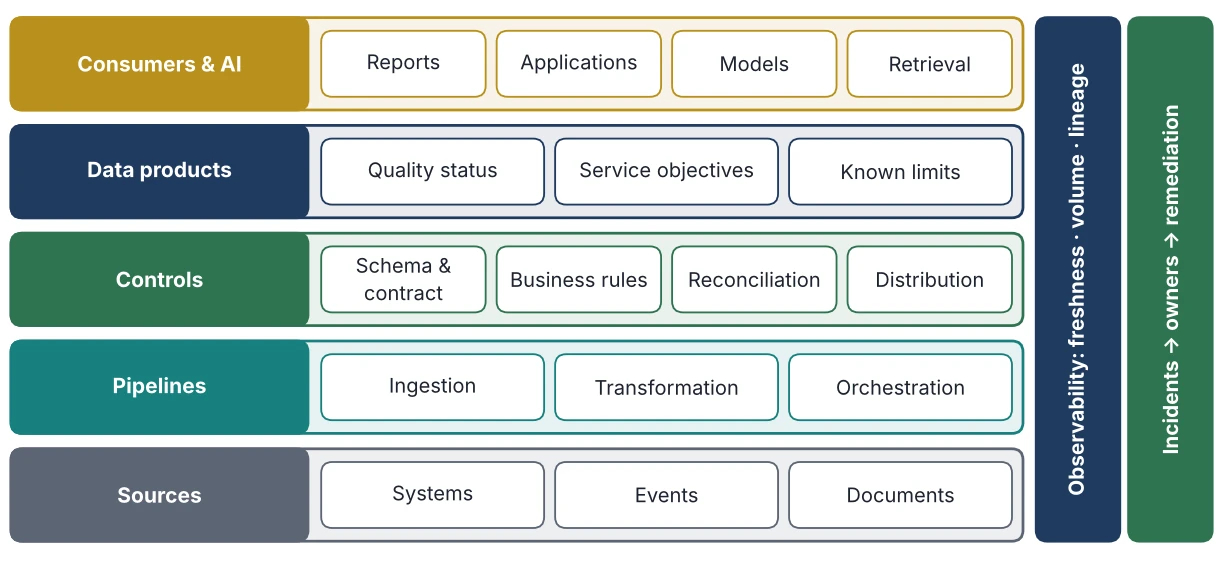
A reference architecture for trust engineering should integrate controls across the data lifecycle. At the source layer, systems expose data and operational signals. Ingestion and transformation services apply schema, contract, and quality checks. Processing and orchestration platforms capture execution metadata, dependencies, and lineage. Data products publish quality measurements and service expectations alongside their data and documentation.
A metadata and observability layer aggregates signals from pipelines, storage systems, transformation engines, catalogs, and monitoring services. It provides a shared view of freshness, volume, schema, distribution, lineage, and operational health. Policy and rule services define reusable controls, while domain teams maintain business-specific expectations. Alerting and incident workflows route significant failures to accountable owners and support investigation and remediation.
Consumers access products through governed interfaces and discover the product’s definitions, quality status, lineage, limitations, and support arrangements. AI applications use the same trust foundation, supplemented by retrieval evaluation, model monitoring, and controls over the use of sensitive or restricted information.
The architecture should support both centralized visibility and domain accountability. A central observability capability can provide consistent monitoring and enterprise-wide impact analysis, while product teams retain responsibility for their data and remediation. This avoids two common extremes: fragmented monitoring in which no one can see enterprise-wide dependencies, and centralized quality operations that become bottlenecks for every domain.
Case study: Meridian Financial Group
19.15 Data Quality and Trust Engineering at Meridian Financial Group
Meridian Financial Group has expanded its cloud data platform, but its data quality practices remain uneven. Some business units maintain detailed validation rules, while others rely on manual reconciliation and local knowledge. The organization has several customer datasets with overlapping definitions, and consumers cannot always determine which product is authoritative for a particular use. Operational monitoring focuses primarily on pipeline completion, leaving gaps in freshness, completeness, and downstream impact visibility.
The issue becomes apparent when a customer reporting product shows a sudden decline in activity for one region. The pipeline reports a successful run, but the output contains fewer records than expected. Analysts initially suspect a business trend. Further investigation reveals that an upstream source changed a status code, causing a transformation to exclude a category of valid records.
The incident exposes several architectural weaknesses. The source contract did not communicate the semantic change. The transformation lacked a control for unexpected distribution changes. The product did not publish a freshness or completeness status that would alert consumers to the issue. Lineage existed in fragments, so the team had difficulty identifying all affected reports.
Meridian responds by establishing a trust engineering approach for its critical data products. Product owners define intended uses and quality expectations with business stewards. The platform team provides standard instrumentation for freshness, volume, schema, and pipeline execution. Domain teams implement business-specific validation and reconciliation rules. A shared catalog exposes ownership, lineage, quality status, and known limitations.
The organization also introduces a severity-based incident process. A failed check does not automatically block every product, but controls associated with critical financial and regulatory uses can prevent publication or trigger escalation. Consumers receive notifications when a product’s status changes, and affected downstream assets can be identified through lineage.
For Meridian’s AI initiatives, the same foundation is extended to knowledge retrieval and model workflows. Approved knowledge sources are tagged with ownership, authority, sensitivity, and effective dates. Retrieval evaluations test whether the system returns relevant and permitted content. AI application teams can see source and evaluation status rather than treating successful model invocation as proof of trustworthy output.
The transformation does not eliminate all data defects. Instead, it makes expectations explicit, failures more detectable, impact easier to assess, and remediation more accountable. Meridian begins to treat trust as a property of its data products and operating model rather than as a final sign-off performed by a separate quality team.
19.16 Practical Artifact: Enterprise Data Trust Assessment
The Enterprise Data Trust Assessment helps an architect evaluate whether a data product or platform has the capabilities required to establish and maintain trust. It can be applied to an individual product, a domain, or an enterprise platform. The assessment should be completed with product owners, data stewards, engineers, platform teams, and relevant risk stakeholders.
| Assessment area | Questions to evaluate | Evidence to collect |
|---|---|---|
| Intended use | Are consumers and supported use cases documented? Are limitations clear? | Product description, consumer inventory, use-case documentation |
| Ownership | Is an accountable owner identified? Are support and escalation routes defined? | Ownership metadata, operating procedures |
| Quality dimensions | Are material dimensions defined in business terms? | Quality requirements, business definitions |
| Quality rules | Are rules measurable, versioned, and linked to business expectations? | Rule catalog, test definitions, execution results |
| Service expectations | Are freshness, availability, and quality objectives defined where needed? | Product objectives, service reports |
| Observability | Are freshness, volume, schema, distribution, and operational health monitored appropriately? | Dashboards, alert definitions, monitoring records |
| Lineage | Can teams trace critical products to sources and identify downstream dependencies? | Technical and business lineage |
| Metadata | Are definitions, classifications, ownership, and known limitations maintained? | Catalog records, metadata review history |
| Incident response | Are failures classified, assigned, communicated, and reviewed? | Incident records, runbooks, post-incident reviews |
| AI readiness | Are provenance, permissions, evaluation, and source quality addressed for AI use? | Retrieval evaluations, model data documentation, access controls |
| Continuous improvement | Are recurring problems analyzed and improvements tracked? | Trend reports, remediation backlog, improvement measures |
The assessment should not be reduced to a single maturity score without context. A product may have strong operational monitoring but weak business definitions, or comprehensive quality rules but no effective incident process. The purpose is to reveal the gaps that matter for the product’s intended use and to establish a prioritized improvement plan.
A useful output is a short trust profile that states what the product is suitable for, what controls support that conclusion, what limitations remain, and who is accountable for addressing them. This profile can be published with the product and updated as the product evolves.
Remember these
19.17 Key Takeaways
- Data quality, observability, and trust engineering are connected architectural capabilities. Quality defines the properties data must satisfy; observability provides evidence about data and platform behavior; trust engineering turns expectations and evidence into accountable operational practice.
- Quality requirements should be derived from business use rather than applied as generic thresholds. Accuracy, completeness, consistency, timeliness, validity, and uniqueness describe different properties and should be measured in ways that preserve their meaning.
- Successful pipeline execution does not prove that the resulting data is trustworthy. Observability must include data-level signals such as freshness, volume, schema, and distribution, together with lineage and operational health.
- Data products should publish expectations, ownership, limitations, and quality status in forms consumers can understand. Service objectives should reflect business criticality and actual source capabilities.
- Lineage supports root-cause analysis and downstream impact assessment. Metadata gives quality signals meaning and helps consumers understand authority, provenance, and permitted use.
- AI systems increase the importance of trust engineering. Source quality, retrieval relevance, provenance, permissions, evaluation, and operational monitoring all contribute to whether AI outputs can be relied upon for a particular purpose.
- Trust is a shared responsibility, but accountability must be explicit. Domain teams own business meaning and product quality; platform teams provide reusable capabilities; governance and risk functions define oversight; and enterprise architects connect these responsibilities through coherent standards and architecture.
Think about your own organization
Architect’s Reflection
When a data product is described as trusted, what evidence supports that description? Is the claim based on a documented quality expectation, a history of reliable operation, an accountable owner, and an understood set of limitations—or is it based primarily on reputation and familiarity?
As an Enterprise Data Architect, consider where your organization detects defects today. Are problems found before publication, by downstream consumers, or only after a business decision has been affected? Can teams trace an incident to its source and identify the consumers that may be affected? Do quality measures reflect business meaning, or are they limited to technical checks that are easy to automate?
Finally, consider whether your architecture makes trust visible. A trustworthy enterprise is not one in which data defects never occur. It is one that understands what its data is intended to support, makes relevant risks observable, responds proportionately when expectations are not met, and learns from failures.