Why this chapter matters
Introduction
Enterprise data governance has often been approached as a collection of policies, committees, standards, and approval processes. These mechanisms remain important, but they are not sufficient for the modern enterprise. Data now moves across cloud platforms, operational applications, analytical environments, data products, external partners, and AI systems. It is copied, transformed, combined, inferred from, and used to support decisions at a scale and speed that traditional governance models were not designed to manage.
The challenge is no longer simply to establish rules for data. It is to make those rules understandable, operational, measurable, and enforceable across the enterprise. Governance must connect business accountability with architecture, engineering, security, privacy, quality, metadata, and the day-to-day work of teams that produce and consume data.
This is particularly important as organizations adopt data products, lakehouse platforms, generative AI, retrieval-augmented generation, and agentic systems. These technologies create new ways to use information, but they also increase the importance of knowing where data came from, what it means, who is permitted to use it, and under what conditions. An AI system may retrieve a document, summarize a customer record, or invoke a business service. Each activity raises governance questions that cannot be answered by a general policy document alone.
Modern enterprise data governance should therefore be understood as an enterprise capability. It establishes decision rights, responsibilities, standards, controls, and evidence so that data can be used responsibly and effectively. Its purpose is not to prevent data use. Its purpose is to enable appropriate data use with clear accountability and proportionate control.
For the Enterprise Data Architect, governance is an architectural concern as well as an organizational one. The architect helps translate governance objectives into data structures, metadata, platforms, access patterns, contracts, policies, and operational controls. This chapter examines how to design governance for a distributed, cloud-enabled, AI-ready enterprise.
17.1 From Traditional Data Governance to Modern Governance
Traditional data governance commonly emerged in response to problems such as inconsistent reporting, duplicate customer records, unclear ownership, poor data quality, and regulatory requirements. Organizations established governance councils, data stewardship roles, business glossaries, data standards, and approval processes to address these issues.
These practices created an essential foundation. They helped organizations recognize that data is not merely a technical by-product of applications. It is an enterprise asset whose meaning, quality, use, and accountability must be managed.
However, many traditional governance programs were designed around centralized data environments and relatively stable information flows. A central team might define standards, approve changes, and oversee data quality initiatives. That model becomes difficult to scale when data is produced and consumed across many domains, platforms, and teams.
Modern architecture introduces a more distributed operating environment. Business domains may own data products. Cloud platforms may provide policy enforcement capabilities. Streaming systems may distribute events continuously. External services may process enterprise information. AI applications may retrieve and transform data dynamically. Governance must operate across these environments without depending entirely on manual review.
This does not mean that governance should become fully decentralized. Some responsibilities must remain enterprise-wide. Security classifications, privacy requirements, core business definitions, regulatory obligations, and architectural principles often require common direction. The design challenge is to distinguish what must be consistent across the enterprise from what can be managed by individual domains.
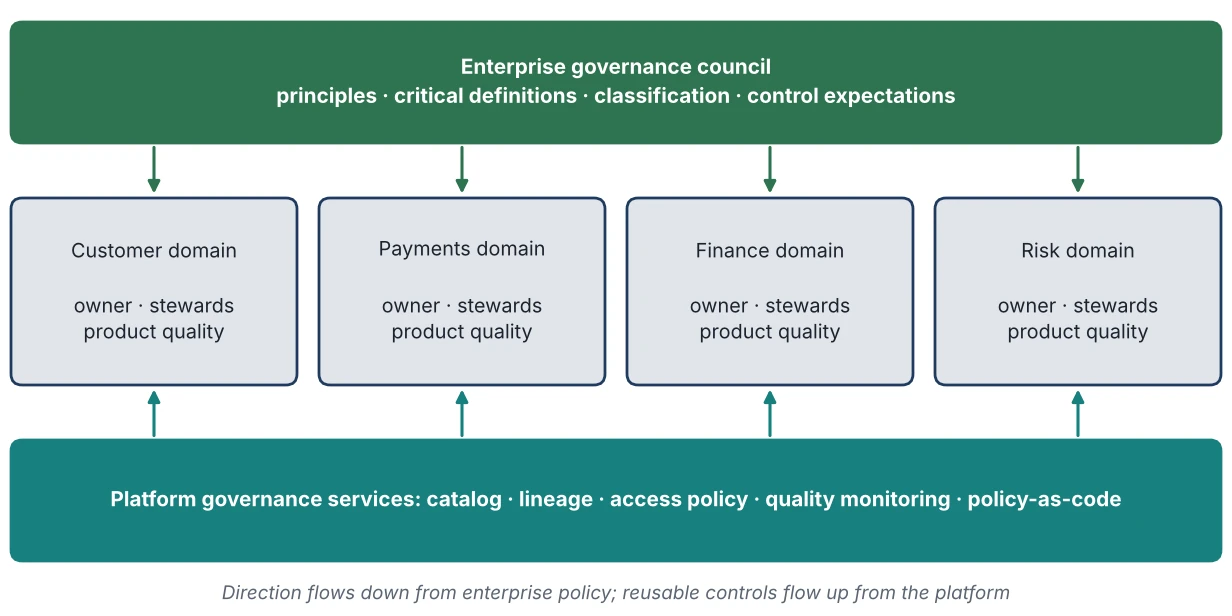
Modern governance therefore combines central coordination with distributed accountability. Enterprise governance establishes common policies, principles, and control expectations. Domains take responsibility for the data they produce and the quality of their products. Platform teams provide reusable capabilities that make governance easier to implement. Risk and control functions provide oversight appropriate to the organization’s obligations.
The result is not governance with fewer rules. It is governance designed to operate as part of the architecture and delivery lifecycle.
17.2 The Objectives of Enterprise Data Governance
A governance program should begin with a clear understanding of what it is intended to achieve. Without defined objectives, governance can become a collection of activities whose value is difficult to demonstrate.
The first objective is to establish accountability. Important data assets need identifiable owners and stewards who understand their business meaning, intended use, and quality expectations. Accountability should be connected to real decision rights rather than assigned only as a title.
The second objective is to establish shared meaning. Enterprise data is often distributed across applications that were built for different purposes. Governance helps define business terms, critical data elements, reference values, metrics, and relationships so that information can be interpreted consistently.
The third objective is to enable appropriate access and use. Data should be available to authorized consumers for legitimate purposes, subject to applicable security, privacy, contractual, and regulatory constraints. Governance must therefore support both protection and enablement.
The fourth objective is to establish trust. Consumers need to understand the source, quality, freshness, lineage, and limitations of the data they use. Trust is not achieved by declaring that a dataset is trusted. It is established through observable evidence and clearly communicated expectations.
The fifth objective is to support compliance and risk management. Organizations must understand their obligations and translate them into operational controls. These controls may apply to data collection, retention, processing, sharing, access, deletion, and use in analytics or AI.
Finally, governance should support change. Data definitions, platforms, business processes, and regulations evolve. A sustainable governance capability must provide a way to assess and manage change without making every modification dependent on a large central approval process.
These objectives reinforce one another. Clear ownership supports quality. Shared semantics support interoperability. Metadata supports discovery and lineage. Access policies support appropriate use. Monitoring provides evidence that controls are operating. Together, they create the foundation for trustworthy enterprise information.
17.3 Governance Principles for the Modern Enterprise
Governance principles provide direction when detailed policies do not cover every situation. They help business and technology teams make consistent decisions while allowing implementation to vary according to context.
A useful principle is that governance should be aligned to business value and risk. Not every dataset requires the same level of control. A public product catalog, a customer identity record, and a regulated financial transaction may have different sensitivity, impact, and quality requirements. Applying the same governance burden to all three can waste effort while failing to provide adequate control where it matters most.
A second principle is that accountability should be close to the point of data creation and use. Domains are often best positioned to understand the meaning and operational context of their data. Enterprise-level governance should establish common expectations, but it should not remove domain responsibility.
A third principle is that governance should be embedded in architecture and delivery. Policies that exist only in documents are difficult to apply consistently. Where practical, requirements should be represented in metadata, data contracts, access policies, workflow controls, automated tests, and monitoring.
A fourth principle is that governance decisions should be transparent and explainable. Teams need to know why a data asset has a classification, why access is restricted, what quality threshold applies, and who can approve an exception.
A fifth principle is that governance should be measurable. Organizations should assess whether ownership is assigned, metadata is complete, critical data quality requirements are met, access reviews occur, and policies are enforced. The measures should indicate whether governance is working, not merely whether governance activities have taken place.
A sixth principle is that governance should support responsible reuse. Reuse can reduce duplication and improve consistency, but only when consumers understand the data product’s intended purpose, limitations, and conditions of use.
These principles can be used to evaluate governance decisions across warehouses, lakehouses, streaming platforms, data products, analytical services, and AI applications.
17.4 Governance Operating Models: Centralized, Federated, and Domain-Oriented
The governance operating model defines how responsibilities and decision rights are distributed across the enterprise. There is no single model that fits every organization. The appropriate design depends on organizational structure, regulatory environment, data maturity, technology landscape, and the degree of domain autonomy.
In a centralized model, a central governance function establishes standards, coordinates stewardship, and may approve important data decisions. This can provide consistency and clear enterprise direction. It may be appropriate where the organization has significant regulatory obligations or where data definitions must be tightly coordinated. However, centralization can become a bottleneck if every operational decision requires central approval.
A federated model distributes responsibility across business units or domains while maintaining enterprise-level coordination. A central function establishes common principles and controls, while domain representatives manage data within their areas. This can improve responsiveness and business alignment, but it requires clear decision rights and mechanisms for resolving disagreements.
A domain-oriented model places substantial responsibility with the teams that produce and manage data products. It aligns naturally with data product and data mesh approaches. Domains define product ownership, quality expectations, metadata, and consumer support within enterprise guardrails. The model can improve accountability, but it depends on strong platform capabilities and consistent standards. Without these, domains may create incompatible definitions, controls, and interfaces.
Many enterprises use a hybrid model. Enterprise governance defines non-negotiable requirements, shared semantics, and risk controls. Domains own their data products and operational quality. Platform teams provide reusable governance services. Specialist functions such as privacy, security, legal, and compliance define requirements within their areas of authority.
The important architectural task is not to select a label. It is to make the operating model explicit. Teams should understand which decisions are enterprise-wide, which are domain-specific, which require consultation, and which can be made independently within established boundaries.
17.5 Governance Roles and Responsibilities
Governance becomes operational when responsibilities are assigned to identifiable roles and connected to actual work.
The data owner is accountable for a defined data asset or domain from a business perspective. The owner helps establish its purpose, quality expectations, permitted uses, and key decisions. In practice, ownership may be assigned to a business role rather than an individual person to ensure continuity when personnel change.
The data steward supports the practical management of data definitions, metadata, quality issues, and governance processes. Stewards often act as a bridge between business users, data producers, and technical teams. Their role should include sufficient authority and time to resolve issues rather than being treated as an informal responsibility added to an already full workload.
The data producer creates or publishes data through operational systems, pipelines, or data products. Producers are responsible for implementing agreed definitions, contracts, metadata, and quality controls within their delivery processes.
The data consumer uses data for operational, analytical, or AI-related purposes. Consumers should follow access conditions, understand product limitations, and communicate issues when the data does not meet its stated expectations.
The platform team provides capabilities that make governance repeatable. These may include identity integration, catalog services, policy enforcement, lineage collection, data quality frameworks, encryption, audit logging, and deployment controls.
The Enterprise Data Architect connects these roles through architecture. The architect helps define common patterns, identify control points, establish metadata requirements, and ensure that governance capabilities work across platforms and domains.
Other functions may include privacy officers, security leaders, records managers, legal teams, compliance specialists, and model risk professionals. Their responsibilities depend on the organization’s structure and applicable obligations.
A responsibility matrix can help clarify who performs, approves, advises, and receives information for important governance activities. It should not become a substitute for clear accountability. If a decision is important, the organization should identify who has the authority to make it and how that authority is exercised.
17.6 Data Ownership and Stewardship in a Distributed Architecture
Distributed architecture makes data ownership more important, not less. When data is copied across platforms and transformed by multiple teams, it can become difficult to identify which source is authoritative, who can resolve a definition conflict, and who is responsible when a data product fails to meet its expectations.
Ownership should be assigned at a level that reflects the business meaning of the data. A customer domain may own the definition and management of customer identity information, while individual applications remain responsible for the operational records they create. A financial reporting domain may own particular reporting measures, while source domains remain accountable for the underlying transactions.
This distinction helps avoid the assumption that one team must own every physical copy of a data element. Governance should distinguish business ownership from technical custody. A platform team may operate the environment in which data is stored, but that does not automatically make the platform team the owner of the data’s meaning or permitted business use.
Stewardship should also be designed around the data lifecycle. A steward may help define terms during data product design, review metadata before publication, coordinate quality issue resolution, and participate in periodic reviews of usage and relevance.
For distributed teams, stewardship processes should be integrated into existing workflows. If a data product cannot be published until required ownership, classification, and metadata fields are completed, governance becomes part of product delivery. If quality issues are routed automatically to the responsible domain, resolution becomes part of operations.
The goal is not to create a large administrative layer. It is to make ownership visible and actionable wherever data is produced, transformed, shared, and used.
17.7 Policies, Standards, and Controls
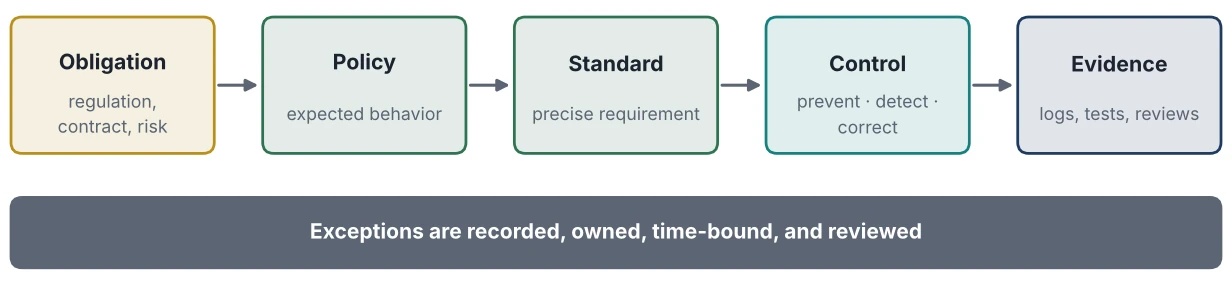
Governance policies describe the organization’s expectations and required behavior. Standards translate those expectations into more specific requirements. Controls provide mechanisms to prevent, detect, or correct non-compliant activity.
For example, a policy may state that sensitive data must be accessible only to authorized users for approved purposes. A standard may define data classification levels and required protection measures for each level. Controls may include identity-based access, encryption, masking, approval workflows, audit logs, and periodic access reviews.
This distinction is important because a policy statement alone does not demonstrate that the organization can enforce it. Conversely, a technical control may be implemented without a clear understanding of the business or regulatory requirement it is intended to satisfy.
Policies should be expressed in language that business and technical stakeholders can understand. Standards should be sufficiently precise to support implementation and testing. Controls should be mapped to the relevant requirements so that the organization can demonstrate how governance is applied.
Governance should also define how exceptions are handled. Some legitimate business needs may not fit a standard pattern. An exception process should identify the decision authority, justification, compensating controls, expiration or review date, and evidence required. Exceptions should be visible and managed rather than becoming permanent undocumented workarounds.
17.8 Metadata and the Enterprise Data Catalog
Metadata is one of the principal mechanisms through which governance becomes visible across a distributed data environment. It describes data assets and provides the context required to discover, understand, access, and manage them.
Technical metadata may describe schemas, tables, columns, formats, storage locations, pipelines, and processing jobs. Business metadata may describe definitions, owners, domains, classifications, and intended uses. Operational metadata may describe freshness, volume, job status, quality results, and service-level expectations. Governance metadata may include access conditions, retention requirements, consent information, and policy references.
An enterprise data catalog brings these descriptions together to support discovery and management. It can help users identify available data products, understand their meaning, assess their suitability, and determine how to request access.
A catalog is not automatically a governance solution. Its value depends on the quality, completeness, freshness, and operational use of its metadata. A catalog containing thousands of poorly described assets may increase confusion rather than reduce it. Metadata should therefore be connected to the processes that create and maintain data assets.
Automation can improve coverage by collecting technical metadata from platforms and pipelines. Business context usually requires domain participation. A useful approach combines automated discovery with accountable stewardship, using required metadata fields and review processes for important assets.
The catalog should also support relationships among assets. Users may need to understand which data product contains a business concept, which pipelines transform it, which reports consume it, and which AI applications retrieve it. These relationships connect governance with lineage, impact analysis, and change management.
17.9 Data Classification and Appropriate Use
Data classification provides a structured way to describe the sensitivity and handling requirements of information. It supports decisions about access, storage, sharing, retention, masking, encryption, and monitoring.
A classification scheme should be understandable and usable. If categories are too numerous or ambiguous, teams may apply them inconsistently. If they are too broad, important differences in risk may be lost. The organization should define categories that reflect its information risks and obligations, then provide practical guidance for assigning them.
Classification should be applied as close as practical to the point where data is created or published. It should also propagate through transformations and copies. A sensitive attribute does not become non-sensitive simply because it is moved into a lakehouse table or included in a data product.
However, classification may need to account for context. A dataset that appears non-sensitive in isolation may become sensitive when combined with other information. Derived attributes and inferred information can also introduce new risks. Governance should therefore consider not only the original source classification but also the sensitivity of the resulting data and its intended use.
Appropriate use is related to, but distinct from, access. A user may be technically authorized to access a dataset while still being restricted from using it for a particular purpose. Governance should make important use limitations visible to consumers and, where feasible, represent them in policy enforcement mechanisms.
This becomes especially important in AI environments, where data may be retrieved dynamically, included in prompts, used to generate embeddings, or passed to external model services. Classification and use conditions should be considered throughout the information lifecycle rather than only at the storage layer.
17.10 Governance Across Data Products and Data Contracts
Data products provide a useful governance boundary because they connect ownership, consumer expectations, interfaces, quality, and permitted use. A well-governed data product makes its responsibilities visible and gives consumers a clear basis for evaluating whether it is suitable. A data product should identify its owner, purpose, domain, schema, definitions, quality expectations, freshness, lineage, access conditions, and support arrangements. Not every product requires identical documentation, but critical information should be consistently represented.
Data contracts extend this approach by defining expectations between producers and consumers. A contract may describe schema, semantics, delivery behavior, quality requirements, compatibility rules, and change notification. It can also include governance requirements such as classification, permitted use, and handling constraints.
Contracts should be treated as managed interfaces, not merely documents. Where feasible, important elements can be validated through automated checks. A schema change may be tested for compatibility. A freshness requirement may be monitored. A classification requirement may be checked during publication. A breaking change may trigger a consumer notification or approval process.
The contract does not eliminate the need for governance. It makes some governance expectations explicit at the point where data is exchanged. Enterprise standards should define which contract elements are mandatory and which can be determined by domains.
A key design consideration is proportionality. Requiring every small internal dataset to follow a heavyweight contract may discourage reuse. Conversely, a critical enterprise data product used by multiple regulated processes requires stronger controls. Governance should distinguish between product criticality and apply requirements accordingly.
17.11 Governance for Cloud and Lakehouse Platforms
Cloud and lakehouse environments can make data more accessible and scalable, but they also create governance challenges. Data may be stored in object storage, accessed through multiple engines, shared across workspaces, and transformed by distributed pipelines. The same underlying data may be exposed through different tables, views, APIs, or analytical services.
Governance must account for these access paths. Applying controls only within one query engine may leave other routes insufficiently governed. The architecture should identify the control points through which users and services access data, and ensure that policy enforcement is consistent with the platform’s capabilities.
Identity and access management provide a foundation. Access should be granted to identifiable users, services, and roles, with permissions aligned to business responsibilities. Broad shared credentials and unmanaged service accounts make accountability difficult.
Data classification should inform access policies. Sensitive fields may require masking or restricted access. Row-level policies may limit records by business relationship or jurisdiction. Encryption and key management protect data at rest and in transit, while audit logging provides evidence of access and administrative activity.
Cloud governance should also address resource and environment management. Data may be copied into development environments, temporary workspaces, or experimental AI projects. Controls should define how sensitive data can be used in non-production environments and whether synthetic or masked data is required.
The Enterprise Data Architect should work with platform, security, and governance teams to establish reusable patterns. The objective is to avoid implementing a separate governance model for every data platform while recognizing that different technologies may require different enforcement mechanisms.
17.12 Governance for Streaming and Real-Time Data
Streaming architectures introduce governance requirements that differ from those of periodic batch processing. Events may be published continuously, consumed by multiple applications, and retained for different periods. Their meaning and schema may evolve while consumers are actively processing them. Event governance should establish ownership, naming conventions, schema definitions, compatibility expectations, classification, and retention rules. Producers should publish events that reflect agreed business semantics. Consumers should understand the event’s purpose, delivery characteristics, and limitations.
Schema registries and event catalogs can support consistency, but they do not replace business governance. A technically valid event may still be ambiguous or unsuitable for a particular consumer. Business definitions and ownership must accompany technical schemas.
Streaming governance should also address replay and retention. Reprocessing events can be useful for recovery or analytical reconstruction, but it may create duplicate actions if consumers are not designed for idempotency. Retention decisions should consider operational needs, legal obligations, privacy requirements, and storage cost.
Real-time systems may act on data before all quality checks can be completed. The architecture should define which checks must occur before an event is accepted, which can occur asynchronously, and how downstream consumers are informed when an event is corrected or invalidated.
This is another reason governance must be integrated into architecture. A policy that assumes all data can be reviewed before use may be incompatible with a real-time decision process. The organization must identify where preventive, detective, and corrective controls are appropriate.
17.13 Governance for AI and Generative AI
AI expands the scope of data governance because information may be used in ways that differ from conventional reporting and application processing. Training data, evaluation data, retrieval corpora, prompts, embeddings, model outputs, and agent interactions all create governance considerations. For traditional machine learning, governance should address data provenance, permitted use, representativeness, quality, retention, and the relationship between training data and model behavior. It should also establish ownership and change controls for datasets and features used in production models.
Generative AI introduces additional questions. An application may retrieve internal documents, summarize customer information, generate recommendations, or send information to a model service. Governance must establish which sources are approved, which users may access them, what information may be included in prompts, and how outputs should be reviewed or retained.
Embedding generation deserves attention because embeddings are derived representations of source content. Their governance should account for source permissions, access boundaries, retention, deletion, and the ability to identify which source material contributed to a retrieval result. Organizations should not assume that transforming information into vectors removes the original governance obligations.
AI applications may also generate new information. Summaries, classifications, recommendations, and extracted attributes should be treated according to their intended use and reliability. A generated summary may be useful for navigation but unsuitable as the authoritative record. A generated classification may require validation before it is used in a consequential workflow.
Agentic systems create further complexity because agents may retrieve data, call tools, and initiate actions. Governance should define the agent’s identity, permissions, allowed tools, data boundaries, approval requirements, and audit expectations. Access should be constrained to the authority required for the task, and actions with material consequences should follow appropriate authorization paths.
The central governance principle is that AI does not create an exemption from data governance. It increases the need to understand information flows, permitted uses, accountability, and evidence.
17.14 Governance Metrics and Effectiveness
Governance programs should be evaluated through measures that indicate whether the organization is achieving its objectives. Counting policies, committees, or training sessions may show activity, but it does not necessarily demonstrate effective governance.
Useful measures can include the proportion of critical data products with assigned owners, the completeness of required metadata, the percentage of critical data elements with approved definitions, the time required to resolve significant quality issues, and the coverage of lineage for important information flows.
Access governance may be evaluated through the timeliness of access reviews, the number of unresolved access exceptions, and the effectiveness of controls for sensitive data. Data product governance may be assessed through contract coverage, consumer satisfaction, incident frequency, and the reliability of published quality and freshness expectations.
AI governance measures may include the proportion of production AI applications with documented data sources and approved use conditions, the coverage of access controls across retrieval sources, and the completeness of records needed to investigate significant outputs or actions.
Metrics should be interpreted in context. A high metadata completion rate does not guarantee that metadata is accurate. A low number of reported quality incidents may reflect weak detection rather than strong quality. A large number of access restrictions may indicate effective protection or an unnecessarily restrictive operating model.
Governance measurement should therefore combine quantitative indicators with periodic reviews by business and control stakeholders. The objective is to understand whether governance enables trusted, appropriate, and effective data use.
Case study: Meridian Financial Group
17.15 Enterprise Data Governance at Meridian Financial Group
Meridian Financial Group operates across several business domains, each with its own applications, analytical environments, and reporting practices. Customer, account, transaction, product, and risk information is distributed across legacy systems and cloud platforms. Governance responsibilities are inconsistently assigned, and data definitions vary across business units.
The organization’s governance council has historically focused on standards and issue escalation. While this has provided a degree of enterprise coordination, business teams often regard governance as a separate approval process rather than part of their delivery responsibilities. Data product and AI initiatives are exposing the limitations of this model.
Meridian begins by defining a federated governance operating model. The enterprise governance council establishes common principles, critical business definitions, classification requirements, and control expectations. Business domains appoint accountable data owners and stewards. Platform teams provide reusable capabilities for cataloging, lineage, access control, quality monitoring, and policy enforcement.
The architecture team identifies a set of critical enterprise data products, beginning with customer identity, account, transaction, and product reference information. Each product receives an accountable owner, a documented purpose, agreed definitions, quality expectations, and access conditions. Technical metadata is collected from the platform, while business metadata is maintained through domain stewardship.
Meridian also introduces data contracts for selected products that are consumed by multiple applications. The contracts specify schema expectations, key business semantics, freshness requirements, and change notification. Automated checks validate important contract elements during deployment and operation.
As the organization expands its generative AI use cases, governance is extended to retrieval sources and AI application workflows. Approved knowledge sources are classified and assigned owners. Retrieval access is aligned with user permissions. AI teams document which data sources are used, how content is refreshed, and what limitations apply to generated outputs. Agents are given scoped identities and tool permissions, with approval requirements for actions that can materially affect customers or financial operations.
The new model does not eliminate central governance. It changes how central governance works. Instead of reviewing every data change manually, the enterprise establishes common requirements and reusable controls. Domains remain accountable for their products, while the platform makes important governance practices easier to apply consistently.
Meridian measures progress through ownership coverage, metadata completeness for critical assets, quality issue resolution, contract compliance, and control evidence. It also reviews whether governance processes are slowing legitimate business use. This helps the organization balance risk management with the need to make trusted information available.
The case illustrates that modern governance is not a choice between central control and complete domain autonomy. It is an architecture of shared rules, distributed responsibility, reusable controls, and visible evidence.
17.16 Practical Artifact: Enterprise Data Governance Design Assessment
This assessment can be used to evaluate an existing governance program or to design governance for a new data platform, data product ecosystem, or AI initiative.
Step 1: Establish Governance Objectives
Identify the business and risk outcomes that governance must support. These may include consistent reporting, trusted data products, appropriate access, regulatory compliance, responsible AI use, or improved issue resolution. Confirm that the objectives are specific enough to guide architectural decisions.
Step 2: Identify Decision Rights
Document which governance decisions are enterprise-wide, domain-specific, platform-specific, or owned by specialist control functions. Identify the accountable role for each important decision and define how conflicts are resolved.
Step 3: Map Roles to the Data Lifecycle
Identify who is responsible for data definition, creation, publication, access, quality, sharing, retention, and retirement. Distinguish business ownership from technical custody and ensure that stewardship responsibilities are supported by workable processes.
Step 4: Review Policies and Standards
Identify the policies that apply to the data environment and map them to implementation standards and controls. Look for policies that are ambiguous, duplicated, outdated, or disconnected from the platforms where data is used.
Step 5: Assess Metadata and Catalog Capabilities
Review whether critical assets have complete and accurate ownership, definition, classification, lineage, quality, and access metadata. Determine which metadata can be collected automatically and which requires business stewardship.
Step 6: Assess Enforcement Mechanisms
Evaluate how governance requirements are implemented across storage, processing, integration, data products, streaming, analytics, and AI applications. Identify control gaps between policy intent and technical enforcement.
Step 7: Extend Governance to AI Use Cases
For each relevant AI application, identify its data sources, retrieval content, prompts, derived representations, model interactions, generated outputs, and potential actions. Confirm that permissions, use conditions, accountability, and audit requirements are defined.
Step 8: Define Measures and Improvement Priorities
Select measures that indicate whether governance is effective. Establish a baseline, identify major gaps, and prioritize improvements based on business impact, risk, feasibility, and dependencies.
| Assessment dimension | Questions to consider | Potential evidence |
|---|---|---|
| Objectives and scope | Are governance goals connected to business and risk outcomes? | Governance charter, objectives, scope |
| Decision rights | Are accountability and approval authority clear? | Role definitions, decision records |
| Ownership and stewardship | Are critical assets assigned to capable owners and stewards? | Ownership registry, stewardship process |
| Policies and standards | Are requirements clear, current, and implementable? | Policies, standards, control mappings |
| Metadata and lineage | Can users understand critical assets and their relationships? | Catalog records, lineage coverage |
| Access and appropriate use | Are permissions and use conditions enforced? | Access policies, audit records, reviews |
| Data products and contracts | Are consumer expectations and responsibilities explicit? | Product definitions, contracts, quality measures |
| AI governance | Are AI data flows, sources, permissions, and actions governed? | AI inventory, source records, evaluation and audit evidence |
| Monitoring and remediation | Are control failures detected and resolved? | Alerts, issue logs, remediation records |
| Effectiveness | Do measures demonstrate trusted and appropriate data use? | Metrics, reviews, improvement plans |
The output should be a governance improvement roadmap that connects organizational changes with architectural capabilities. It should identify what must be clarified, what can be automated, what requires stronger accountability, and where the enterprise needs additional control evidence.
Remember these
Key Takeaways
- Modern enterprise data governance is an operational capability that connects accountability, shared meaning, appropriate use, trust, compliance, and change management.
- Traditional governance practices remain valuable, but they must evolve to support distributed domains, cloud platforms, data products, streaming architectures, and AI systems.
- Effective governance combines enterprise-wide policies and controls with distributed domain responsibility.
- Data ownership should reflect business accountability, while technical custody and platform operation should be treated as distinct responsibilities.
- Policies, standards, and controls serve different purposes and should be connected so that governance intent can be implemented and demonstrated.
- Metadata, catalogs, lineage, classification, and data contracts help make governance visible and actionable across the data lifecycle.
- Governance should be embedded into architecture and delivery workflows wherever practical, rather than relying exclusively on manual review.
- AI governance must account for source data, retrieval content, embeddings, prompts, generated outputs, model interactions, and agent permissions.
- Governance effectiveness should be measured through evidence of trusted and appropriate data use, not merely through the volume of governance activity.
- The Enterprise Data Architect helps translate governance objectives into reusable architectural patterns, platform capabilities, and controls that support responsible enterprise data use.
Think about your own organization
Architect’s Reflection
Consider how governance works in your organization today. Are policies understood by the teams that build and operate data products? Can users identify who owns a critical data asset? Are access conditions and quality expectations visible where data is consumed? Can the organization trace important information through its platforms and AI applications?
Then consider where governance is creating friction. Are teams waiting for approvals that could be handled through clear standards and automated controls? Are domains making decisions that should be coordinated enterprise-wide? Are important controls dependent on individual knowledge rather than repeatable processes?
Modern governance requires both discipline and practicality. Too little governance creates ambiguity, risk, and inconsistent information. Too much centralized process can prevent teams from responding to legitimate business needs. The architect’s role is to help design the boundaries, shared capabilities, and accountability mechanisms that make responsible use possible at enterprise scale.
The central question is not whether the enterprise has a governance framework. It is whether governance is present in the decisions, interfaces, controls, and operating practices through which data is actually used.