Why this chapter matters
Introduction
The purpose of enterprise data and AI architecture is not simply to make data available or to introduce intelligent technologies. Its deeper purpose is to improve how an enterprise understands its environment, evaluates alternatives, makes decisions, and acts. Data platforms create the conditions for analysis. AI systems can identify patterns, generate explanations, and support complex workflows. Yet these capabilities produce enterprise value only when they are connected to decisions that matter.
Decision intelligence brings together data, analytics, business knowledge, AI, decision processes, and organizational accountability. It provides an architectural perspective on how decisions are made across the enterprise, how evidence informs those decisions, and how outcomes are measured. It also recognizes that many important decisions are not purely analytical. They involve policies, constraints, professional judgment, regulatory obligations, and competing business objectives.
For the Enterprise Data Architect, this creates a broader responsibility. The architect must understand not only where data originates and how it moves, but also how it influences operational and strategic decisions. This requires connecting information architecture, data products, semantic models, analytical platforms, AI capabilities, business processes, and decision governance into a coherent architecture.
This chapter examines enterprise decision intelligence as an architectural capability. It explores the relationship between data, analytics, AI, and decisions; distinguishes decision support from decision automation; and describes the architectural components needed to make decisions traceable, governed, and continuously improvable. The Meridian Financial Group case study illustrates how an enterprise can move from fragmented reporting and isolated AI experiments toward a connected decision intelligence capability.
16.1 From Data and Analytics to Decision Intelligence
Enterprises have invested in data warehouses, business intelligence platforms, advanced analytics, and increasingly, AI. These investments have improved the ability to collect information, produce reports, detect trends, and build predictive models. However, the presence of analytical capability does not automatically mean that an organization makes better decisions.
A dashboard may show that customer attrition is increasing, but it may not explain which customers are at risk, what actions are available, or which intervention is appropriate for each customer. A predictive model may estimate the likelihood of fraud, but the organization still needs a decision process that determines how to investigate, escalate, or decline a transaction. A generative AI assistant may summarize a policy, but a business process must still establish who is authorized to act on that summary and what evidence is required.
Decision intelligence addresses the gap between producing insight and using insight. It treats decisions as explicit organizational objects that can be understood, modeled, supported, governed, and improved. A decision has a purpose, an owner, a set of possible actions, relevant evidence, constraints, and an expected outcome. It may be made by a person, a system, or a combination of both.
This perspective changes the architectural question. Instead of asking only, “How do we make the data available?” the architect also asks, “Which decision does this information support, what evidence is required, and how will the organization know whether the decision produced the intended result?”
The distinction is important because data and AI programs can become technology-led. Teams may select platforms, build pipelines, create models, and deploy assistants without a sufficiently clear understanding of the decisions those capabilities are intended to improve. Decision intelligence provides a business-oriented organizing principle for connecting these investments to enterprise outcomes.
16.2 Understanding Enterprise Decisions
Enterprise decisions vary in purpose, frequency, consequence, and degree of uncertainty. Some are strategic and infrequent, such as entering a new market or changing the enterprise operating model. Others are operational and repeated thousands or millions of times, such as approving a transaction, prioritizing a service request, or determining whether a customer interaction requires escalation.
A useful architecture begins by classifying decisions according to their characteristics rather than assuming that all decisions should be supported in the same way.
Strategic decisions typically involve long time horizons, incomplete evidence, multiple stakeholders, and significant uncertainty. They may draw on scenario analysis, market intelligence, financial projections, and executive judgment. Tactical decisions translate strategic direction into resource allocation, policy, and operational priorities. Operational decisions are often more frequent and may be supported by rules, analytical models, workflow systems, or AI-assisted recommendations.
The boundaries between these categories are not absolute. A strategic decision may depend on operational evidence, while an operational decision may have cumulative strategic consequences. The purpose of classification is not to create rigid organizational categories. It is to help architects understand the decision’s context, risk, information requirements, and appropriate level of automation.
A decision can also be examined through several common elements:
- Decision objective: The outcome the organization is trying to achieve.
- Decision owner: The person or organizational role accountable for the decision.
- Decision context: The business situation in which the decision occurs.
- Evidence: The data, knowledge, policies, and analysis used to inform it.
- Alternatives: The available actions or choices.
- Constraints: The policies, regulations, thresholds, and operational limits that apply.
- Decision mechanism: The rules, judgment, model, workflow, or combination used to select an action.
- Outcome: The result that follows from the decision.
- Feedback: The information used to evaluate and improve future decisions.
These elements create a foundation for architectural analysis. They make it possible to identify where data is needed, where business rules are applied, where AI contributes, and where accountability must remain with a designated role.
16.3 Decision Support, Decision Augmentation, and Decision Automation
Not every decision should be automated. The appropriate relationship between people and technology depends on the decision’s risk, repeatability, reversibility, regulatory context, and the quality of available evidence.
Decision support provides information that helps a person make a decision. A dashboard, analytical report, search interface, or AI-generated summary may support this role. The system presents evidence, but the decision remains with the human decision-maker.
Decision augmentation goes further. The system analyzes information, identifies patterns, estimates outcomes, or recommends possible actions. A human reviews the recommendation, considers additional context, and decides whether to accept, modify, or reject it. Augmentation can be valuable where decisions are complex but still require professional judgment or explicit accountability.
Decision automation allows a system to select and execute an action within defined boundaries. Automation may be appropriate for high-volume, well-understood, low-risk decisions where the organization has established clear policies and effective monitoring. Even then, the architecture must account for exceptions, changing conditions, and the possibility that the system’s assumptions no longer hold.
These modes can coexist within one decision process. A transaction may be automatically processed when it satisfies established conditions, routed for additional analysis when an anomaly is detected, and escalated to a human reviewer when the evidence is ambiguous or the potential impact is high.
The architecture should therefore make the decision mode explicit. It should identify which steps are automated, which are advisory, and which require human authorization. It should also define what happens when information is missing, a model is unavailable, confidence is insufficient, or a policy constraint is triggered.
A common architectural mistake is to treat automation as the natural endpoint of every analytics or AI initiative. In practice, the goal is not maximum automation. It is an appropriate and governed relationship between people, evidence, and systems.
16.4 The Decision Intelligence Architecture
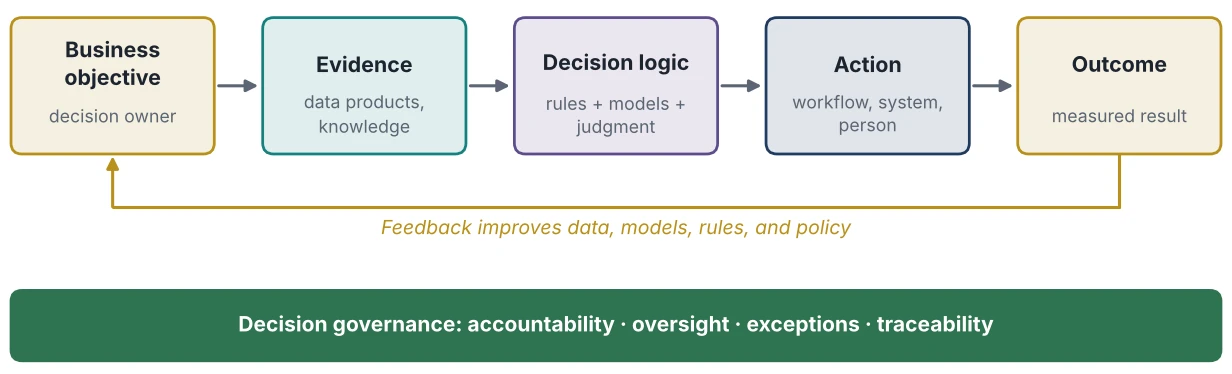
Decision intelligence is not a single product or platform. It is a set of connected architectural capabilities that allow an enterprise to move from business context to evidence, decision, action, and feedback. A decision intelligence architecture typically includes several layers:
- Business decision architecture describes important decisions, their owners, objectives, dependencies, and relationship to business capabilities and processes. It helps the enterprise identify where decisions occur and which decisions have the greatest business significance.
- Data and information architecture provides the trusted information required to understand the decision context. This includes operational data, analytical data, master and reference data, metadata, lineage, and governed data products.
- Semantic and knowledge architecture provides shared meaning. Business terms, metrics, entities, relationships, policies, and contextual knowledge help ensure that decision participants and systems interpret evidence consistently.
- Analytics and AI architecture provides descriptive, diagnostic, predictive, and generative capabilities. These capabilities may include reporting, statistical analysis, machine learning, optimization, retrieval-augmented generation, and agentic workflows.
- Decision logic and orchestration connects evidence to action. It may include business rules, decision tables, scoring services, workflow engines, model-serving services, and APIs that coordinate decision processes.
- Experience and action systems present evidence and recommendations to users or execute approved actions through operational applications, workflow platforms, and enterprise services.
- Governance and feedback establish accountability, policy controls, monitoring, outcome measurement, and mechanisms for improvement.
These layers should not be interpreted as a mandatory technology stack. They describe architectural responsibilities that may be implemented through different products and deployment patterns. In some enterprises, decision logic may reside within operational applications. In others, it may be exposed through reusable decision services. The architecture should reflect the organization’s scale, risk profile, technology landscape, and operating model.
16.5 Connecting Business Decisions to Data Products
A decision intelligence architecture depends on information that is relevant, trusted, timely, and understandable. Enterprise data products provide a way to organize and expose that information around defined business needs.
A data product should not be considered valuable merely because it makes a dataset accessible. Its value depends on whether it supports a meaningful consumer need. For decision intelligence, that need may be a specific decision or a group of related decisions.
Consider a customer retention decision. The organization may need customer profile information, product holdings, interaction history, service incidents, transaction patterns, customer preferences, and relevant consent information. These data elements may originate in different systems and be owned by different domains. A decision-oriented architecture identifies the information required, clarifies its meaning, and establishes how it can be accessed under appropriate controls.
A customer data product may provide a governed view of customer identity and relationships. A service interaction product may expose relevant interaction history. A product holdings product may describe the customer’s current relationship with the organization. These products can be composed into a decision context without requiring each decision team to recreate the same integration logic.
The relationship between data products and decisions should be documented. This includes the intended use, business definitions, freshness expectations, quality requirements, access conditions, and limitations. A data product designed for financial reporting may not be suitable for a real-time operational decision without additional controls or transformation.
The architect should also distinguish between data product availability and decision readiness. A dataset can be technically accessible but unsuitable for a particular decision because it is stale, incomplete, poorly defined, or not authorized for that use. Decision readiness requires evaluating the data in the context of the decision’s purpose and risk.
16.6 Decision Models, Business Rules, and Analytical Models
Decision intelligence brings together several forms of logic. These forms should be distinguished because they have different ownership, governance, and lifecycle requirements.
Business rules express policies, constraints, and conditions that guide action. They may determine eligibility, thresholds, required approvals, or exception handling. Rules are often relatively explicit and may be maintained by business or policy owners in collaboration with technology teams.
Analytical models use data to describe, explain, predict, or optimize. A forecasting model may estimate future demand. A classification model may identify a pattern associated with a particular outcome. An optimization model may evaluate possible allocations against defined objectives and constraints.
Generative AI models provide additional capabilities, such as interpreting unstructured information, summarizing evidence, translating natural-language requests into structured queries, or assisting users in exploring alternatives. Their outputs may be probabilistic and require validation, especially when used in consequential workflows.
A decision model coordinates these elements. It defines how evidence, rules, model outputs, and human judgment contribute to a decision. For example, a model may estimate a risk score, while a policy rule determines whether the case requires review. A human reviewer may then consider additional evidence before making the final decision.
The architecture should avoid embedding all decision logic inside a single model or application. When business rules, analytical models, and workflow decisions are tightly coupled, changes become difficult to govern and test. Separating concerns where practical allows each capability to evolve under an appropriate lifecycle.
This separation does not mean every rule or model must become a standalone service. Excessive decomposition can create operational complexity. The appropriate design depends on reuse, change frequency, scale, latency, ownership, and control requirements.
16.7 Descriptive, Diagnostic, Predictive, and Prescriptive Intelligence
Decision intelligence often uses a progression of analytical capabilities. These categories describe different questions that an organization may ask, but they should not be treated as a mandatory maturity sequence. Descriptive analytics explains what has happened or what is happening. It provides measures, trends, and summaries. Diagnostic analytics investigates why a particular outcome occurred by examining contributing factors, relationships, and patterns.
Predictive analytics estimates what may happen under specified conditions. It can support decisions involving demand, risk, customer behavior, service needs, or operational performance. Predictions are estimates rather than guarantees, and their usefulness depends on data quality, model validity, and the stability of the environment.
Prescriptive analytics evaluates possible actions in relation to objectives and constraints. It may use optimization, simulation, decision analysis, or combinations of analytical techniques to compare alternatives.
Generative AI can complement these capabilities by making information easier to explore, explaining analytical results, or helping users formulate questions. It does not replace the need for sound analytical methods. A natural-language explanation of a prediction is not itself evidence that the prediction is valid.
An enterprise may combine all four categories in one decision process. A supply chain decision, for example, may use descriptive measures of current inventory, diagnostic analysis of delays, predictive estimates of future demand, and optimization to evaluate replenishment options. The final action may still require human approval because of contractual, financial, or operational constraints.
16.8 Generative AI as a Decision Intelligence Interface
Generative AI changes how people interact with enterprise information. Users can ask questions in natural language, request summaries, explore scenarios, and obtain explanations without needing to understand every underlying data structure or query language. This can make decision support more accessible, but it also introduces architectural responsibilities. A conversational interface must interpret the user’s intent, identify the relevant information, apply access controls, retrieve appropriate context, and communicate the limits of the available evidence.
For analytical questions, a generative AI system may translate a request into a structured query or invoke a governed analytical service. The architecture should validate the query, enforce row-level and column-level access policies, and distinguish retrieved results from model-generated interpretation. It should not rely on the language model alone to enforce enterprise authorization.
For knowledge-intensive decisions, retrieval-augmented generation may provide access to policies, procedures, contracts, or business documentation. The retrieved material should have identifiable sources, suitable permissions, and clear currency. The system should present citations or source references where the use case requires users to verify the underlying evidence.
Generative AI may also help users compare alternatives. It can summarize assumptions, identify missing information, and explain possible implications. However, a generated scenario should not be confused with a validated forecast or approved recommendation. The architecture should label the nature of the output and provide a way to inspect the evidence and assumptions behind it.
A decision intelligence interface should support user understanding rather than merely produce fluent answers. Useful features may include evidence summaries, source links, confidence or uncertainty indicators where technically meaningful, policy reminders, escalation paths, and explicit confirmation before consequential actions.
16.9 Decision Context and Enterprise Semantics
A decision cannot be interpreted reliably without context. The same metric may have different meanings across business units, products, regions, or regulatory environments. A customer may be represented differently across systems. A risk threshold may depend on product type, jurisdiction, or policy version.
Semantic architecture provides a shared foundation for interpreting this information. Business glossaries, conceptual models, ontologies, knowledge graphs, and governed metrics can help establish consistent meaning across decision processes.
For example, an enterprise may define “active customer” differently for marketing, financial reporting, and service operations. If a decision system uses the term without identifying the applicable definition, users may interpret the result incorrectly. A governed semantic layer can expose the definition, relevant attributes, and permitted uses.
Context also includes time. A decision may depend on the information available at the time it was made, not simply the latest value in a source system. Reconstructing historical decisions may require temporal data, policy versions, model versions, and records of the evidence presented to the decision-maker.
This is particularly important for regulated or high-impact decisions. The organization may need to explain why a decision was made, which information was considered, what policy applied, and who or what authorized the resulting action. The Enterprise Data Architect should therefore treat semantics and context as operational capabilities, not documentation exercises. Their value becomes visible when different systems and teams can interpret evidence consistently and when decision histories can be reconstructed.
16.10 Decision Governance and Accountability
Decision governance defines who is accountable for a decision, which evidence and methods may be used, what controls apply, and how outcomes are reviewed. It connects data governance, model governance, business policy, operational risk, and organizational authority.
The decision owner is accountable for the business decision, even when technology supports or automates parts of the process. Data owners remain responsible for the defined quality and use conditions of their data products. Model owners are responsible for the model lifecycle and its approved operating conditions. Technology owners are responsible for the reliability and security of the systems that implement the decision process.
These responsibilities should be explicit. Without clear ownership, an enterprise may deploy a model into a workflow without anyone being accountable for its ongoing suitability. Alternatively, a business owner may be accountable for an outcome but lack visibility into the data, rules, and model behavior that shaped it.
Governance should be proportionate to the decision’s impact. A low-risk internal prioritization process may need lightweight controls. A decision affecting customer eligibility, financial exposure, employment, access to services, or regulatory obligations may require more formal review, documentation, testing, and human oversight.
Decision governance should address at least the following questions:
- Who owns the business decision and its intended outcome?
- What data and knowledge sources are approved for the use case?
- Which rules, models, and policies govern the decision?
- What level of human review is required?
- How are exceptions and appeals handled?
- What evidence must be retained?
- How will performance, fairness, reliability, and unintended effects be monitored?
- Who can suspend or change the decision process?
These questions should be answered before a decision capability becomes operational, not after an incident reveals that accountability was unclear.
16.11 Measuring Decision Quality and Business Outcomes
A decision intelligence capability should be evaluated by more than the availability of data, model accuracy, or system performance. Those measures are important, but they do not fully explain whether the decision process is creating value.
Decision quality can be assessed through several dimensions. These include the relevance and reliability of the evidence, the consistency of the decision process, the timeliness of the decision, the appropriateness of the action, and the degree to which the outcome aligns with the intended objective.
Business outcome measures vary by decision. A fraud investigation process may consider detection effectiveness, false positives, investigation workload, and financial loss. A customer service decision may consider resolution time, customer experience, repeat contacts, and cost to serve. A supply chain decision may consider availability, inventory levels, delivery performance, and operating cost.
The organization should distinguish between model performance and decision performance. A model can achieve strong predictive performance while producing limited business value if its output does not change an action or if the action is poorly designed. Conversely, a model with imperfect predictive performance may still provide value when it improves prioritization and is used with appropriate human review.
Measurement also requires a baseline. Without a clear understanding of the existing process, it can be difficult to determine whether a new decision capability has improved outcomes. Where possible, organizations should define the intended outcome, comparison method, evaluation period, and known limitations before deployment.
Some outcomes are influenced by factors beyond the decision system. Market conditions, policy changes, user behavior, and operational capacity may affect results. Evaluation should therefore avoid attributing every observed change to the technology.
16.12 Decision Observability and Continuous Improvement
Traditional observability focuses on whether systems are operating as expected. Decision observability extends this perspective to whether decision processes are producing appropriate and reliable outcomes.
At the technical level, observability may include pipeline freshness, service availability, query performance, model latency, error rates, and workflow execution. At the decision level, it may include the distribution of recommendations, human override rates, exception volumes, decision cycle time, outcome measures, and changes in input data.
Decision observability should make it possible to identify when a decision process is behaving differently from its approved operating assumptions. A sudden increase in overrides may indicate that users no longer trust a recommendation, that the environment has changed, or that the model is no longer suitable. A decline in the quality of a source dataset may affect several downstream decisions even if the systems remain technically available.
The architecture should connect decision logs with relevant data lineage, model versions, policy versions, and workflow records. This supports investigation and enables the organization to understand which components contributed to a particular result.
Continuous improvement should be governed. Changes to decision rules, models, data sources, or automation boundaries may alter business outcomes and risk exposure. The organization should define how changes are tested, approved, deployed, and monitored. Where appropriate, it should retain the ability to roll back a change or return a process to a human-led mode.
Decision observability is therefore not simply a dashboard for AI operations. It is a capability for understanding and improving the full decision lifecycle.
16.13 Decision Intelligence and the Intelligent Enterprise Operating Model
Decision intelligence requires coordination across business, data, analytics, AI, technology, risk, and operations. It cannot be delivered effectively by a centralized data team acting alone.
Business leaders identify the decisions that matter and own the intended outcomes. Domain teams understand the context and policies of their business areas. Data product teams provide governed information. Analytics and AI teams develop models and decision-support capabilities. Enterprise architects connect these capabilities to the broader technology and information landscape. Risk, legal, privacy, and compliance functions establish controls appropriate to the use case.
The operating model should balance enterprise consistency with domain autonomy. Common principles, semantic definitions, security controls, model governance, and observability standards help prevent fragmentation. Domain teams should retain the ability to design decision processes that reflect their business context.
A decision portfolio can help coordinate investment. It identifies important decisions, their business value, risk, current maturity, information dependencies, and opportunities for improvement. This makes it possible to prioritize work based on business need rather than the availability of a particular technology.
The operating model should also account for the lifecycle after deployment. Decision capabilities require owners, service levels, monitoring, user support, change management, and periodic review. A successful pilot is not necessarily an operational capability. The enterprise must be prepared to maintain the underlying data, models, rules, integrations, and controls over time.
16.14 Architectural Patterns for Enterprise Decision Intelligence
Several architectural patterns can support decision intelligence. They are not mutually exclusive and may be combined within a single enterprise.
Decision support pattern. Governed data products and analytical services provide evidence through dashboards, reports, or user interfaces. A human makes the decision. This pattern is appropriate when professional judgment is central or when automation is not justified.
Decision service pattern. A reusable service evaluates inputs against business rules, analytical models, or both, and returns a recommendation or decision result. This pattern can reduce duplication when multiple applications require consistent decision logic.
Human-in-the-loop pattern. A system prepares a recommendation, presents supporting evidence, and routes the case to an authorized person for review. The person may approve, reject, or modify the recommendation. This pattern is useful when decisions are consequential or require contextual judgment.
Event-driven decision pattern. An event triggers evaluation of relevant data and decision logic. The system may take an approved action, create a case, or notify a user. This pattern supports timely decisions in operational environments, provided that event quality, ordering, duplication, and recovery are addressed.
AI-assisted knowledge decision pattern. A generative AI interface retrieves governed enterprise knowledge and provides summaries or explanations to support a human decision. Source traceability, access control, and clear separation between evidence and generated interpretation are central requirements.
Closed-loop decision pattern. The system captures the outcome of an action and uses that information to evaluate or improve future decisions. The feedback may support analytics, model retraining, policy review, or process redesign. The organization must ensure that feedback is interpreted carefully and does not automatically reinforce unintended behavior.
16.15 Selecting the Appropriate Decision Architecture
The appropriate architecture depends on the characteristics of the decision, not simply on the newest available technology. Before selecting a pattern, the architect should understand the decision’s business purpose, frequency, consequence, reversibility, and uncertainty.
A high-volume decision with clear policies and reliable inputs may be suitable for automation. A decision with significant consequences and ambiguous evidence may require human review. A decision involving unstructured documentation may benefit from retrieval and generative AI, while a decision involving numerical optimization may require a specialized analytical approach.
Latency is another important consideration. Some decisions can tolerate batch processing and periodic review. Others must be made within seconds or as part of an interactive workflow. The architecture must account for data freshness, processing time, model response time, and the operational consequences of delay.
Reuse also matters. If multiple applications implement the same decision logic independently, a shared decision service may improve consistency. However, centralizing every decision can create a bottleneck or obscure domain-specific context. Reuse should be balanced against autonomy and the cost of operating shared services.
The architect should consider failure behavior as carefully as normal operation. If a model becomes unavailable, should the process fall back to a rule-based approach, route the case to a person, or stop processing? If required evidence is missing, should the system defer the decision? If a policy changes, how will active workflows be handled?
A decision architecture is complete only when it describes not just how a decision is made under normal conditions, but also how the enterprise detects, manages, and recovers from conditions in which the decision mechanism is unsuitable.
Case study: Meridian Financial Group
16.16 Enterprise Decision Intelligence at Meridian Financial Group
Meridian Financial Group has developed a broad data and analytics environment, but its decision processes remain fragmented. Customer service, fraud operations, lending, risk management, and product teams use different data sources and definitions. Several decisions depend on manually assembled reports, while others are supported by models embedded in individual applications.
Meridian’s leadership wants to improve customer experience, operational efficiency, and risk management. Early AI initiatives have focused on conversational assistants and predictive models. However, the organization recognizes that these initiatives will not deliver consistent value unless they are connected to well-defined decisions, trusted information, and accountable operating processes.
The architecture team begins by establishing a decision portfolio. Rather than starting with a list of AI use cases, the team identifies important decisions across selected business capabilities. Each decision is documented with its owner, objective, current process, information requirements, applicable policies, and outcome measures.
One initial focus is the prioritization of customer service cases. Today, cases are routed using a mixture of static rules and manual judgment. Relevant information is distributed across customer, product, interaction, and service systems. The same customer may appear differently across applications, and the organization lacks a consistent view of recent interactions.
The team defines a decision architecture in which governed data products provide customer identity, product relationship, and service interaction information. A semantic layer standardizes important concepts such as customer, active relationship, unresolved case, and service priority. Analytical models may estimate case complexity or the likelihood of repeat contact. A decision service combines these signals with business rules to recommend a routing priority.
Generative AI is introduced as an assistive capability. It summarizes relevant interaction history and retrieves approved service procedures for authorized users. It does not independently determine customer eligibility or override policy. The service representative remains responsible for decisions that require judgment, while the system records the evidence and recommendations presented.
Meridian also establishes explicit exception handling. Cases with missing information, conflicting evidence, or high potential impact are routed for human review. The architecture records which data products, rules, model versions, and policy versions contributed to the recommendation. Outcome measures include case resolution time, repeat contact, routing changes, and service quality indicators.
The organization initially limits automation to low-risk routing actions that meet defined conditions. It monitors override patterns and reviews them with business owners. When a source system changes or a data product falls below its freshness requirements, affected recommendations can be restricted or routed through an alternative process.
Over time, Meridian applies the same architectural approach to additional decisions. The decision portfolio helps the organization reuse common capabilities without assuming that every business decision should use the same model or workflow. The case illustrates a central principle: decision intelligence is not achieved by adding AI to an existing process. It emerges when the enterprise deliberately connects decision ownership, trusted data, shared meaning, analytical capabilities, operational workflows, governance, and outcome feedback.
16.17 Practical Artifact: Enterprise Decision Intelligence Assessment
The following assessment can be used to evaluate a decision process or a portfolio of enterprise decisions. It is designed to reveal architectural gaps and establish a practical improvement agenda.
Step 1: Define the Decision
Select a decision that is important to a business capability or value stream. Document its objective, owner, frequency, affected stakeholders, and expected outcome. Avoid defining the initiative solely as a technology implementation.
Step 2: Map the Decision Lifecycle
Describe how the decision is initiated, what evidence is gathered, how alternatives are evaluated, who or what selects an action, how the action is executed, and how the outcome is reviewed. Include exceptions and escalation paths.
Step 3: Identify Information Dependencies
List the data products, operational systems, analytical sources, documents, policies, and semantic definitions required. For each important source, record its owner, quality expectations, freshness, access conditions, and known limitations.
Step 4: Identify Decision Logic
Separate business rules, analytical models, generative AI capabilities, workflow logic, and human judgment. Document how they interact and which components are authoritative for different parts of the decision.
Step 5: Assess Risk and Accountability
Identify the decision owner, technology owners, data owners, model owners, and relevant control functions. Document the impact of an incorrect decision, the required level of human oversight, and the evidence that must be retained.
Step 6: Define Outcome Measures
Establish measures that reflect the decision’s purpose. Include operational performance, business outcomes, user experience, and relevant risk indicators. Define a baseline and an evaluation approach.
Step 7: Assess Operational Readiness
Review monitoring, exception handling, fallback behavior, change management, service ownership, and recovery procedures. Confirm that the organization can operate the decision capability beyond an initial pilot.
Step 8: Prioritize Architectural Improvements
Group findings into improvements to information quality, data products, semantics, decision logic, AI capabilities, governance, integration, and observability. Prioritize based on business importance, risk, dependency, and implementation effort.
| Assessment area | Key question | Evidence to collect |
|---|---|---|
| Decision definition | Is the decision clearly described and owned? | Decision record, accountable owner, intended outcome |
| Information readiness | Is the required evidence trusted and fit for purpose? | Data products, quality measures, lineage, freshness |
| Semantic consistency | Are business terms and metrics interpreted consistently? | Glossary, definitions, metric specifications |
| Decision logic | Are rules, models, and human judgment clearly separated? | Decision tables, model documentation, workflow |
| Governance | Are authority, oversight, and exception paths explicit? | Policies, approvals, escalation procedures |
| Outcome measurement | Can the organization evaluate decision performance? | Baselines, KPIs, outcome and risk measures |
| Operational readiness | Can the capability be monitored and maintained? | Logs, alerts, ownership, recovery procedures |
| Continuous improvement | Can evidence and outcomes inform controlled change? | Review cadence, change process, feedback records |
The assessment should lead to a decision architecture roadmap, not simply a maturity score. Its purpose is to identify what must change for a specific decision to become more reliable, transparent, timely, or effective.
Remember these
Key Takeaways
- Enterprise decision intelligence connects data, analytics, AI, business knowledge, and operational action around decisions that matter.
- The availability of data and analytical tools does not guarantee better decisions. The enterprise must define the decision objective, evidence requirements, ownership, and outcome measures.
- Decision support, augmentation, and automation are distinct modes. The appropriate mode depends on the decision’s impact, uncertainty, reversibility, and governance requirements.
- A decision intelligence architecture spans business decision architecture, trusted information, semantics, analytics and AI, decision logic, operational systems, governance, and feedback.
- Data products become more valuable when their purpose and quality requirements are connected to identifiable business decisions.
- Business rules, analytical models, generative AI, workflow logic, and human judgment have different roles and should be governed accordingly.
- Semantic architecture and decision context help ensure that information is interpreted consistently and that historical decisions can be understood.
- Decision observability extends technical monitoring to include recommendations, overrides, exceptions, outcomes, and changes in decision behavior.
- The Enterprise Data Architect helps connect business objectives to information and technology capabilities while ensuring that decisions remain traceable and governed.
- The goal of decision intelligence is not to automate every decision. It is to improve the relationship between evidence, judgment, action, and accountability.
Think about your own organization
Architect’s Reflection
When you review an enterprise data or AI initiative, ask whether the organization has identified the decision it is intended to improve. If the initiative begins and ends with a platform, dashboard, model, or assistant, the connection to business value may remain unclear.
Consider a decision that is important in your organization. Who owns it? What information is required? Are the business definitions consistent? Which rules, models, or people influence the outcome? Can the organization reconstruct why a particular action was taken? Does it measure whether the action produced the intended result?
Also consider where automation is appropriate and where human judgment should remain central. An architecture that preserves accountability is not less intelligent than one that automates more. It is designed around the real conditions under which the enterprise operates.
The Enterprise Data Architect’s contribution is to make these relationships visible and actionable. By connecting information, semantics, analytics, AI, governance, and business processes, the architect helps the enterprise move beyond data availability toward better-informed and more accountable decisions.