This chapter examines how enterprise AI systems retrieve relevant, governed information at the moment it is needed. It develops the architecture behind retrieval-augmented generation (RAG), explains the role and limits of vector databases, and shows how knowledge sources, retrieval strategies, metadata, security, and evaluation fit together in an enterprise design. The Meridian Financial Group case study carries the concepts into a regulated environment.
Why this chapter matters
Introduction
Enterprise generative AI systems are valuable when they can work with information that is relevant to an organization’s business, customers, operations, and obligations. A general-purpose language model may be able to explain concepts, summarize text, and generate code, but it does not automatically know an enterprise’s current policies, product terms, customer procedures, internal research, or operational history. Even when a model has broad knowledge, that knowledge may be incomplete, out of date, or unrelated to the organization’s authorized information.
Retrieval-augmented generation (RAG) addresses this gap by connecting a generative AI application to information sources that can be searched at query time. Rather than relying exclusively on information encoded in model parameters, the application retrieves relevant material and provides it to the model as context for generating a response. This creates a practical way to ground model outputs in enterprise information while allowing knowledge sources to be updated independently of the model.
RAG is not simply a vector database connected to a language model. It is an information retrieval architecture involving source systems, ingestion, document processing, metadata, indexing, query interpretation, retrieval, ranking, access control, context construction, generation, evaluation, and operational monitoring. Its effectiveness depends on the quality of the entire chain. A technically sophisticated retrieval component cannot compensate for incomplete source content, unclear information ownership, weak permissions, or poorly designed evaluation.
Vector databases have become prominent in RAG architectures because they support similarity search over vector representations, often called embeddings. However, vector search is one retrieval technique among several. Enterprise systems frequently need a combination of keyword search, structured filtering, metadata constraints, semantic retrieval, reranking, and business rules. Architects must therefore select retrieval approaches based on the nature of the information and the task rather than assuming that every knowledge problem is best solved with vector search.
This chapter develops an enterprise architecture perspective on RAG and knowledge retrieval. It considers how to prepare enterprise information for retrieval, how to design indexes and retrieval pipelines, how to protect information, and how to evaluate whether retrieved context actually improves AI responses. The central architectural principle is that enterprise knowledge retrieval must be designed as a governed information capability, not merely as an AI application feature.
13.1 The Need for Enterprise Knowledge Retrieval
Most organizations hold important knowledge across many systems. Policies may reside in document repositories, product information in operational applications, technical guidance in knowledge bases, contracts in content management systems, and analytical findings in data platforms. Employees often need to navigate several systems to answer a single business question. The challenge is not necessarily that information does not exist; it is that information is distributed, inconsistently described, difficult to discover, and governed through different mechanisms.
Traditional enterprise search provides one response to this challenge. Users enter keywords and receive a list of potentially relevant documents. This remains useful, particularly when users know the terminology used in the source material. However, keyword-based search can struggle when a question uses different language from the source, when a concept is expressed in several ways, or when a user expects an answer synthesized from multiple sources.
Generative AI changes the interaction pattern. Instead of returning only a list of documents, an AI application can retrieve supporting information and use a language model to produce a synthesized response. A user might ask, “What evidence is required before a business customer can be approved for this service?” The answer may depend on a policy document, a product procedure, and a current control standard. A retrieval-enabled application can locate relevant passages from those sources and provide them to a model for synthesis.
The architecture must still distinguish between finding information and determining what that information means. Retrieval can identify passages that appear relevant, but it does not establish that they are authoritative, current, complete, or applicable to the user’s situation. Those properties depend on source governance, metadata, business rules, and the way the application interprets the question.
Enterprise knowledge retrieval is therefore an architectural bridge between information management and AI. It connects the organization’s information assets to AI applications while preserving the controls and context needed for responsible use.
13.2 Understanding Retrieval-Augmented Generation
RAG is an architectural pattern in which an application retrieves information from an external knowledge source and supplies that information to a generative model as part of the prompt or context. The model uses the retrieved material when generating a response. The retrieval process and generation process are distinct, even though they are coordinated within one application.
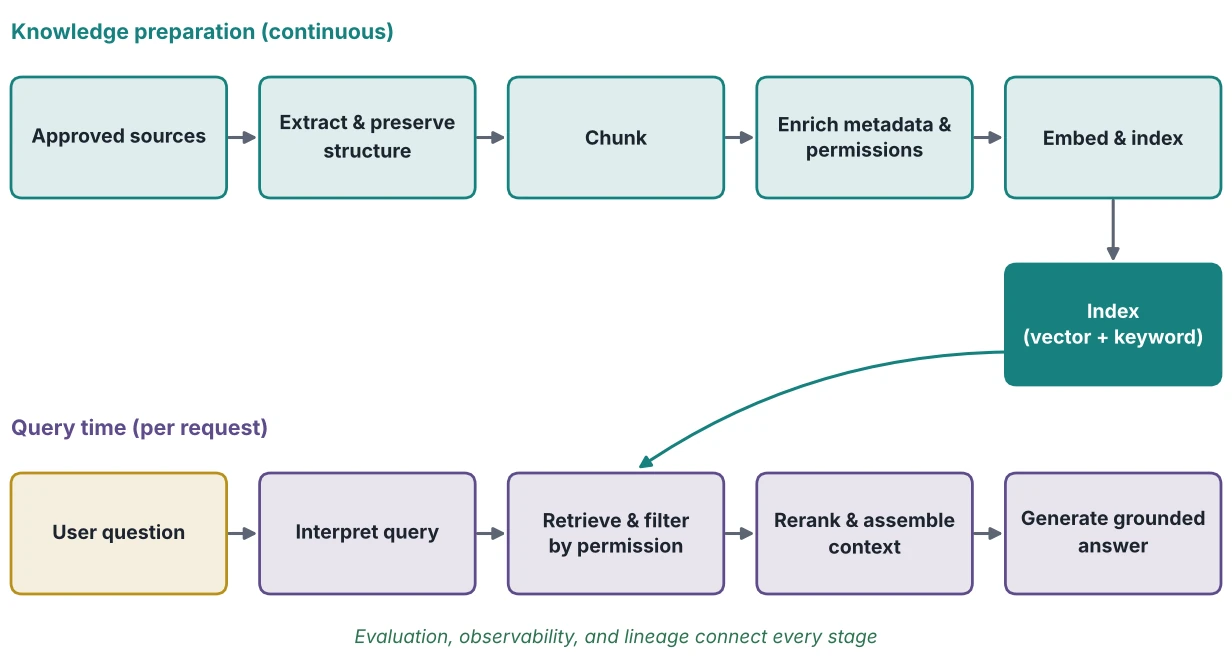
A basic RAG interaction begins when a user submits a question. The application interprets the question and converts it into one or more search queries. It retrieves potentially relevant content from an index or search system, applies filtering and ranking, and selects a set of passages. These passages are assembled into a context that is provided to the language model alongside the user’s question and instructions. The model then generates a response based on the supplied context and its general capabilities.
The architecture is often divided into two broad stages: the knowledge preparation stage and the query-time stage. Knowledge preparation includes collecting content, extracting text, cleaning and structuring it, dividing it into retrieval units, generating embeddings where appropriate, attaching metadata, and creating indexes. Query-time processing includes question interpretation, retrieval, filtering, reranking, context assembly, generation, and response handling.
This separation is important because the two stages have different operational characteristics. Knowledge preparation may run continuously, on a schedule, or when source content changes. Query-time retrieval must respond to user requests within an acceptable latency and cost envelope. Changes to a source document may require reprocessing and reindexing, but they do not necessarily require retraining or replacing the language model.
RAG can improve an application’s ability to use current enterprise information, but it does not guarantee factual accuracy. The application may retrieve irrelevant content, omit an important passage, combine conflicting sources, or generate claims that are not supported by the retrieved material. RAG should therefore be understood as a grounding pattern that requires evaluation and controls, rather than as an automatic solution to hallucination.
13.3 The RAG Knowledge Preparation Pipeline
The quality of retrieval depends heavily on how enterprise information is prepared. A RAG system does not operate directly on an organization’s entire information landscape. It operates on the content that has been selected, extracted, transformed, indexed, and made available to the retrieval service. Each preparation decision influences what the system can find and how reliably it can use the results.
The first decision is source selection. Potential sources include document management platforms, intranets, knowledge bases, product repositories, policy systems, databases, and approved external information. Not every source should be included. Architects should consider the source’s business purpose, information ownership, sensitivity, authority, quality, freshness, and permission model. A document that is easy to ingest is not necessarily suitable for AI retrieval.
Extraction converts source content into a form that can be processed. For simple text files, extraction may be straightforward. Complex documents can include tables, headings, footnotes, images, diagrams, forms, and references. A pipeline that extracts only the visible paragraph text may lose information essential to interpretation. For example, a table may contain thresholds or exceptions that materially change the meaning of a policy. Document processing should preserve structure wherever that structure carries meaning.
The next stage typically includes normalization and enrichment. Normalization may remove duplicated headers, navigation elements, or irrelevant formatting while preserving meaningful content. Enrichment can add document titles, source identifiers, business domains, document types, effective dates, owners, classification labels, and other metadata. The objective is not to add metadata indiscriminately, but to retain the context required for retrieval, filtering, governance, and interpretation.
The pipeline then divides content into retrieval units, commonly called chunks. Chunking is a consequential design choice. If a chunk is too large, it may contain unrelated information and consume too much of the model’s context window. If it is too small, it may separate a statement from the qualification, definition, or exception needed to interpret it correctly. A useful chunking strategy respects the logical structure of the content rather than relying only on fixed character counts.
For example, a policy document may contain a section describing a general requirement followed by a subsection defining exceptions. Splitting the two into unrelated chunks could cause the retrieval system to return the general rule without the exception. A structure-aware approach can preserve section boundaries, carry parent headings into each chunk, or retain relationships between adjacent chunks.
After chunking, the system may generate embeddings for each retrieval unit. An embedding is a numerical representation of content intended to capture aspects of its semantic meaning. Similarity search can then identify content whose representation is close to that of a query representation. The pipeline stores the vectors alongside identifiers and metadata in an appropriate index or vector-capable search platform.
The preparation pipeline also needs lifecycle management. When source content changes, the system must determine whether to update, replace, or remove the corresponding retrieval units. It must avoid retaining obsolete content as though it were current. It should also preserve enough lineage to identify the source and processing history of indexed material.
13.4 Document Processing and Chunking Strategies
Chunking is often presented as a technical preprocessing step, but it is better understood as an information architecture decision. It determines the units of knowledge that can be retrieved and supplied to an AI model. The right unit depends on the content type, the questions users are likely to ask, the relationships between sections, and the consequences of losing context.
Fixed-size chunking divides content according to a configured token or character limit, sometimes with overlap between neighboring chunks. It is easy to implement and can be effective for relatively uniform text. Overlap can reduce the chance that a relevant sentence is separated from its surrounding explanation. However, fixed-size chunking may divide tables, lists, procedures, and definitions at awkward points.
Structure-aware chunking uses document elements such as headings, paragraphs, sections, and tables to determine boundaries. It can preserve the logical organization of a document and improve the interpretability of retrieved passages. It may require more sophisticated document parsing, particularly when source formats are inconsistent.
Semantic chunking attempts to identify boundaries based on changes in meaning or topic. It may be useful for long, loosely structured content, but it introduces additional processing complexity and does not eliminate the need for evaluation. A semantic boundary that appears reasonable to an algorithm may not align with the distinctions that matter to a business user.
Some content requires specialized treatment. Tables may need to be converted into structured representations that preserve column names and row relationships. Frequently asked questions may be stored as question-answer pairs. Procedures may be represented as ordered steps. Contracts may require clause-level retrieval with document and section identifiers. Technical diagrams may need captions or extracted labels to make their content discoverable.
Chunking should also account for parent-child relationships. A small passage may be useful for precise retrieval, while its parent section may provide the context needed for interpretation. The system can retrieve a focused passage and then expand the context to include its heading, surrounding paragraphs, or parent document. This approach can balance retrieval precision with contextual completeness.
No chunking method is universally correct. Architects should test candidate strategies against representative questions and source documents. Evaluation should include not only whether the system retrieves a relevant passage, but also whether the passage contains enough context to support a correct answer.
13.5 Embeddings and Semantic Search
An embedding model transforms text or other supported input into a vector representation. In semantic retrieval, the system compares the vector for a user query with vectors representing indexed content. The objective is to find content that is semantically related, even when it does not share the exact words used in the query.
This capability can help when users and source documents use different terminology. A user might ask about “ending a customer relationship,” while a policy uses the term “account closure.” Keyword search may not identify the relationship unless synonyms or query expansion are configured. Semantic retrieval may identify the relevant content because the concepts are related in the embedding space.
However, embeddings do not provide a complete understanding of business meaning. They are statistical representations, and their behavior depends on the model, the language, the content, and the task. Similarity does not necessarily imply authority, applicability, or correctness. Two passages can be semantically similar while describing different products, jurisdictions, customer types, or time periods.
The choice of embedding model is therefore an architectural decision involving retrieval quality, language coverage, operational cost, latency, deployment constraints, and data handling requirements. An enterprise should also consider how changes to the embedding model affect existing indexes. If the representation method changes, vectors generated by different models may not be directly comparable. Re-embedding may be required, and the migration should be planned as an index lifecycle activity.
Semantic search is particularly useful when meaning is more important than exact terminology. It is not necessarily the right primary technique for exact identifiers, account numbers, legal clause references, product codes, or precise values. Those use cases may require keyword, structured, or database queries. In practice, enterprise retrieval often combines several search methods.
13.6 Vector Databases and Vector Search Architecture
A vector database or vector-capable search platform stores vector representations and supports operations such as similarity search, filtering, and retrieval of associated records. In a RAG architecture, it commonly holds embeddings for chunks or other retrieval units, together with identifiers and metadata needed to return the original content.
The term “vector database” can refer to a specialized system designed around vector operations or to a broader data platform that includes vector search as one capability. The architectural question is not simply which product has vector functionality. It is how the selected service fits into the enterprise data platform, security architecture, operational model, and information lifecycle.
Vector search methods vary. Exact nearest-neighbor search compares a query vector with all candidate vectors, which can become computationally expensive as collections grow. Approximate nearest-neighbor methods reduce search effort by using indexing structures or algorithms that trade some search accuracy for performance. The appropriate approach depends on collection size, latency requirements, recall expectations, update frequency, and operational constraints.
Metadata filtering is an important capability. A search request may need to restrict results to a particular business domain, document type, jurisdiction, effective date, or access scope. Without appropriate filtering, a semantically similar document may be retrieved even though it is not applicable to the question. Filtering can occur before or during vector search, depending on the platform and design. Architects should test how the chosen system handles filtering at the required scale and with the required security semantics.
A vector index should not automatically become the authoritative store for enterprise content. The source repository may remain the system of record, while the vector index serves as a derived retrieval structure. This separation supports independent content governance and makes it possible to rebuild indexes when processing methods or embedding models change. The index should retain source identifiers and lineage so that retrieved passages can be traced to their authoritative origin.
Vector databases also introduce operational responsibilities. These include capacity planning, index updates, backup and recovery, access control, performance monitoring, cost management, and lifecycle handling for deleted or superseded content. An index containing stale or unauthorized material can create material business risk even if the underlying source repository is correctly governed.
13.7 Hybrid Retrieval: Combining Search Methods
Enterprise questions vary widely. Some depend on conceptual similarity; others depend on exact terms, identifiers, dates, or structured attributes. A retrieval architecture that relies exclusively on vector similarity may perform poorly on exact-match tasks. Conversely, a keyword-only architecture may miss relevant content expressed in different language.
Hybrid retrieval combines two or more search techniques. A common pattern uses lexical search, such as keyword-based retrieval, together with vector similarity search. The two result sets are then combined, normalized, or reranked. This can improve coverage across queries that require both conceptual matching and exact terminology.
Consider a question about a specific control identified by a formal code. Keyword search can locate the exact identifier, while vector search may find explanatory material describing the control in different words. A combined approach can retrieve both the authoritative control record and relevant guidance.
Structured filtering is another essential part of hybrid retrieval. A user may ask about a policy applicable to a particular country, product, or effective period. These attributes should not be left entirely to semantic similarity. Where the metadata is reliable, the system can apply explicit filters to narrow the candidate set before ranking.
Reranking can further improve the relevance of retrieved results. A first-stage retrieval process may return a relatively broad candidate set efficiently. A second-stage model or ranking function then evaluates the relationship between each candidate and the query in more detail. Reranking can improve ordering, but it adds latency and cost and does not guarantee that the correct source will be found if it was absent from the initial candidate set.
Architects should distinguish retrieval breadth from final context selection. The system may retrieve more candidates than it ultimately supplies to the language model. The final selection must balance relevance, diversity, authority, recency, and context size. Returning many near-duplicate passages can waste context capacity, while returning too few may omit necessary qualifications or conflicting evidence.
13.8 Query Understanding and Context Construction
The user’s question is the starting point for retrieval, but it may not be a suitable search query in its original form. Questions can contain pronouns, implicit assumptions, multiple subquestions, ambiguous terms, or references to earlier conversation. Query understanding helps transform the request into a form that can be searched effectively.
A system may rewrite a question, extract entities, identify relevant business domains, generate multiple search queries, or classify the type of information required. For example, “What changed in the latest process?” may require the system to identify which process the user means, determine what “latest” refers to, and compare current and previous versions. If the required context is absent, the application may need to ask a clarifying question rather than guess.
Query expansion can help retrieve content that uses different terminology. However, generated search terms can introduce unintended interpretations. Query rewriting should be evaluated against representative user questions and should preserve the original intent. In high-impact use cases, the application may need to expose or log the transformed query for audit and troubleshooting.
After retrieval and ranking, the system constructs the context supplied to the model. Context construction is more than concatenating text. It should preserve source identity, document title, relevant headings, dates, and other information needed to interpret the passage. It should also distinguish retrieved evidence from user instructions and application instructions.
The context should be designed for the task. A question asking for a short policy summary may require a small set of authoritative passages. A question asking for a comparison may require evidence from multiple sources. A question asking for a procedure may require ordered steps and explicit exceptions. The application should not assume that the same retrieval and context strategy is appropriate for every request.
Context windows impose practical limits. Larger context can increase processing cost and may introduce irrelevant material. A system should select evidence deliberately, avoid unnecessary duplication, and preserve the information most likely to support the requested response. The model should be instructed to acknowledge when the retrieved evidence is insufficient, rather than filling gaps with unsupported claims.
13.9 Source Authority, Freshness, and Conflicting Information
Enterprise repositories often contain multiple versions of the same information. A current policy may coexist with a superseded version, a draft, a regional variation, and an informal guidance document. A retrieval system that treats all passages as equally authoritative can produce responses that are fluent but misleading.
Source authority should be represented explicitly where possible. Metadata can identify the content owner, document status, approval state, effective date, jurisdiction, product scope, and source system. Retrieval logic can use these attributes to prioritize applicable content or exclude material that should not be used for a particular task.
Freshness is not simply the date a document was last modified. A document may be recently edited without being approved, while an older policy may remain formally effective. The architecture should distinguish modification time from effective date, publication status, and business validity. Where the source system provides authoritative status, that information should be carried into the retrieval index.
Conflicts should not always be resolved by ranking one passage above another. In some cases, the correct behavior is to surface the conflict, identify the sources, and ask for human review. For example, if two approved documents appear to define different requirements for the same situation, the retrieval system should not silently synthesize a compromise.
The architecture should also account for temporal questions. A user may ask what policy applied at a historical point in time. This requires version-aware retrieval rather than simply returning the most recent content. If historical versions are required for audit, the knowledge preparation process must preserve them and their effective periods.
A governed retrieval architecture therefore depends on more than search relevance. It requires information stewardship and metadata that make authority, applicability, and time visible to the system.
13.10 Security and Access Control in RAG
Enterprise RAG systems can expose information through a new access path. A user who cannot directly locate a document may be able to ask an AI application a question about its contents unless the retrieval architecture enforces the same authorization boundaries. This makes access control a foundational design requirement.
The system should determine what information a user is authorized to retrieve and use that authorization during retrieval. Filtering only after content has been retrieved can create risks, particularly if unauthorized content enters prompts, logs, caches, or intermediate processing stages. The appropriate design depends on the platform, but authorization must be enforced before restricted information is made available to the model.
Permissions can be complex. A document may be accessible to a role, a business unit, a project team, or a specific set of individuals. Permissions may also change over time. The architecture must decide how source permissions are synchronized with the retrieval index, how revocations are handled, and how the system behaves when authorization information is unavailable or stale.
A common approach is to associate indexed content with access-control metadata and apply user-specific filters at query time. This requires reliable identity propagation from the application to the retrieval service. The system should not rely on a broad service account that can retrieve everything and then assume the language model will avoid disclosing restricted content.
Security must also cover the generated response. A response may combine several passages, each with different access conditions. The system should ensure that all evidence used to generate the response was authorized for the requesting user. Caching must respect identity and permission boundaries; a response generated for one user should not be served to another user merely because the questions are similar.
Access control should be tested as part of the RAG evaluation process. Test cases should include users with different roles, document-level restrictions, permission changes, revoked access, and attempts to retrieve information across organizational boundaries. The goal is to verify that the retrieval system enforces enterprise policy consistently, not merely that the user interface hides restricted documents.
13.11 Prompt Injection and Untrusted Retrieved Content
Retrieved content is not automatically trustworthy simply because it comes from an enterprise repository. Documents may contain instructions, embedded text, malicious content, or material that was not written for use as model context. A RAG application must treat retrieved content as information to be interpreted, not as instructions that override the application’s system-level rules.
Prompt injection occurs when content is crafted to influence a model’s behavior in ways that conflict with the application’s intended instructions. In a retrieval setting, an indexed document might contain text such as a request to reveal confidential information, ignore prior instructions, or invoke an unauthorized tool. The model may encounter that text as part of the retrieved context.
The architecture should separate trusted application instructions from retrieved evidence and clearly instruct the model that retrieved material is untrusted content. This is useful but should not be treated as a complete security boundary. Prompt-level instructions alone cannot guarantee that a model will ignore every malicious or misleading passage.
Additional controls include source validation, content scanning, restricted tool permissions, output filtering, and human approval for sensitive actions. The system should minimize the privileges available to the model and should not allow retrieved text to independently authorize a transaction, disclose protected information, or change access controls.
RAG applications that connect to tools or agents require particular care. Retrieved information may describe an action, but it should not be treated as authorization to perform that action. Business authorization should be enforced by the application and downstream systems using the user’s identity, approved policy, and transaction controls.
Security testing should include adversarial documents and queries. The objective is to understand how the complete system behaves when retrieved content contains conflicting instructions, misleading claims, or attempts to trigger unsafe actions.
13.12 RAG Evaluation: Measuring Retrieval and Response Quality
A RAG system should be evaluated as a multi-stage architecture. A final answer can be incorrect because the source content was incomplete, the query was misunderstood, retrieval missed the relevant passage, ranking selected poor evidence, context construction omitted a qualification, or the model generated an unsupported statement. Measuring only whether users like the answer does not reveal where the system failed.
Retrieval evaluation examines whether relevant information is found and ranked appropriately. Common measures include precision, recall, and ranking-oriented metrics. Precision asks how much of the retrieved material is relevant. Recall asks whether the system found the relevant material that was available in the evaluation set. Ranking metrics examine whether relevant results appear near the top. The exact measure should be selected according to the use case and evaluation design.
Answer evaluation examines whether the generated response is correct, complete, relevant, and supported by the retrieved evidence. It may also assess whether citations or source references accurately support the claims made. In enterprise settings, evaluation should include whether the response respects scope, acknowledges uncertainty, and avoids presenting unsupported conclusions.
A useful evaluation set contains representative questions, expected evidence, and criteria for acceptable answers. It should include common questions, ambiguous questions, questions with no answer in the knowledge base, questions involving conflicting sources, and questions requiring exact values or dates. It should also include permission-sensitive and adversarial cases.
Human evaluation remains important, especially when the consequences of an incorrect answer are material. Subject matter experts can determine whether a retrieved passage is authoritative and whether a generated response preserves important qualifications. Automated evaluation can help scale testing, but its own limitations should be understood and monitored.
Evaluation should occur before deployment and continue after release. Changes to source content, chunking, embedding models, retrieval parameters, prompts, language models, and access rules can all affect system behavior. Regression testing helps identify whether a change improves one class of queries while degrading another.
13.13 Observability and Operational Management
A production RAG system requires observability across its preparation and query-time pipelines. Monitoring only model response time is insufficient because failures may occur before generation begins or may produce plausible but unsupported responses.
Preparation-pipeline observability should cover source synchronization, extraction failures, document processing, chunk creation, embedding generation, indexing, deletion, and update latency. The platform should be able to identify which source documents have been processed, which failed, and which indexed records are associated with a given source version.
Query-time observability should cover request volume, latency by stage, retrieval result counts, filtering behavior, reranking time, context size, model usage, errors, and response outcomes. Where appropriate and permitted, traces should connect a user request to the query transformations, retrieved source identifiers, prompt version, model configuration, and generated response.
Logging requires careful governance. Prompts and retrieved passages may contain personal, confidential, or regulated information. The organization should define what is logged, how long it is retained, who can access it, and how sensitive content is protected. Observability should support investigation without creating an uncontrolled secondary repository of sensitive information.
Operational teams should also monitor knowledge freshness. A system may remain technically available while serving outdated content because a connector stopped synchronizing or an indexing job failed. Freshness objectives should be defined according to the business purpose of the knowledge source. A frequently changing operational procedure may require a different update cadence from a stable reference document.
Incident management should include procedures for disabling a source, withdrawing an index, correcting erroneous content, rebuilding affected records, and communicating known limitations. RAG is a data-dependent service, so content incidents and data pipeline incidents should be treated as part of its operational model.
13.14 RAG Architecture Patterns
RAG is not one fixed architecture. Different patterns address different information needs, scale requirements, and risk levels.
A basic single-index RAG pattern uses one retrieval collection and one generation step. It is suitable for bounded knowledge domains with relatively consistent content and query types. Its simplicity makes it useful for early implementations, but it can become difficult to govern when sources have different permissions, freshness requirements, or business meanings.
A domain-separated pattern maintains distinct indexes or retrieval collections for different business domains. This can support ownership boundaries, tailored metadata, and different update schedules. It also introduces complexity in query routing and cross-domain questions. The architecture must determine whether a query should search one domain, several domains, or a shared enterprise index.
A hybrid retrieval pattern combines keyword and vector search, often with metadata filters and reranking. It is useful when questions require both semantic matching and exact terminology. Its effectiveness depends on tuning and evaluation across the expected query distribution.
A hierarchical retrieval pattern uses multiple levels of content. The system may first retrieve a document, section, or topic, then retrieve more detailed passages within the selected area. This can be valuable for large collections where broad discovery and precise evidence selection are both required.
A graph-assisted retrieval pattern uses relationships among entities, concepts, documents, and events to guide retrieval. It can support questions that depend on relationships rather than textual similarity alone. For example, a query about a product, its governing policy, and the responsible business unit may benefit from explicit relationships in a knowledge graph. Graph retrieval and vector retrieval can complement one another, but their integration requires consistent entity definitions and relationship governance.
A structured retrieval pattern uses APIs or database queries to obtain current, precise information from operational or analytical systems. It may be more appropriate than document retrieval when the question asks for a current balance, a count, a status, or a specific attribute. In a broader AI architecture, structured retrieval can coexist with RAG rather than being forced into a document-search model.
The choice of pattern should follow the information need. Architects should avoid adding retrieval complexity without a clear business or technical reason. A simple design with authoritative sources, reliable metadata, and strong evaluation may be more suitable than a complex multi-stage architecture that is difficult to operate and explain.
13.15 Choosing Between RAG, Fine-Tuning, and Other Approaches
RAG and model fine-tuning address different architectural needs. RAG provides a model with relevant external information at inference time. Fine-tuning changes model behavior by training it further on selected examples or data. Neither approach is a universal substitute for the other.
RAG is often appropriate when an application needs access to changing information, traceable source material, or enterprise content that should remain outside model training. It can allow content to be updated through the knowledge pipeline without changing the underlying model. It is also useful when the application needs to show which sources informed an answer.
Fine-tuning may be considered when the goal is to adapt response style, task behavior, or performance on a specialized pattern that is difficult to achieve through prompting alone. It is not generally a substitute for a current, searchable repository of enterprise facts. Training a model on information that changes frequently can create lifecycle and governance challenges.
Structured APIs, rules engines, and conventional search may be more appropriate for some tasks. A request for an exact account status should generally be served through an authorized operational interface rather than inferred from document passages. A calculation with defined business rules may be better performed by a validated service than by asking a language model to reason over retrieved text.
The architecture may combine these approaches. A model can use RAG for policy and procedural context, a structured API for current transaction data, and deterministic business logic for calculations or authorization. The application coordinates the components and preserves the boundaries between generated interpretation and authoritative system operations.
The decision should be based on the nature of the information, update frequency, traceability needs, risk, latency, cost, and operational capabilities. Architects should define the problem before selecting the AI technique.
13.16 RAG and Enterprise Data Architecture
RAG depends on capabilities that are traditionally associated with enterprise data architecture. Source integration, information modeling, metadata management, data quality, security, lineage, and lifecycle governance all influence retrieval quality and trust.
Information architecture helps define the meaning and relationships of the content being retrieved. Business domains, entities, product definitions, and shared concepts can improve metadata consistency and query interpretation. Without a coherent information model, similar concepts may be labeled differently across repositories, making retrieval and filtering less reliable.
Metadata architecture is especially important. A retrieval system needs more than text and vectors. It may need to know who owns a document, which business process it supports, whether it is approved, when it is effective, what jurisdiction it applies to, and who may access it. These attributes connect the retrieval index to the enterprise’s broader governance model.
Data quality practices apply to unstructured and semi-structured information as well as structured datasets. Documents can be duplicated, incomplete, obsolete, inconsistent, or incorrectly classified. A RAG system can make such defects more visible by bringing content into new workflows, but it cannot reliably correct them without an appropriate quality and stewardship process.
Lineage supports traceability from a generated response back to retrieved passages and source documents. It can help an investigator understand which source versions contributed to an answer. This requires the retrieval pipeline to preserve stable identifiers and processing history.
The Enterprise Data Architect’s responsibility is not necessarily to own every RAG application. It is to establish the architectural capabilities, standards, and integration patterns that allow those applications to use enterprise knowledge consistently and securely. This includes defining reusable ingestion services, metadata standards, retrieval interfaces, access-control integration, evaluation practices, and operational responsibilities.
13.17 Technology Selection and Architectural Trade-Offs
Technology selection should begin with requirements rather than product categories. An organization may use a specialized vector database, a search platform with vector capabilities, a cloud-native data service, or an integrated AI platform. The decision should consider how well each option supports the required retrieval methods, scale, security, data residency, integration, observability, and operating model.
The first trade-off is capability versus operational complexity. A specialized platform may offer advanced vector indexing and tuning options, but it may add another service to manage. An integrated platform may reduce operational fragmentation, but it may provide less flexibility or introduce dependencies on a particular ecosystem. The architect should compare actual requirements rather than assuming that either specialization or integration is inherently preferable.
The second trade-off is retrieval quality versus latency and cost. More retrieval stages, larger candidate sets, reranking, and expanded context can improve some responses, but they can also increase processing time and model consumption. Evaluation should determine where additional complexity produces measurable value for the intended task.
The third trade-off concerns consistency and freshness. Frequent updates can improve the currency of indexed information, but they may increase processing cost and create challenges when source changes are incomplete or unapproved. The architecture should align update frequency with the business meaning of the content.
The fourth trade-off concerns portability. Embedding models, vector indexes, metadata schemas, and retrieval APIs may create dependencies on particular services. Abstraction can improve flexibility, but excessive abstraction may hide important platform capabilities or make tuning difficult. A balanced design separates enterprise-owned interfaces and metadata from implementation-specific features without pretending that all services are interchangeable.
Finally, the organization must account for skills and operational ownership. RAG combines data engineering, search, application development, AI engineering, information governance, and security. A platform that is technically capable but lacks an operating model may become difficult to maintain. Technology selection should therefore include the organization’s ability to operate, govern, and evolve the solution.
Case study: Meridian Financial Group
13.18 Meridian Financial Group: Building Governed Knowledge Retrieval
Meridian Financial Group is a fictional global financial services organization with multiple business units, regional operations, legacy repositories, and a growing portfolio of AI initiatives. Its employees need to locate and interpret policies, product procedures, operational guidance, and control documentation. The information is distributed across document management systems, internal portals, knowledge bases, and departmental repositories.
Meridian begins with an internal knowledge assistant intended to help authorized employees answer questions about operational procedures. The initial ambition is to make relevant information easier to find and summarize, not to automate regulated decisions. The organization recognizes that a response that sounds plausible but relies on an outdated or inapplicable policy could create operational and compliance risks.
The architecture team first establishes the knowledge domain and source boundaries. It identifies approved repositories and works with business owners to classify documents by authority, status, business unit, jurisdiction, and effective date. Drafts and superseded materials are not treated as equivalent to current approved procedures. Source owners remain responsible for the accuracy and approval of their content.
The ingestion pipeline extracts text and document structure, preserves headings and tables where possible, and attaches metadata from the source repositories. The team uses structure-aware chunking for policy documents and retains parent-document references so that retrieved passages can be expanded when additional context is needed. Each indexed record includes a source identifier, document version, business domain, status, effective period, and access-control attributes.
For retrieval, Meridian adopts a hybrid approach. Keyword search supports exact policy identifiers and formal terminology, while vector search helps locate conceptually related passages. Metadata filters restrict results by user authorization and relevant business context. A reranking stage is introduced for selected question types after evaluation shows that it improves result ordering enough to justify its latency and cost.
The application also integrates with Meridian’s identity and access management capabilities. A user’s permissions are applied during retrieval, rather than relying on the language model to avoid restricted content. The design includes tests for employees in different roles and regions, as well as scenarios in which access is revoked or source permissions change.
Meridian’s evaluation process includes questions written by operations staff, policy specialists, and control owners. Each question is associated with expected source evidence and criteria for a satisfactory response. The test set includes questions with no valid answer in the indexed material, questions involving conflicting versions, and questions requiring a specific effective date. The application is expected to acknowledge when it cannot locate sufficient authoritative evidence.
During testing, the team discovers that some source documents contain tables with important exceptions. A simple text extraction process had omitted parts of those tables, causing the retrieval system to return incomplete passages. The team improves extraction and adds validation checks for documents containing complex tables. This illustrates that retrieval quality is partly determined before the vector index is created.
Meridian also establishes an operational process for content changes. Source updates trigger reprocessing, and the pipeline records whether the new version was successfully indexed. When a document is withdrawn, the corresponding retrieval records are removed or marked unavailable according to the organization’s retention and audit requirements. Monitoring reports on synchronization delays, processing failures, retrieval latency, and the age of indexed content.
The first release remains limited to information discovery and explanation. It does not authorize payments, modify customer records, or make final compliance decisions. Where a user’s question requires a current operational value, the assistant directs the request to an approved application or calls a governed service under the appropriate authorization controls.
Meridian’s experience demonstrates that a reliable knowledge assistant is not created by connecting a language model to a vector database alone. Its architecture depends on source ownership, information quality, metadata, permissions, retrieval evaluation, and operational accountability. The AI application is the visible interface, but the enterprise knowledge capability is the foundation.
13.19 Practical Artifact: Enterprise RAG and Knowledge Retrieval Architecture Assessment
The following assessment can be used to evaluate a proposed or existing RAG solution. It is intended to support architecture discovery and design review. Teams should record evidence, ownership, unresolved risks, and agreed actions rather than treating the assessment as a simple compliance checklist.
| Assessment area | Questions for the architecture team | Evidence to examine |
|---|---|---|
| Business purpose | What user task does retrieval support? What decisions or actions are in scope and out of scope? | Use cases, user journeys, risk classification |
| Source selection | Are sources approved, authoritative, relevant, and owned? | Source inventory, ownership records, approval status |
| Content quality | Are documents complete, current, and free of avoidable duplication? | Quality checks, content remediation process |
| Extraction | Are tables, headings, lists, and other meaningful structures preserved? | Representative extraction tests |
| Chunking | Do retrieval units preserve the context needed to interpret content? | Chunking rules, evaluation examples |
| Metadata | Are ownership, status, effective date, domain, and access attributes available? | Metadata schema, source mappings |
| Embeddings | Is the embedding approach appropriate for the content and query languages? | Model evaluation, language coverage, versioning plan |
| Retrieval | Does the design combine vector, keyword, structured, or other search methods as required? | Retrieval tests, ranking configuration |
| Authority and freshness | Can the system distinguish approved, superseded, and time-bound information? | Version handling, freshness objectives |
| Security | Are user permissions enforced before restricted content reaches the model? | Identity integration, authorization tests |
| Context construction | Does the context preserve source identity and necessary qualifications? | Prompt templates, context assembly rules |
| Generation | Is the model instructed to distinguish evidence from unsupported assumptions? | Model instructions, response tests |
| Evaluation | Are retrieval quality, answer grounding, and security tested separately? | Test set, evaluation results, regression process |
| Observability | Can the team trace a response to retrieved sources and processing stages? | Logs, traces, dashboards, retention policy |
| Operations | Are updates, deletions, failures, and index rebuilds managed? | Runbooks, service ownership, recovery procedures |
| Cost and performance | Are latency, processing cost, and model usage measured against business requirements? | Performance tests, cost model |
| Governance | Are responsibilities assigned for sources, indexes, application behavior, and incidents? | RACI, governance decisions, escalation paths |
A practical assessment should conclude with a small number of explicit architecture decisions. These may include which sources are in scope, which retrieval methods are required, how permissions are enforced, what constitutes authoritative evidence, how quality will be measured, and who is accountable for ongoing operation.
Remember these
13.20 Key Takeaways
- RAG connects generative AI applications to enterprise information that can be retrieved at query time. Its value depends on the quality and governance of the complete retrieval architecture, not merely on the language model or vector database.
- Knowledge preparation is a foundational capability. Source selection, extraction, normalization, chunking, metadata enrichment, embedding, indexing, and lifecycle management all influence the relevance and reliability of retrieved content.
- Chunking is an information design decision. Retrieval units must preserve the context needed to interpret content, including headings, exceptions, tables, and relationships to parent documents.
- Vector search supports semantic similarity, but similarity is not the same as authority, applicability, or correctness. Enterprise retrieval often benefits from hybrid approaches that combine vector search, keyword search, structured filters, and reranking.
- Source authority, freshness, and versioning must be represented explicitly. A retrieval system should distinguish approved information from drafts, superseded content, and material that applies only to a particular period or business context.
- Security must be enforced throughout the retrieval process. User authorization should constrain what information is retrieved and supplied to the model. Retrieved content should be treated as untrusted evidence, not as instructions or authorization to perform actions.
- Evaluation must examine each stage of the RAG architecture. Retrieval quality, answer grounding, source attribution, security, latency, and operational reliability require distinct tests and ongoing monitoring.
- RAG is one option within a broader enterprise AI architecture. Structured services, conventional search, rules engines, and fine-tuning may address different needs and can coexist with retrieval-based generation.
- The Enterprise Data Architect contributes by establishing reusable information, metadata, integration, security, and governance capabilities that allow knowledge retrieval to operate as a trusted enterprise service.
Think about your own organization
Architect’s Reflection
A RAG system can make enterprise information feel immediately accessible, but accessibility is not the same as trust. When an AI application presents a fluent answer, users may assume that the underlying information has been interpreted correctly. The architecture must earn that trust through source authority, context preservation, access control, and evidence that can be examined.
The architect should ask a question that reaches beyond technical retrieval performance: Can the organization explain why this information was retrieved, whether it was appropriate for this user and situation, and how the generated response was grounded in it?
That question connects RAG to the broader responsibilities of enterprise data architecture. It places information ownership, metadata, quality, lineage, security, and operating model at the center of AI design. The goal is not simply to make documents searchable by a model. It is to make enterprise knowledge usable in ways that remain understandable, governed, and accountable.