Artificial intelligence is changing how enterprises use information.
For many years, enterprise data architecture focused primarily on enabling operational systems, reporting, analytics, and business intelligence. The architecture was designed to move data from source systems into governed environments where it could be integrated, analyzed, and used to support decisions.
AI expands this responsibility.
Machine learning systems depend on data for training, evaluation, and inference. Generative AI applications depend on information and context to produce useful responses. Retrieval-augmented generation systems depend on enterprise knowledge that can be discovered and retrieved. AI agents may need access to tools, APIs, and business processes to complete tasks.
These capabilities create new demands on enterprise data architecture. An AI application may be technically connected to a model, but that connection alone does not make it enterprise-ready. The application must also access appropriate information, understand its meaning, respect permissions, provide traceability, and operate within organizational controls. This is where Enterprise Data Architecture becomes a foundational discipline for AI. The relationship is reciprocal. Data architecture enables AI by providing trusted information and governed access. AI also changes data architecture by introducing new forms of information processing, new consumers, new operational requirements, and new expectations for context.
The Enterprise Data Architect must therefore understand AI not only as another workload running on the data platform, but as a new architectural consumer and producer of enterprise information. This chapter establishes that relationship and develops a framework for connecting enterprise data architecture to AI architecture.
11.1 From Analytical Data to Intelligent Information
Traditional analytical architecture was largely designed to support human interpretation. A business intelligence dashboard might present revenue by region. An analyst would interpret the results, compare them with other information, and decide what action to take. AI changes the interaction. A machine learning model may identify patterns in transaction data. A generative AI application may summarize policies and customer records. An agent may use enterprise information to prepare a recommendation or initiate an approved workflow. In each case, information is consumed differently.
A human analyst can recognize ambiguity, ask a colleague for clarification, or consult another source. An AI application may instead process information according to its design, available context, and model behavior. If the underlying information is incomplete, inconsistent, outdated, or incorrectly interpreted, the application may produce an unreliable result.
This makes information quality and meaning central to AI architecture. The enterprise must consider not only whether data is available, but whether it is suitable for a particular AI use.
A dataset prepared for historical reporting may not be appropriate for real-time inference. A document repository may contain valuable knowledge but lack the metadata needed to identify its authority, currency, or access restrictions. A customer table may contain useful attributes but lack the relationships required to answer a complex business question.
AI readiness therefore requires a broader view of information. The objective is not simply to make more data available to models. It is to make the right information available, with sufficient context and appropriate controls.
11.2 AI as a New Enterprise Data Consumer
Enterprise data architecture has traditionally supported several categories of consumers:
- Operational applications
- Reporting and business intelligence
- Analytical users
- Data science teams
- External partners
AI adds new consumer types. These include:
- Predictive models
- Generative AI applications
- Retrieval systems
- Intelligent assistants
- Autonomous or semi-autonomous agents
- Decision-support applications
Each consumer has different information requirements.
A reporting application may need consistent historical measures. A predictive model may require carefully prepared features and a defined observation period. A RAG application may need relevant document passages, source metadata, and permission information. An agent may need access to current business state and approved tools.
The architecture must understand these differences. A useful design principle is:
Do not assume that information prepared for one consumer is automatically suitable for another.
A data product may serve several consumers, but its contract should make clear what it provides and what assumptions consumers must not make. For example, a customer profile product may support analytics and customer-service applications. A machine learning use case may require a separate feature representation with explicit rules about time, missing values, and target leakage. The underlying business concepts may be shared, while the physical representations differ.
11.3 AI as a New Producer of Enterprise Information
AI is not only a consumer of enterprise data. It can also produce information. Examples include:
- Document classifications
- Extracted entities
- Generated summaries
- Predicted outcomes
- Recommendations
- Embeddings
- Conversational records
- Agent execution logs
These outputs may become useful enterprise information assets. However, they should not automatically be treated as authoritative business facts.
A model-generated summary, for example, is a derived representation of source information. It may be useful, but it does not replace the original record. A predicted customer risk category is not necessarily equivalent to an approved risk classification. An AI-generated answer may contain a claim that requires validation before it is used in a business process.
The architecture should therefore distinguish among:
- Source information — information originating from an operational or authoritative source.
- Transformed information — information created through defined processing and business rules.
- Model-derived information — predictions, classifications, embeddings, summaries, or other AI outputs.
- Human-approved information — outputs reviewed and accepted through an appropriate business process.
This distinction helps preserve provenance and accountability.
11.4 The Data Foundations of AI
AI systems depend on multiple dimensions of data readiness. A useful way to examine readiness is to consider six foundations.
Availability
The information required for an AI use case must be accessible through appropriate technical interfaces. Availability does not mean unrestricted access. It means that authorized applications can obtain the information they need through governed mechanisms.
Quality
Information should meet the requirements of the use case. A predictive model may be sensitive to missing values, inconsistent labels, or biased sampling. A retrieval application may be affected by duplicated documents, incomplete metadata, or outdated content.
Semantics
The application must have a reliable understanding of what the information represents. A field called account_status may have different meanings across systems. AI applications need explicit definitions rather than assumptions based on names alone.
Context
Information must be presented in a form that supports the task. A model answering a policy question may need the policy text, effective date, jurisdiction, and relevant business context—not simply a collection of documents.
Lineage and Provenance
The enterprise should be able to identify where information came from, how it was transformed, and whether an AI output can be traced to its supporting sources.
Governance
Information must be used according to applicable access, privacy, retention, and business policies.
These foundations are interdependent. A highly available dataset with unclear semantics may still be unsuitable for AI. A well-documented knowledge source without access controls may create unacceptable exposure. AI readiness is therefore a property of the broader information architecture, not merely of a model or platform.
11.5 The Relationship Between Data Architecture and AI Architecture
Data architecture and AI architecture are distinct but connected disciplines. Data architecture defines how enterprise information is structured, governed, integrated, stored, and delivered. AI architecture defines how models, data, prompts, retrieval, tools, applications, evaluation, and operational controls work together to support AI capabilities. Their responsibilities overlap. For example, a RAG application requires:
- Source data and documents
- Ingestion and transformation
- Metadata
- Chunking and indexing
- Retrieval
- Access control
- Model integration
- Evaluation
- Monitoring
The data architecture provides much of the information foundation. The AI architecture determines how that information is used within the application. The boundary should be explicit enough to establish ownership, but flexible enough to support joint design.
| Architectural Concern | Data Architecture Contribution | AI Architecture Contribution |
|---|---|---|
| Information sources | Source ownership, integration, quality | Use-case suitability |
| Semantics | Definitions, models, relationships | Context interpretation |
| Access | Data products, APIs, permissions | Application access patterns |
| Metadata | Catalog, lineage, classification | Retrieval and prompt context |
| Processing | Ingestion and transformation | Embedding and model-specific processing |
| Governance | Data policies and stewardship | Model and application controls |
| Quality | Data validation and observability | Model and response evaluation |
| Operations | Pipeline reliability | Inference and application operations |
These are not rigid organizational boundaries. In some enterprises, the same team may perform several responsibilities. The architectural distinction remains useful because it prevents important capabilities from being overlooked.
11.6 A Reference Architecture for Enterprise Data and AI
An AI-ready enterprise architecture should connect source systems, data platforms, information products, semantic capabilities, and AI applications. A conceptual architecture can be organized into eight layers:
- Enterprise sources: operational systems, SaaS applications, documents, events, external data, and other information sources.
- Data integration and engineering: ingestion, transformation, validation, orchestration, and data processing.
- Governed data platform: storage, compute, metadata, security, quality, lineage, and observability.
- Information and data products: domain-owned datasets, APIs, streams, semantic models, and other managed information services.
- Semantic and knowledge services: business definitions, ontologies, knowledge graphs, document metadata, and enterprise context.
- AI enablement: model access, embedding services, retrieval, feature services, evaluation, and AI-specific governance.
- AI applications and intelligent processes: assistants, predictive applications, decision-support systems, and agents.
- Enterprise control and operations: identity, policy enforcement, monitoring, audit, risk management, and lifecycle controls across the architecture.
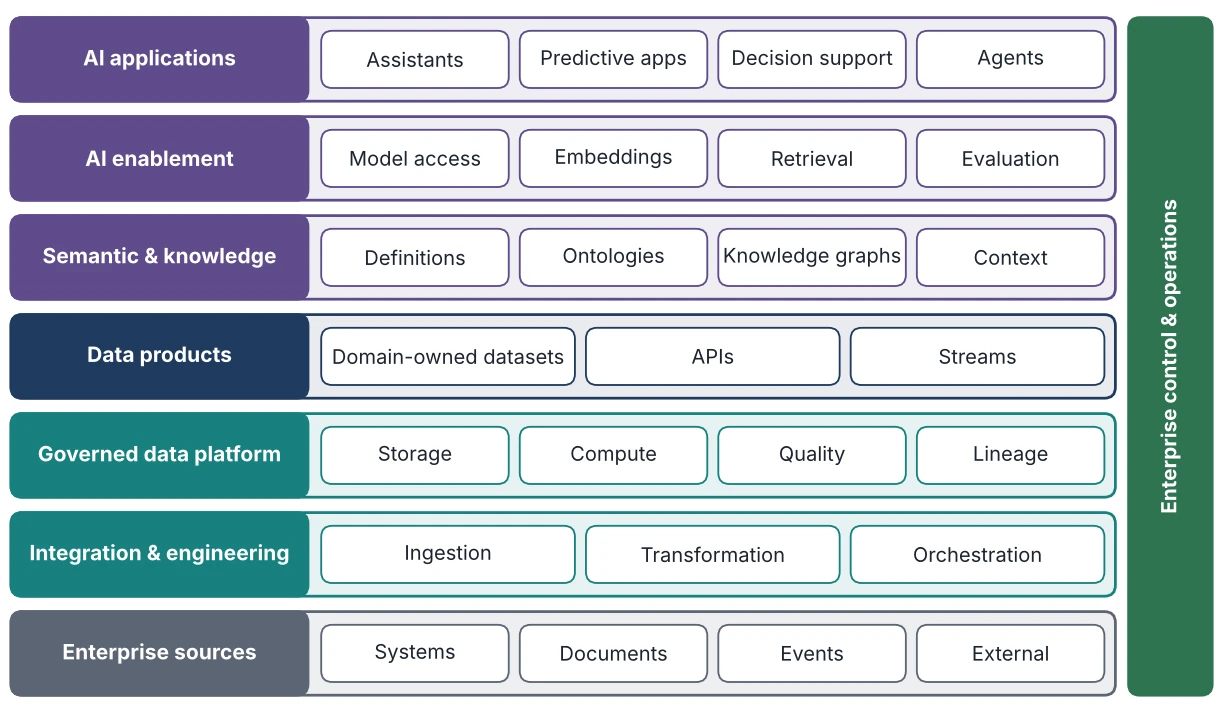
The architecture is not intended to prescribe one technology stack. It describes capabilities and relationships. An organization may implement several layers using one platform or distribute them across multiple services. The important requirement is that the capabilities are accounted for and their interfaces are understood.
11.7 Structured, Unstructured, and Multimodal Information for AI
AI applications increasingly work with more than structured tables. Enterprise information may include:
- Relational records
- Documents
- Emails
- Presentations
- Images
- Audio
- Video
- Application logs
- Sensor data
This creates a broader information architecture challenge. Structured information often has defined schemas and relationships. Unstructured information may contain valuable knowledge but require additional processing to become discoverable and usable. Multimodal information can combine text, images, audio, and other forms. The architecture should not assume that all information can be managed in the same way.
For example, a financial transaction table may require strict schema and reconciliation controls. A policy document repository may require document versioning, classification, effective dates, and paragraph-level provenance. An audio archive may require transcription, speaker or event metadata where appropriate, and controls over derived text.
AI-specific processing can create additional representations, such as extracted text, chunks, embeddings, or classifications. These representations should retain links to their source material.
11.8 Data Products as the Interface Between Enterprise Data and AI
Chapters 9 and 10 established the importance of data engineering and data products. In an AI-ready architecture, data products can become a controlled interface between enterprise information and AI applications. Consider an internal AI assistant supporting financial analysts. The assistant may require:
- Financial transactions
- Account information
- Customer relationships
- Product definitions
- Policy documents
- Regulatory guidance
Connecting the assistant directly to every underlying system would create a large number of dependencies and potentially inconsistent access mechanisms. A data-product approach can expose governed information through defined interfaces. The application can consume the products it needs without implementing the integration and business logic independently.
This does not mean that every AI use case should consume only pre-existing data products. Some use cases require specialized processing or new information products. The architectural objective is to reuse trusted capabilities where appropriate and make new dependencies explicit.
A data product used by AI should describe not only its schema but also its semantics, freshness, quality, access rules, and known limitations.
11.9 The Importance of Context
Data availability and data context are different. A model may have access to a large volume of information but still lack the context needed to interpret it correctly. Context can include:
- Business definitions
- Relationships among entities
- Time periods
- Jurisdiction
- Source authority
- User permissions
- Task-specific instructions
- Relevant operational state
For example, an AI application answering a question about a financial product may need to know which product version applies, when a policy became effective, and which customer segment is in scope. Without this context, the model may retrieve information that is topically related but not applicable. Context engineering is therefore an important architectural concern. It involves determining what information should be provided to an AI system, how it should be represented, and how it should be selected for a particular task.
The Enterprise Data Architect contributes by ensuring that enterprise information has sufficient structure, metadata, and semantic clarity to support context construction.
11.10 Enterprise Semantics and AI Interpretation
AI systems can process language and identify patterns, but enterprises still need explicit definitions for important business concepts. A model may recognize the words “customer,” “account,” or “revenue.” That does not guarantee that it understands the enterprise’s approved meaning. Enterprise semantics provide a controlled vocabulary and a set of relationships that help maintain consistency. These may include:
- Business glossary terms
- Conceptual and logical models
- Reference data
- Ontologies
- Knowledge graphs
- Domain-specific definitions
For example, the term “active customer” may depend on a defined set of business conditions. If those conditions differ between marketing, finance, and risk, an AI application may produce different answers depending on which source it retrieves. The architecture should make these differences explicit. Where a shared enterprise definition is required, it should be governed. Where domain-specific definitions are legitimate, the domain and context should be identified. AI does not remove the need for semantic architecture. It increases the consequences of semantic ambiguity.
11.11 AI Readiness Is More Than Data Availability
Organizations sometimes define AI readiness primarily in terms of whether data can be accessed by a model. That is too narrow. An AI-ready information environment should also address:
- Business relevance
- Data quality
- Semantic consistency
- Provenance
- Permissions
- Freshness
- Evaluation
- Monitoring
- Lifecycle management
A collection of accessible datasets may support experimentation, but production AI requires stronger controls.
For example, a prototype may use a collection of policy documents to answer questions. A production application may need to ensure that it retrieves the currently effective policy, respects the user’s permissions, identifies supporting sources, and handles cases where the evidence is insufficient.
The difference is architectural. AI readiness should be assessed against the requirements of the intended use case and its consequences. A low-risk internal summarization tool may require different controls from an application that influences financial, employment, health, or other consequential decisions.
11.12 Data Quality and AI Quality
Data quality and AI quality are related, but they are not identical. Data quality examines whether information meets defined requirements. AI quality examines whether the AI system performs appropriately for its intended purpose. An AI application can produce poor results even when its source data is technically valid. Possible causes include:
- Unsuitable retrieval
- Incomplete context
- Ambiguous instructions
- Model limitations
- Weak evaluation
- Incorrect tool use
- Changes in source information
Likewise, a model may perform acceptably in a test environment but degrade when source data changes. The architecture should therefore connect data quality controls with AI evaluation and monitoring. For example:
Source Data Validation → Product Quality → Retrieval Evaluation → Response Evaluation → Production Monitoring
This creates a chain of assurance rather than treating the model as an isolated component.
11.13 Data Lineage and AI Traceability
Traditional data lineage traces information through systems and transformations. AI introduces additional questions. For a generated answer, an enterprise may need to understand:
- Which sources were available
- Which sources were retrieved
- Which data product was used
- Which version of a document was retrieved
- Which model and application configuration were involved
- Whether the output was reviewed
- What action followed
The precise level of traceability depends on the use case, regulatory environment, and risk. However, the architecture should consider traceability from the beginning. It is difficult to reconstruct provenance after an AI application has been deployed if the necessary metadata and logs were never captured.
Traceability also supports debugging. When an AI application produces an unexpected response, the team needs to distinguish among possible causes:
- Incorrect source data
- Outdated content
- Retrieval failure
- Semantic ambiguity
- Model behavior
- Application logic
Without traceability, these causes can be difficult to separate.
11.14 Security and Access Control Across Data and AI
AI applications create new access patterns. A user may ask a question through an assistant rather than directly querying a database or document repository. The architecture must ensure that this new interface does not bypass existing permissions. For example, if a user cannot access a restricted document through the enterprise search platform, the AI assistant should not expose its content through a generated answer. This requires security to extend through the entire information path. The architecture should consider:
- User identity
- Application identity
- Data-product permissions
- Document-level access
- Retrieval filtering
- Tool permissions
- Output handling
- Audit records
It is not sufficient to secure only the model endpoint. The system must preserve appropriate authorization as information moves through ingestion, indexing, retrieval, generation, and action.
11.15 The AI Data Lifecycle
AI workloads introduce additional data lifecycle requirements. A typical lifecycle may include:
- Source acquisition.
- Data validation.
- Transformation and enrichment.
- Feature or context preparation.
- Model training, retrieval, or inference.
- Output generation.
- Evaluation and monitoring.
- Retention, archival, or deletion.
Different AI patterns require different lifecycles. A predictive model may require training datasets, feature definitions, and model evaluation data. A RAG system may require document processing, chunking, embeddings, indexes, and source references. An agent may require tool-access records and execution traces. The Enterprise Data Architect should work with AI architects and governance teams to establish which information is retained, why it is retained, and when it should be removed. The lifecycle should account for derived information as well as original source data.
11.16 Architectural Patterns for Data and AI Integration
Several patterns can connect enterprise data architecture to AI.
Pattern 1: AI Application Consuming Data Products
The AI application accesses governed data products through defined interfaces. This is useful when the information is structured, reusable, and already managed as a product.
Pattern 2: Retrieval-Augmented Generation
The application retrieves relevant enterprise information and provides it as context to a generative model. This is useful for questions that depend on organizational knowledge not contained in the model itself.
Pattern 3: Feature-Based Machine Learning
Data engineering pipelines prepare features for training and inference. This is useful for predictive use cases requiring repeatable feature definitions.
Pattern 4: Event-Driven AI Processing
Events trigger model inference or AI workflows. This is useful when processing must respond to business events or changes in operational state.
Pattern 5: AI-Assisted Data Processing
AI is used to classify, extract, summarize, or enrich information as part of a data pipeline. This is useful for processing information that is difficult to handle through traditional deterministic transformations alone.
These patterns can coexist. The architect should select them according to business requirements, information characteristics, latency, governance, and operational constraints.
11.17 The Role of the Enterprise Data Architect in AI
The Enterprise Data Architect does not need to become the designer of every model or AI application. The role is to ensure that AI capabilities fit within a coherent enterprise information architecture. This includes:
- Defining how AI applications access enterprise information
- Establishing reusable data and context interfaces
- Aligning AI requirements with data products
- Ensuring semantic consistency
- Incorporating governance and security
- Supporting lineage and traceability
- Identifying platform capabilities
- Coordinating with AI, application, security, and business architects
The architect must also understand enough about AI patterns to recognize their information requirements. For example, designing a RAG architecture without understanding document metadata, retrieval, permissions, and source provenance would be incomplete. Similarly, designing a predictive analytics environment without understanding feature consistency and training-serving differences would leave important architectural questions unanswered. The Enterprise Data Architect’s contribution is not to own every AI technology decision. It is to connect those decisions to enterprise information, business meaning, and governance.
Case study: Meridian Financial Group
11.18 Enterprise Data and AI Architecture at Meridian Financial Group
Meridian Financial Group had begun several AI initiatives. Different business units were experimenting with:
- Document summarization
- Customer-service assistants
- Financial analysis
- Risk analytics
- Operational forecasting
The initiatives were initially developed independently. Some teams connected applications directly to source systems. Others copied documents into separate repositories. Some built their own data preparation processes. This created several concerns. The organization could not consistently determine which sources supported AI responses. Similar business concepts were represented differently across applications. Access controls varied. Reusable data products were not always available. Meridian recognized that its AI program needed a stronger enterprise information foundation.
Establishing an AI Information Architecture
The organization established a shared architectural approach. AI applications were expected to identify:
- Their information sources
- The data products they consumed
- The context required
- Applicable permissions
- Quality expectations
- Traceability requirements
The enterprise data platform provided common ingestion, transformation, metadata, and observability capabilities. Domain teams remained responsible for business meaning and data-product quality. AI application teams remained responsible for application behavior, model integration, and use-case evaluation. Enterprise architecture coordinated the overall design.
A Customer-Service Assistant
One initiative involved an internal customer-service assistant. The application needed access to customer profiles, service cases, product information, and approved service policies. Meridian designed the information path so that the assistant consumed selected governed products and retrieved policy information through a controlled knowledge service. The application did not receive unrestricted access to every underlying system. The architecture also retained source references and relevant execution information to support review and troubleshooting.
Architectural Outcome
Meridian’s AI architecture became more consistent because the organization treated information access as a first-class architectural concern. The central lesson was not that every AI application had to use an identical design. It was that every AI application needed an explicit and governed relationship with enterprise information.
Practical Artifact: Enterprise Data and AI Readiness Assessment
This assessment can be used to evaluate whether an enterprise data environment is prepared to support AI initiatives.
Step 1: Identify AI Use Cases
For each proposed use case, document:
- Business objective
- Intended users
- Expected outcome
- Information required
- Decision or process supported
- Consequences of an incorrect result
Avoid assessing AI readiness without a defined use case. Readiness is relative to the intended application.
Step 2: Map Information Requirements
Identify:
- Structured sources
- Unstructured sources
- External information
- Data products
- Semantic models
- Reference data
- Real-time information requirements
Determine which sources are authoritative and who owns them.
Step 3: Assess Information Quality
For each important source, evaluate:
- Completeness
- Accuracy
- Consistency
- Timeliness
- Uniqueness
- Known limitations
Identify quality requirements specific to the AI use case.
Step 4: Assess Semantic Readiness
Determine whether important concepts have:
- Clear definitions
- Consistent identifiers
- Documented relationships
- Approved reference values
- Appropriate domain context
Identify terms that have different meanings across business areas.
Step 5: Assess Context and Retrieval Requirements
For generative AI use cases, identify:
- Relevant source material
- Document structure
- Metadata requirements
- Effective dates
- Source authority
- Retrieval needs
- Citation or evidence requirements
For predictive use cases, identify feature definitions, time boundaries, and training and inference requirements.
Step 6: Assess Security and Governance
Determine how the architecture will enforce:
- User permissions
- Application permissions
- Data classification
- Privacy requirements
- Retention
- Permitted use
- Auditability
Consider whether permissions must be preserved at document or record level.
Step 7: Assess Traceability
Determine what must be recorded to understand an AI result. This may include:
- Source identifiers
- Data-product versions
- Retrieved documents
- Model and application versions
- Tool calls
- Review status
- Downstream actions
The required level of traceability should reflect the use case and its risk.
Step 8: Assess Operational Readiness
Evaluate whether the organization can monitor:
- Data pipelines
- Source freshness
- Retrieval quality
- Model behavior
- Application reliability
- Usage
- Cost
- Incidents
Identify who is responsible for responding when a problem occurs.
Step 9: Identify Architectural Gaps
Group findings into:
- Information quality
- Semantics
- Data products
- Platform capabilities
- AI integration
- Security and governance
- Traceability
- Operations
Prioritize gaps according to business need and risk rather than attempting to modernize everything at once.
Enterprise Data and AI Readiness Matrix
| Dimension | Assessment Question |
|---|---|
| Information availability | Can authorized AI applications access required information? |
| Data quality | Is information fit for the intended use? |
| Semantics | Are important business concepts clearly defined? |
| Context | Can relevant information be selected and provided appropriately? |
| Data products | Are reusable, governed information interfaces available? |
| Metadata | Is ownership, classification, and lineage available? |
| Security | Are permissions preserved across AI access paths? |
| Traceability | Can important AI outputs be related to supporting information? |
| Evaluation | Can information quality and AI behavior be assessed? |
| Operations | Can the complete data-to-AI workflow be monitored and supported? |
| Lifecycle | Are source and derived information managed appropriately? |
| Accountability | Are data, platform, AI, and business responsibilities clear? |
This matrix is intended to reveal architectural gaps. It is not a universal certification standard or a substitute for use-case-specific risk assessment.
Remember these
Key Takeaways
- AI expands the role of enterprise data architecture from analytical enablement to governed information and context delivery.
- AI is both a consumer and a producer of enterprise information.
- AI readiness depends on availability, quality, semantics, context, provenance, and governance—not simply access to data.
- Data architecture and AI architecture are distinct disciplines that must be designed together.
- Data products can provide controlled interfaces between enterprise information and AI applications.
- Enterprise semantics become more important as AI applications interpret and combine information across business domains.
- Data quality and AI quality are related but different; both require explicit controls.
- Lineage and traceability should be designed into AI information flows rather than added after deployment.
- Security must be preserved across ingestion, indexing, retrieval, generation, and action.
- Different AI patterns create different information requirements, so architecture should be use-case-driven.
- The Enterprise Data Architect helps establish the information foundation and enterprise controls for AI without needing to own every model or application design.
- The AI-ready enterprise is built on trusted information, shared context, governed access, and clear accountability.
Think about your own organization
Architect’s Reflection
The arrival of AI can make enterprise architecture conversations focus too quickly on models, frameworks, and platforms. These technologies matter, but they are not the entire architecture. An AI application can connect to a model in a relatively short period of time. Establishing a reliable relationship between that application and enterprise information is often a much broader challenge. The application needs to know what information is relevant, what that information means, whether it is current, who is allowed to access it, and how its use can be understood later. These are longstanding information architecture concerns. AI makes them more visible because the information is now being interpreted and acted upon by systems that may operate at speed and scale. This changes the architect’s responsibility. The Enterprise Data Architect must increasingly design for both human and machine consumption. That does not mean abandoning the foundations of enterprise data architecture. It means applying them to a wider range of consumers and outcomes. Business domains still matter. Data quality still matters. Metadata still matters. Semantics still matter. Governance still matters. What changes is the way these capabilities are assembled and exposed to applications.
In an AI-ready enterprise, the data platform is not simply a place where information is stored and transformed. It becomes part of a larger information delivery architecture. Data products expose trusted information. Semantic services provide business meaning. Knowledge services provide relevant context. AI applications use these capabilities to support tasks and decisions. Governance and security operate across the complete information path. This is the architectural connection that the Enterprise Data Architect must help establish. The objective is not to make every enterprise dataset available to every model. It is to make appropriate information available to appropriate AI applications, for appropriate purposes, with appropriate controls. That is the difference between an AI experiment connected to enterprise data and an AI capability integrated into enterprise architecture.